If you own or maintain an aircraft, oil choice is one of those decisions that sounds simple but gets complicated fast. There are strong opinions, conflicting advice, and just enough chemistry involved to make it confusing.
Here’s a clear breakdown of the three oil types used in piston aircraft engines, when to use each one, and why full synthetic hasn’t caught on — despite working well in almost every other engine on the planet.
The Two Main Types: Mineral and Ashless Dispersant
There are two primary oil specifications for certified aircraft piston engines. Both are mineral-based — meaning they start with refined petroleum crude oil. The difference is in the additives.
Straight Mineral Oil
Straight mineral oil is the simplest formulation. It’s refined petroleum with no cleaning additives. It lubricates, it cools, it seals — but it doesn’t actively manage the combustion byproducts and contaminants that accumulate inside the engine.
Its main use today is during engine break-in. When a new or freshly overhauled engine is first run, the piston rings need to seat against the cylinder walls. This seating process requires controlled friction between the rings and the cylinder bore. The rings slowly wear microscopic grooves into the cylinder surface, creating a tight seal that maintains compression and minimizes oil consumption.
Mineral oil is less “slippery” than ashless dispersant oil because it lacks the cleaning additives. That slight roughness helps the rings seat more quickly and completely. Most break-in procedures call for mineral oil during the first 25 to 50 hours of operation.
Continental Motors recommends straight mineral oil for break-in. Lycoming recommends it for normally aspirated engines, but specifies ashless dispersant oil for turbocharged engines from the start.
Ashless Dispersant (AD) Oil
Ashless dispersant oil is mineral oil with added chemicals that do two important jobs.
The “dispersant” part keeps contaminants — carbon particles, lead deposits, moisture, acids — suspended in the oil rather than allowing them to settle and form sludge on internal engine surfaces. Suspended contaminants get carried to the oil filter, where they’re captured and removed from circulation.
The “ashless” part is critical, and it’s what separates aviation oil from automotive oil. Automotive engine oils use metallic detergent additives — compounds containing metals like calcium and zinc — that clean aggressively but leave behind metallic ash when they burn. In a water-cooled car engine that barely consumes oil, this is fine. In an air-cooled aircraft engine that routinely burns some oil past the piston rings, those metallic ash deposits can accumulate in the combustion chamber and cause preignition — hot spots that ignite the fuel-air mixture before the spark plug fires.
Preignition can burn holes through piston crowns. It’s catastrophic. That’s why aircraft engine oil must be ashless. The cleaning additives in AD oil are non-metallic compounds that burn cleanly without leaving dangerous deposits.
After break-in is complete, AD oil is the standard recommendation for normal operations in most piston aircraft engines. It keeps the engine cleaner, extends the time between overhauls, and handles the lead byproducts of 100LL avgas better than straight mineral oil.
The Synthetic Problem
In virtually every other application — cars, trucks, turbine engines, industrial machinery — synthetic oil outperforms mineral oil. Synthetic base stocks are engineered molecules rather than refined crude. They have more consistent molecular structure, better thermal stability, wider operating temperature range, and longer service life.
So why hasn’t synthetic oil taken over in aircraft piston engines? The answer is lead.
100LL avgas contains tetraethyl lead as an anti-knock additive. When leaded fuel burns, it produces lead oxide and lead bromide byproducts. In a mineral-based oil, the ashless dispersant additives do a reasonable job of keeping these lead compounds suspended and moving them to the filter.
Full synthetic oils don’t handle lead byproducts as well. Shell conducted extensive testing of all-synthetic oil in aircraft piston engines. At 600 to 900 hours, the engines began burning more oil and losing compression. When the engines were torn down, technicians found piston rings coated with a gray, tacky substance — primarily lead combustion byproducts that the synthetic oil had failed to manage.
The lead deposits formed a gummy film on the rings that prevented them from sealing properly against the cylinder walls. The result was blow-by (combustion gases leaking past the rings), increased oil consumption, and falling compression — essentially, accelerated engine wear from the inside out.
This problem is specific to leaded fuel. In turbine engines, which burn Jet-A (unleaded), synthetic oils are standard and work beautifully. In automotive engines running unleaded gasoline, full synthetic is the gold standard. But as long as the GA piston fleet runs on 100LL, full synthetic oil remains problematic.
Semi-Synthetic: The Middle Ground
The market’s answer to the synthetic problem is semi-synthetic or partial synthetic oil. These are blends of mineral oil base stock and synthetic base stock (typically polyalphaolefin, or PAO), combined with the standard ashless dispersant additive package.
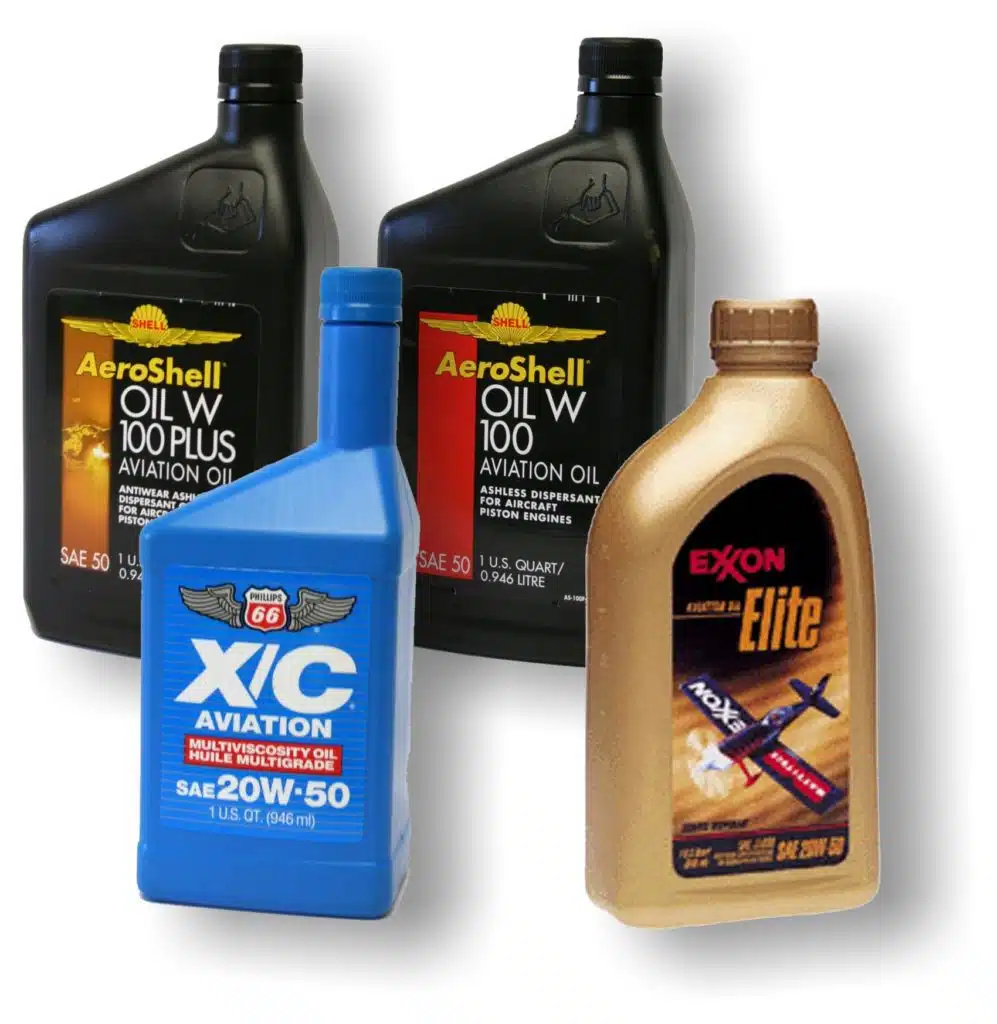
AeroShell 15W-50 is the most widely used semi-synthetic aviation oil in the U.S. Its base stock is approximately 50% mineral oil and 50% PAO synthetic. Exxon Elite 20W-50 is similar but uses a 75/25 mineral-to-synthetic ratio.
The synthetic component improves the oil’s viscosity index — meaning its thickness changes less across a wide temperature range. That’s why these are marketed as multigrade oils (15W-50 or 20W-50). They flow better at cold startup temperatures while maintaining adequate film strength at high operating temperatures.
Semi-synthetics are a practical compromise. They offer some of the thermal stability and cold-flow benefits of synthetic without the lead-management problems of a fully synthetic base stock. However, some engine shops and overhaul facilities — including RAM Aircraft — report that their service history records show mineral-based AD oils performing better than synthetic and semi-synthetic formulations over time.
Single-Grade vs. Multigrade
Beyond the mineral/synthetic question, you’ll also choose between single-grade and multigrade viscosities.
Single-grade oils (like AeroShell W100 or Phillips 66 Type M) have one viscosity rating. W100, for example, is an SAE 50-weight oil. It provides excellent film strength at operating temperature but is thick and sluggish in cold weather. Pilots in warm, stable climates often prefer single-grade AD oils for their simplicity.
Multigrade oils (like AeroShell 15W-50 or Phillips 66 X/C 20W-50) use viscosity index improvers — or a synthetic blend — to perform across a wider temperature range. A 15W-50 oil flows like a 15-weight oil when cold (easier starting, faster circulation) but maintains 50-weight film strength at operating temperature.
If you fly year-round in a climate with significant temperature swings, multigrade oils offer real advantages at startup. Cold starts are when the most engine wear occurs, because the oil hasn’t fully circulated to all bearings and surfaces. A thinner cold-flow rating gets oil where it needs to be faster.
What You Should Use
This is the easiest part: check your engine manufacturer’s recommendations and follow them.
For break-in, Continental recommends straight mineral oil. Lycoming recommends mineral for normally aspirated engines and AD oil for turbocharged engines. Your overhaul shop may have its own recommendation based on their experience.
For normal operations after break-in, use an ashless dispersant oil in the viscosity grade appropriate for your climate. If you fly in consistently warm conditions, a single-grade like W100 or W120 works well. If you see cold mornings regularly, a multigrade 15W-50 or 20W-50 is the better choice.
Change the oil every 50 hours or every four months — whichever comes first. If your engine doesn’t have a full-flow oil filter, cut that interval to 25 hours. And don’t mix oil brands or types without draining and refilling completely.
The best oil for your engine is the one the manufacturer recommends, changed on schedule, and checked regularly between changes. No oil additive or premium brand will compensate for neglected maintenance.