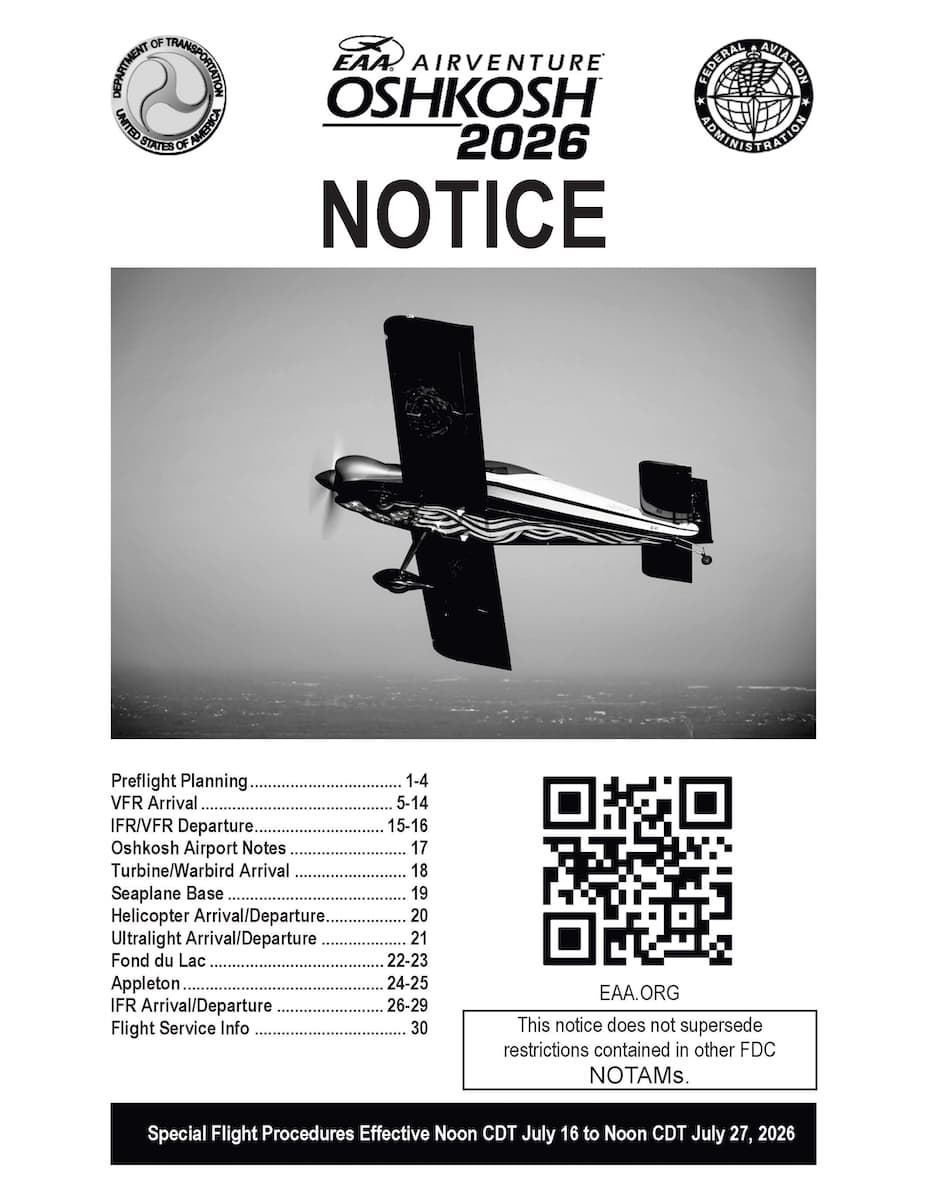
The FAA has released the EAA AirVenture Oshkosh 2026 Notice — better known as the Oshkosh NOTAM — and if you’re planning to fly to the world’s largest aviation event this summer, this document is your required reading.
EAA’s 73rd annual fly-in runs July 20–26 at Wittman Regional Airport (KOSH) in Oshkosh, Wisconsin. The NOTAM goes into effect at noon CDT on July 16 and remains active through noon CDT on July 27. It governs all arrivals, departures, and operations at Oshkosh and nearby airports affected by AirVenture traffic.
Here’s what’s in it, what’s new for 2026, and how to prepare — whether this is your first trip or your twentieth.
What’s New for 2026
The biggest procedural feature returning for 2026 is the ATC-assignable western transition points. These were introduced in recent years and are back again because they work.
Three fixes — Endeavor Bridge, Puckaway Lake, and Green Lake — sit along the western approach to Oshkosh. During peak arrival periods, ATC can activate them to manage congestion before pilots join the standard Fisk arrival flow. When active, they’re announced on the arrival ATIS.
The idea is simple: instead of having hundreds of aircraft stacking up in a single line from Ripon to Fisk, ATC can sequence traffic through these upstream transition points to spread out the flow. The result is less holding, better spacing, and fewer delays for inbound pilots.
The 2026 NOTAM also includes new VFR reporting points and updated routes for aircraft arriving into Appleton (KATW), one of the key overflow airports during the event.
How the Fisk Arrival Works
If you’ve never flown into Oshkosh, the Fisk VFR Arrival is unlike anything else in general aviation. For one week each year, Wittman Regional Airport becomes the busiest airport in the world — handling more operations per day than O’Hare. The Fisk procedure is how it all works without chaos.
Here’s the sequence:
Start at Ripon. Most VFR traffic enters the arrival flow at the town of Ripon, about 15 miles southwest of Oshkosh. You pick up a set of railroad tracks and follow them northeast toward the town of Fisk. Altitude is 1,800 feet MSL. Airspeed is 90 knots. If your aircraft can’t safely fly at 90 knots, a high-performance lane is available at 2,300 feet and 135 knots.
Get in line. The rule is single-file, half a mile in trail behind the aircraft ahead of you. No side-by-side flying. No S-turns to slow down — if you can’t maintain spacing, you’re expected to break off and re-enter at the start. This is where discipline matters most.
Fisk controllers identify you visually. At Fisk, four controllers work from a portable trailer using binoculars and radios. They identify aircraft by type, color, or any distinguishing feature — “red and white Cessna, rock your wings.” You don’t transmit. You acknowledge by rocking your wings. They assign you a runway and a frequency.
Land on a colored dot. Each runway at KOSH has colored dots painted on the surface — orange, pink, green. The tower controller tells you which dot to land on. You must touch down on that dot, not the one before or after it. This system allows the tower to land multiple aircraft on the same runway simultaneously with safe spacing.
Exit immediately. After touchdown, you roll to the nearest taxiway or exit onto the grass, guided by ground marshals. The controller’s parting words are the best in aviation: “Welcome to Oshkosh.”
The entire system runs on visual identification, minimal radio communication, and pilot discipline. It’s elegant, it’s intense, and it works — year after year, safely handling 10,000 or more aircraft over the course of the event.
Preparing for Your Flight
The NOTAM is roughly 40 pages long and covers everything from VFR and IFR arrivals to helicopter procedures, ultralight operations, warbird and turbine arrivals from Fond du Lac, seaplane operations, departure procedures, and NORDO (no-radio) aircraft entry.
Sean Elliott, EAA’s vice president of advocacy and safety, put it plainly: “The most essential information for any pilot flying to Oshkosh involves reading and thoroughly understanding the 2026 AirVenture Notice to ensure safe operations on arrival and departure.”
Here’s a practical preparation checklist:
Read the NOTAM cover to cover. Not skimming. Not just the arrival section. The entire document. Download it at EAA.org/NOTAM or order a free printed copy by calling EAA Membership Services at 800-564-6322.
Attend the EAA webinar. EAA is hosting a live webinar on June 17 at 7 p.m. CDT covering the 2026 procedures and changes. Register through EAA’s website. This is especially valuable for first-timers.
Load the arrival in your EFB. Make sure your Garmin, ForeFlight, or other EFB has the FISK arrival loaded with current data. Load waypoints for VPENV, VPPLK, VPGRN, VPRIP, and VPFIS. Have the Chicago Sectional and KOSH airport diagram ready.
Print your signs. Physical printed signs are required — for your parking preference and, if arriving IFR, a windshield “IFR” placard. Tablet-displayed signs are not accepted.
Plan fuel conservatively. Plan for at least one hour of holding, multiple go-arounds, and a diversion to your alternate. Rush Lake, Green Lake, and Puckaway Lake all have published holding patterns. You may use them.
Practice precision landings. Landing on a specific dot on a specific runway is not optional. If you miss your dot, you go around. Practice spot landings before you go.
Check for mass arrivals. Bonanza, Mooney, RV, and other type clubs organize mass arrivals on specific days. Check the EAA schedule so you know when the high-traffic windows are.
International pilots: file your TSA waiver early. The waiver must be submitted at least 10 days before your flight. Canadian pilots flying experimental or ultralight aircraft also need an FAA Special Flight Authorization.
Key Frequencies and Numbers
These are worth having on a kneeboard card:
- Fisk Approach: 120.7 (monitor only — do not transmit unless asked)
- Arrival ATIS: Check the NOTAM for the current frequency
- Departure ATIS: 121.75 (monitor before engine start)
- OSH Tower (direct): 920-424-8002 (for NORDO pilots, call between 7–10 AM CDT)
- EAA Membership Services: 800-564-6322 (for printed NOTAM copies)
The Bottom Line
Flying into Oshkosh is one of the great experiences in general aviation. It’s also one of the most demanding VFR operations a private pilot will ever fly. The procedures exist because they work — and they only work if every pilot in the flow has read, understood, and practiced them.
The 2026 NOTAM is available now. The webinar is June 17. AirVenture opens July 20. You’ve got two months to prepare. Use them.
Sources:
- General Aviation News — 2026 Oshkosh NOTAM Released (May 21, 2026)
- AVweb — FAA Releases 2026 Oshkosh NOTAM With Arrival Updates (May 20, 2026)
- GlobalAir — FAA Releases 2026 Oshkosh NOTAM for Pilots Flying to AirVenture (May 20, 2026)
- Cessna Flyer Association — EAA AirVenture Oshkosh 2026 Notice (May 20, 2026)
- EAA — AirVenture NOTAM Download Page
- AOPA — Oshkosh Here We Come: Tips for the Fisk Arrival