Choosing a flight training program is one of the most consequential financial decisions you will make as a pilot. Costs can reach $100,000 or more for a full professional pathway, and the wrong choice can cost you months of wasted time and thousands of dollars in repeated training. When you compare flight training programs seriously, the differences between them go far deeper than price per hour. Program structure, instructor quality, fleet condition, and career pipeline affiliations all shape whether you reach your certificate efficiently or stall before you get there. This guide breaks down exactly what to look for.
Key takeaways
| Point | Details |
|---|---|
| Part 61 vs Part 141 matters | Part 141 requires fewer minimum hours and suits career-track pilots; Part 61 offers flexibility for those with irregular schedules. |
| Normalize all costs before comparing | Hourly rates alone are misleading; total program cost including fuel surcharges, exams, and ground school tells the real story. |
| Completion rates reveal school quality | National PPL completion sits near 20%, but top schools reach 80%+. Ask every school for their number. |
| Career pipelines add long-term value | Schools with airline partnerships and ATP-CTP integration offer more than hours. They offer a structured path to the flight deck. |
| Operational logistics affect your timeline | Aircraft availability, booking lead times, and examiner scheduling can offset any theoretical hour savings on paper. |
How to compare flight training programs: Part 61 vs Part 141
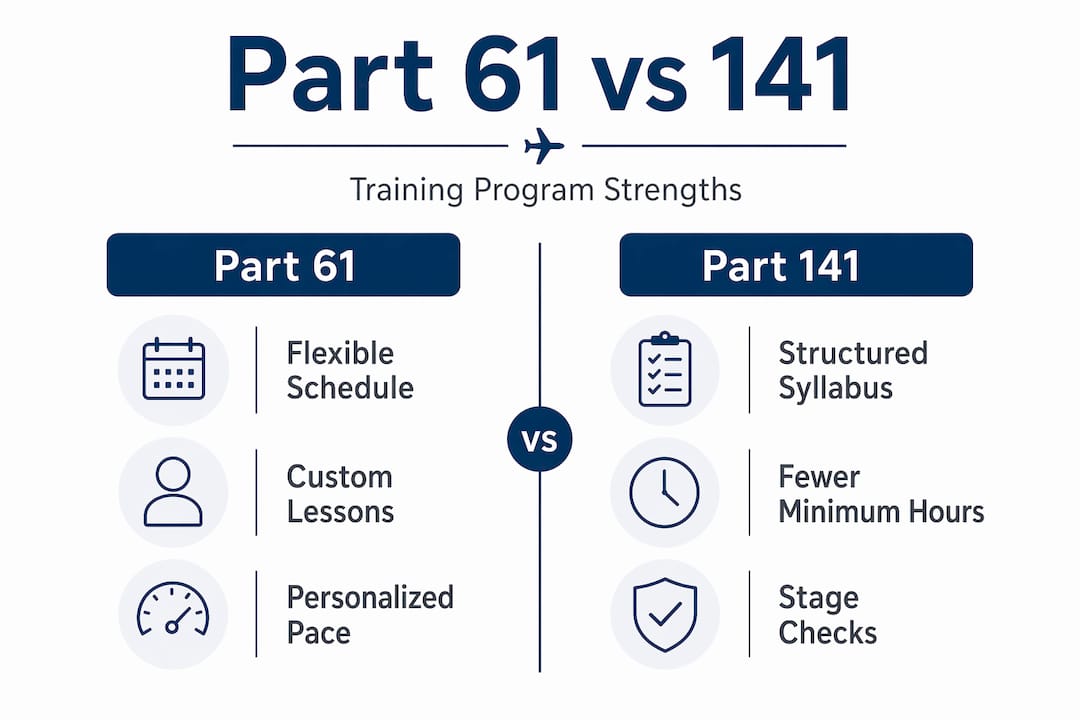
The first decision you face when evaluating aviation training programs is whether to train under FAA Part 61 or Part 141. These are not just administrative labels. They represent fundamentally different training philosophies, and understanding the distinction is the foundation of any serious flight school comparison.
Part 141 schools operate under an FAA-approved syllabus with structured stage checks and a designated Chief Flight Instructor overseeing curriculum quality. The payoff is efficiency. Part 141 minimum hours are 35 hours for a Private Pilot License and 190 hours for a Commercial Pilot License, compared to 40 and 250 hours respectively under Part 61. For a career-track pilot, that difference in commercial hours alone represents tens of thousands of dollars in potential savings.
Part 61, by contrast, gives you and your CFI the freedom to build a training plan around your schedule and learning pace. There is no rigid syllabus, no stage checks, and no FAA inspections of the curriculum. Part 61 suits pilots with irregular work schedules, family obligations, or those who simply prefer to train at their own pace without structured timelines.
| Feature | Part 61 | Part 141 |
|---|---|---|
| PPL minimum hours | 40 hours | 35 hours |
| CPL minimum hours | 250 hours | 190 hours |
| Curriculum structure | Flexible, CFI-driven | FAA-approved syllabus |
| Stage checks required | No | Yes |
| VA benefits eligible | Generally no | Yes |
| Best for | Recreational/flexible pilots | Career-track pilots |
The key insight here is that Part 61 and Part 141 each have genuine strengths. Neither is universally better. Your personal circumstances, career goals, and schedule should drive the decision, not which program sounds more prestigious.

Key factors beyond regulatory type
Once you understand the regulatory framework, the real work of comparing best flight training options begins. Here is what to evaluate systematically before you commit to any school.
- Total program cost, not hourly rate. A school advertising $185/hour wet rates may look cheaper than one charging $210/hour, but if the first school’s aircraft burns more fuel, requires more hours to complete the syllabus, or charges separate instructor fees, the total bill can easily flip. Always ask for a complete cost estimate for your target certificate, including ground school, written exam fees, checkride fees, and any fuel surcharges.
- Fleet size, age, and avionics. A school with three aging Cessna 172s and no glass cockpit aircraft will create scheduling bottlenecks and may leave you underprepared for modern airline operations. Ask how many aircraft are available for student use and what percentage are currently airworthy.
- Instructor experience and student-to-CFI ratio. A systematic checklist for flight school comparisons should always include CFI-to-student ratio and instructor experience levels. A school that cycles through newly certificated CFIs every six months is using you to build their instructors’ hours, not the other way around.
- Completion rates. This is the single most revealing data point a school can share. Ask directly: what percentage of students who start your PPL program finish it?
- Schedule flexibility and booking lead times. A school that requires two-week advance booking for a single lesson will drag your training out regardless of how good the curriculum looks on paper.
- Safety record and FAA oversight. Part 141 schools receive regular FAA inspections. For Part 61 schools, ask about their safety management practices and any incident history.
- Career pathways and airline partnerships. If you are training toward an airline career, a school with formal regional airline partnerships, structured ATP-CTP offerings, or a CFI pathway gives you a measurable advantage over one that simply logs your hours.
Pro Tip: When you call a school, ask for their average time to checkride for PPL students in the last 12 months. If they cannot answer that question, their record-keeping and operational consistency may not support your training goals.
Understanding costs and timelines realistically
Pilot training costs are rising 3% to 5% annually, which means every month you delay or extend your training increases the total bill. Here is a realistic breakdown of what to expect at each stage.
| Certificate / Rating | Typical Cost Range | Average Hours |
|---|---|---|
| Private Pilot License (PPL) | $14,000 to $18,000 | 60 to 75 hours |
| Instrument Rating (IR) | $8,000 to $15,000 | 40 to 60 hours |
| Commercial Pilot License (CPL) | $20,000 to $35,000 | 190 to 250 hours total |
| Multi-Engine Rating (MEI) | $5,000 to $10,000 | 10 to 25 hours |
| ATP-CTP Course | $4,000 to $6,000 | 30 hours ground/sim |
These ranges reflect realistic cost breakdowns including aircraft rental, instructor time, ground school, and exam fees. Accelerated programs can compress timelines significantly. A full-time student in a structured Part 141 program can complete a PPL in as little as eight to ten weeks. A part-time student training on weekends may take 18 months for the same certificate.
Funding your training deserves as much research as choosing the school itself. Key options include:
- VA benefits: Available for eligible veterans, but VA benefits require enrollment in Part 141 programs. This alone can be a deciding factor for veterans comparing schools.
- Payment plans: Many schools offer monthly installment plans. Confirm whether the plan locks in current pricing or adjusts with rate increases.
- Aviation scholarships: Organizations like AOPA, EAA, and Women in Aviation International offer competitive scholarships. Most require Part 141 enrollment or specific career-track criteria.
- Personal loans and aviation financing: Lenders specializing in aviation training often offer better terms than general personal loans.
Airline readiness programs and career pipelines
For pilots targeting the airlines, the conversation shifts from basic hour minimums to how well a program prepares you for the flight deck. This is where structured airline readiness training becomes a genuine differentiator.
The ATP Certification Training Program combines classroom instruction and advanced simulator training to prepare pilots for the ATP written exam and airline-style multi-crew operations. ATP-CTP covers automation management, crew resource management, and high-altitude aerodynamics, areas that go well beyond what standard commercial training addresses.
When evaluating career-focused aviation training programs, look for:
- Formal regional airline partnerships with defined hiring pipelines
- Integrated ATP-CTP offerings with full-motion or advanced aviation training device (ATD) simulator access
- A structured CFI pathway that lets you build hours instructing at the same school
- Defined timelines from zero hours to first officer interview readiness
- Mentorship programs connecting students with working airline pilots
Structured airline readiness programs are no longer a bonus feature at elite schools. They are becoming a standard expectation for career-track pilots who want to move efficiently from training to a paying flying job. A school that simply logs your hours without building toward airline readiness is leaving significant career value on the table.
Pro Tip: Ask any career-track school for the names of their regional airline partners and the number of graduates hired in the last 12 months. Real partnerships produce real placements. Vague claims about “relationships” with airlines do not.
Common pitfalls when choosing a flight school
Even pilots who do their homework make avoidable mistakes during the selection process. Here are the most costly ones.
- Comparing hourly rates without normalizing total costs. Failing to normalize all costs is the single biggest mistake pilots make when comparing programs. Always request a full written cost estimate for your specific certificate.
- Ignoring completion rates. The national PPL completion rate sits around 20%, but top schools achieve 80% or higher. A school with a low completion rate is a warning sign, not just a statistic.
- Underestimating scheduling friction. Booking lead times and aircraft availability can stretch a theoretically short program into a multi-year commitment. Ask specifically about average days between lessons for current students.
- Assuming Part 141 always means faster completion. The structured curriculum helps, but operational bottlenecks like aircraft downtime and limited examiner availability can offset those hour savings entirely.
- Transferring programs without understanding the consequences. Switching from Part 61 to Part 141 mid-training is possible, but you may need to repeat stage checks or complete additional hours to fit the new school’s FAA-approved syllabus. Plan your path before you start, not after you are frustrated.
The best program is not the cheapest or the most prestigious. It is the one that matches your schedule, your goals, and your budget while giving you the support to actually finish.
Our take on what most pilots get wrong
We have watched a lot of pilots make the same mistake: they choose a program based on the lowest advertised hourly rate or the most impressive marketing, then spend the next two years fighting scheduling conflicts, inconsistent instruction, and unexpected fees. The sticker price is almost never the real price.
What we have found is that accelerated Part 141 programs genuinely deliver on their promise for full-time students. But the moment your availability becomes inconsistent, that structured syllabus becomes a constraint rather than an asset. Aircraft get booked by other students, stage checks get delayed, and you end up paying for the structure without benefiting from it.
The pilots who complete training fastest and most cost-effectively are usually the ones who matched their program choice to their actual lifestyle, not their ideal lifestyle. If you have a job and a family, a rigid accelerated program may look great on paper but derail your training within three months.
Career pipeline affiliations matter more than most pilots realize. For career-track pilots, evaluating how a program integrates CPL completion with instructing and airline transition training is more important than chasing raw hour minimums. Two pilots can reach 1,500 hours at the same time. The one with ATP-CTP, multi-crew sim experience, and a regional airline referral will get the interview. The other one will wait.
Do your research upfront. Call the schools. Ask hard questions about completion rates, fleet availability, and real airline placements. The time you invest before signing anything will save you far more time and money than any discounted package.
Find your training match on Skyfarer
Skyfarer connects you with vetted flight instructors and schools across all 50 states, so you can search, compare, and book training that fits your goals and schedule. Whether you are starting your PPL or building toward an ATP, the platform gives you the tools to make a genuinely informed decision.

Use the Skyfarer platform to filter by location, certification level, and program type, and connect directly with instructors who match your training needs.
FAQ
What is the difference between Part 61 and Part 141 training?
Part 141 uses an FAA-approved structured syllabus with lower minimum hour requirements (35 hours for PPL vs 40 under Part 61), while Part 61 offers flexible, CFI-directed training suited for pilots with irregular schedules.
How much does flight training cost from zero to commercial pilot?
Total costs from zero to CPL typically range from $60,000 to $100,000 or more, depending on location, aircraft rental rates, and whether you choose an accelerated or part-time program.
Can I use VA benefits for flight training?
Yes, but VA benefits generally require enrollment in a Part 141 approved program. Confirm eligibility with your chosen school and the VA before committing.
What is ATP-CTP and do I need it?
The ATP Certification Training Program is a required course for pilots pursuing an Airline Transport Pilot certificate. It combines classroom and simulator training focused on airline-style operations and multi-crew coordination.
How do I verify a flight school’s quality before enrolling?
Ask for their PPL completion rate, average days between lessons for current students, fleet airworthiness percentage, and the number of graduates hired by airline partners in the past 12 months.