Contrails — short for condensation trails — are lines of ice crystals that form behind aircraft flying at high altitude. They appear when hot, humid engine exhaust meets extremely cold air, causing water vapor to condense onto soot particles and freeze almost instantly. Whether a contrail lasts for seconds or lingers for hours depends on one thing: how much moisture is in the surrounding atmosphere.
If you’ve ever watched your breath form a cloud on a cold morning, you’ve seen the same basic physics at work. Contrails are that process, scaled up to 35,000 feet.
How Do Contrails Form?
Jet engines burn fuel and produce exhaust containing water vapor, carbon dioxide, nitrogen oxides, and fine particles including soot and sulfate compounds. At cruising altitude — typically 26,000 to 40,000 feet — the surrounding air temperature routinely drops below minus 40°C (minus 40°F).
When that hot, moist exhaust plume enters this frigid environment, it cools rapidly. Within a fraction of a second, the relative humidity in the mixing zone can exceed 100 percent — meaning the air is holding more water vapor than it can sustain as invisible gas.
At that point, the water vapor needs something to condense onto. The soot and sulfate particles in the exhaust serve as condensation nuclei — tiny seeds that give the vapor a surface to latch onto. Water droplets form around these particles, then freeze almost instantly into microscopic ice crystals. Billions of these ice crystals together create the visible white line trailing behind the aircraft.
This process is governed by a principle called the Schmidt-Appleman criterion, first formulated in the 1940s. It defines the thermodynamic balance between the added water vapor and heat from the exhaust and the humidity and temperature of the ambient air. If the criterion is met — generally when the ambient temperature is below approximately minus 40°C — a contrail forms. If it isn’t met, no contrail appears, regardless of how much exhaust the engine produces.
That’s why you see contrails behind some aircraft and not others, even on the same day. Two planes flying at different altitudes may encounter very different temperature and humidity conditions just a few thousand feet apart.
Why Do Some Contrails Disappear Quickly While Others Last for Hours?
This is the question most people notice but few can answer. The formation process is the same in every case. What differs is the atmosphere the contrail forms in.
Short-lived contrails appear as brief white streaks that vanish within seconds or minutes. The surrounding air at that altitude is relatively dry. The ice crystals sublimate — transitioning directly from solid ice back into invisible water vapor — as fast as the plane moves across the sky. These are the most common type.
Persistent non-spreading contrails remain visible for minutes to hours but maintain their narrow, linear shape. The surrounding air has enough moisture to sustain the ice crystals but not enough to allow them to grow significantly.
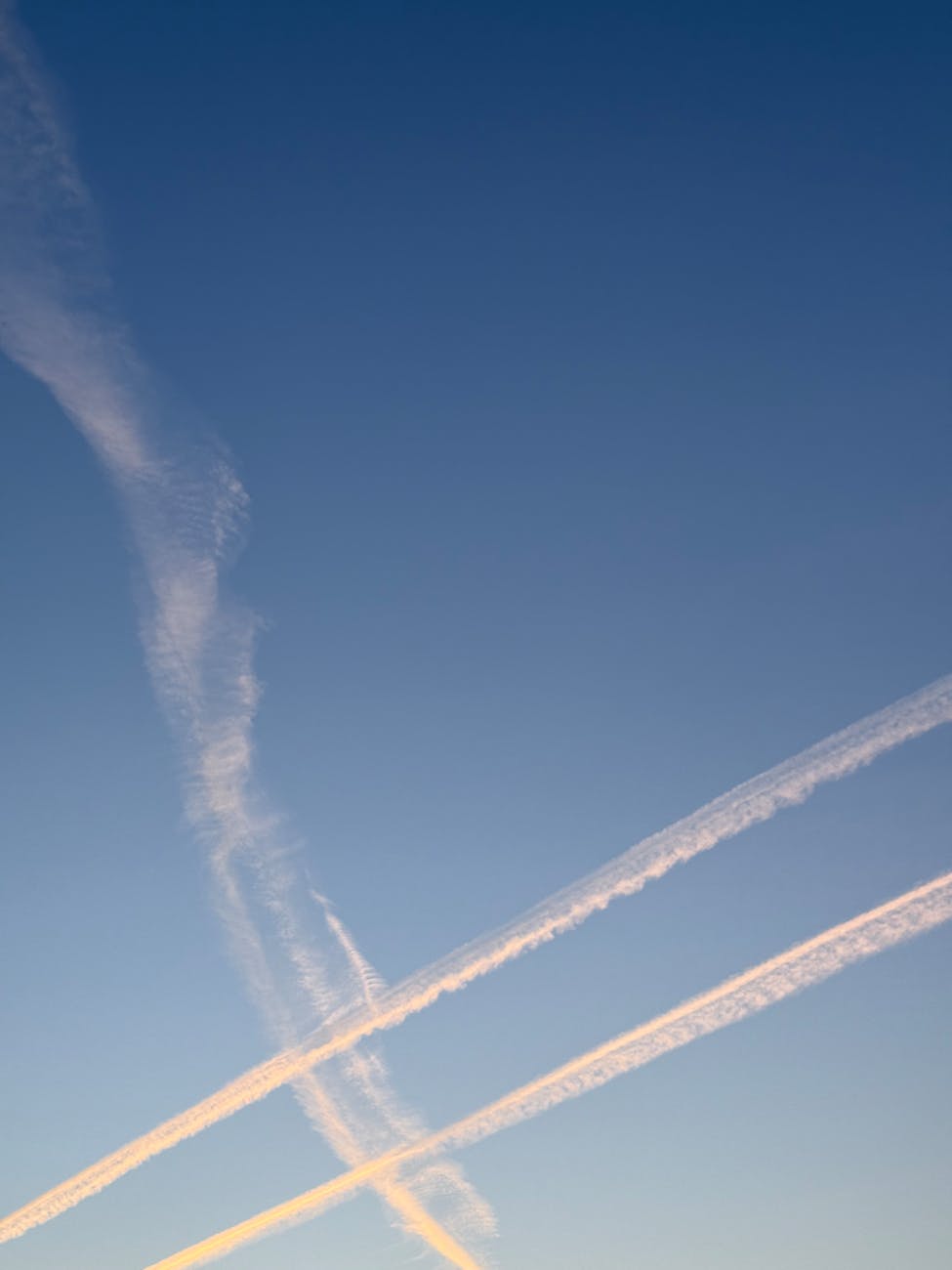
Persistent spreading contrails linger for hours and gradually widen, sometimes merging with existing cirrus cloud cover until they’re indistinguishable from natural high-altitude clouds. These form when the upper atmosphere is supersaturated with moisture — meaning the relative humidity with respect to ice exceeds 100 percent. In these conditions, the ice crystals in the contrail don’t just survive, they grow by absorbing additional water vapor from the surrounding air.
The key takeaway: a contrail’s lifespan tells you about the humidity at that altitude, not about what’s coming out of the engine. A sky full of persistent, spreading contrails is a visible indicator that the upper atmosphere is very moist — useful information for weather-aware pilots.
At What Altitude Do Contrails Form?
Contrails typically form above 26,000 feet (8,000 meters), where temperatures drop below minus 36.5°C (minus 34°F). Most form in the band between 30,000 and 40,000 feet — the same altitudes where commercial jets cruise.
NASA research has found that the likelihood of persistent contrails increases with altitude between 30,000 and 35,000 feet. Above 40,000 feet, the atmosphere becomes so dry that persistent contrails become less common, even though the temperature is colder. The “sweet spot” for long-lasting contrails sits in the middle band where temperatures are extremely low and enough moisture exists for ice crystals to survive.
Season and geography also play a role. Contrails tend to be most common in spring and fall, when upper atmospheric moisture patterns are most variable. At very high latitudes in winter — Alaska, Siberia, central Canada — temperatures can be cold enough for contrails to form at ground level, creating ice fog that has occasionally forced airfields to close.
In the lower atmosphere where most GA piston aircraft operate (below 15,000–18,000 feet), the temperature is almost never cold enough to produce contrails. That’s why contrails are associated almost exclusively with jets and high-altitude turboprops.
What Do Contrails Tell Pilots About the Weather?
For weather-savvy pilots, contrails are a free atmospheric observation tool.
Persistent, spreading contrails signal high moisture content at upper levels. This often correlates with an approaching weather system — warm fronts, in particular, push moist air into the upper atmosphere well ahead of surface weather changes. A sky filled with spreading contrails on an otherwise clear morning can be an early visual clue that a front is on its way.
Short-lived or absent contrails suggest dry upper-level air. In stable, high-pressure weather patterns, the upper atmosphere is typically dry enough that contrails either don’t form or dissipate almost immediately.
Multiple contrail layers — some persistent, some not — indicate varying moisture content at different altitudes. This can signal wind shear or changing atmospheric conditions with altitude, useful context for pilots planning altitude changes or assessing turbulence potential.
None of this replaces a proper weather briefing. But contrails are a real-time, visible data source that supplements the forecast information available before and during flight.
Are Contrails Just Artificial Clouds?
Essentially, yes. Contrails are classified as a type of cirrus cloud — high-altitude ice crystal formations. The only difference is the trigger: natural cirrus forms when atmospheric processes lift moist air to altitudes cold enough for ice crystals to nucleate. Contrails form when engine exhaust provides both the moisture and the condensation nuclei.
Once formed, persistent contrails behave like any other cirrus cloud. They reflect incoming sunlight (a cooling effect) and trap outgoing heat from Earth’s surface (a warming effect). Research from NASA, the German Aerospace Center (DLR), and Resources for the Future estimates that the net warming effect of contrail cirrus is roughly three times greater than the warming effect of all aviation CO2 emissions combined — making contrails a significant and active area of climate research.
Several airlines and research organizations are now experimenting with contrail avoidance strategies — small altitude adjustments of 1,000 to 2,000 feet that route aircraft around supersaturated atmospheric layers where persistent contrails would form. Early results suggest these adjustments can significantly reduce contrail formation with minimal impact on fuel consumption.
The Bottom Line for Pilots
Contrails are one of the most visible and least understood phenomena in aviation. The science is straightforward: hot exhaust meets cold air, water vapor condenses on soot particles, ice crystals form. Whether the contrail vanishes in seconds or spreads into a cirrus sheet depends entirely on how much moisture is in the atmosphere at that altitude.
For pilots, contrails are more than a visual curiosity. They’re a real-time weather indicator — a glimpse at upper-level moisture that no instrument in a light aircraft cockpit can directly measure. The next time you look up and see persistent white lines spreading across an otherwise blue sky, you’re watching the atmosphere tell you something about tomorrow’s weather.
Frequently Asked Questions
What causes contrails behind airplanes? Contrails form when hot, humid exhaust from jet engines meets extremely cold air — typically below minus 40°C — at altitudes above 26,000 feet. Water vapor in the exhaust condenses onto soot particles and freezes almost instantly into ice crystals, creating a visible white trail behind the aircraft.
Why do some contrails last longer than others? A contrail’s persistence depends on the humidity of the surrounding air at that altitude. In dry air, ice crystals sublimate within seconds and the contrail disappears quickly. In moist or supersaturated air, the ice crystals survive and even grow by absorbing additional water vapor, producing contrails that can persist for hours and spread into cirrus-like cloud cover.
At what altitude do contrails form? Contrails typically form above 26,000 feet (8,000 meters), where temperatures drop below minus 36.5°C. The most persistent contrails occur between 30,000 and 35,000 feet. Above 40,000 feet, the atmosphere is usually too dry for contrails to persist, despite the colder temperatures.
Can contrails predict weather changes? Yes, to a degree. Persistent, spreading contrails indicate high moisture content in the upper atmosphere, which often precedes an approaching weather system — particularly a warm front. Short-lived or absent contrails suggest dry upper-level air and stable conditions. Pilots can use contrails as a supplemental visual indicator of atmospheric moisture.
Are contrails harmful? Contrails are composed primarily of water ice crystals and do not pose direct health risks, according to the EPA and FAA. However, persistent contrails contribute to cirrus cloud cover, which has a net warming effect on Earth’s climate. Research estimates that contrail-induced cirrus warming may exceed the warming from all aviation CO2 emissions combined, making contrail reduction an active area of climate research.
Sources:
- NASA Earthdata — On the Trail of Contrails (March 2025)
- U.S. EPA — Information on Contrails from Aircraft (July 2025)
- FAA — Aircraft Contrails Factsheet
- Resources for the Future — Contrails, Aviation, and Climate Change (November 2025)
- ScienceInsights — What Is a Contrail? Formation, Types, and Climate Effects (March 2026)
- GLOBE.gov — The Science of Contrails
- Royal Meteorological Society — Contrails