If you’re a pilot who reads, Tom Young’s latest novel belongs on your list.
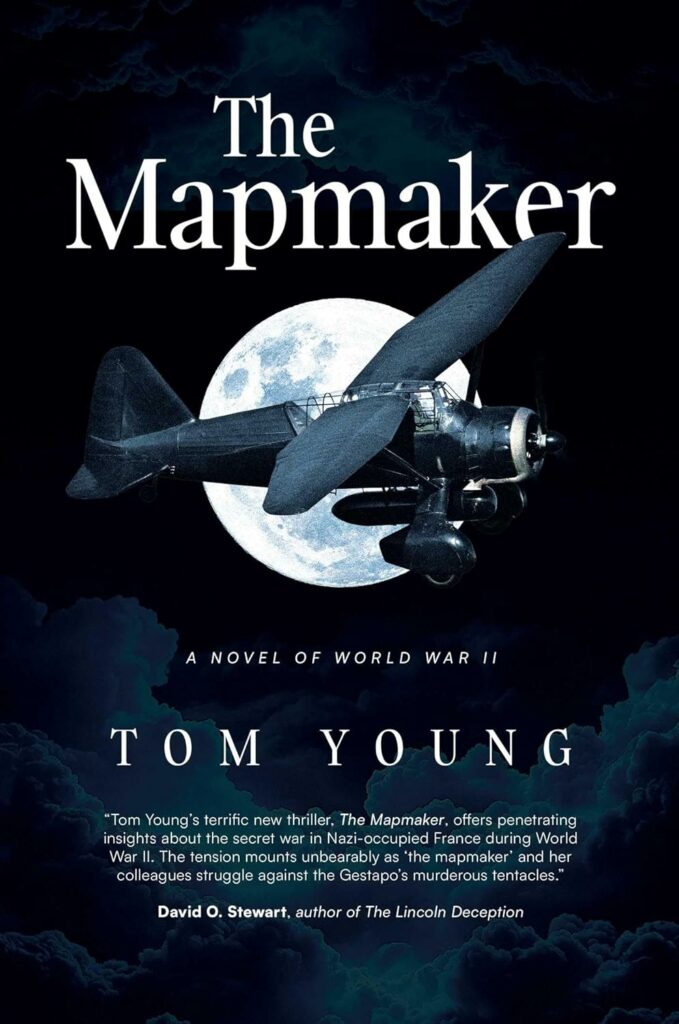
The Mapmaker is a World War II thriller set in the weeks before D-Day, following two characters whose fates converge over occupied France: Charlotte Denneau, an American Resistance operative carrying hand-drawn maps of German rail targets, and Philippe Gerard, a French pilot flying covert nighttime missions for the RAF.
What sets the book apart from typical WWII fiction is the author behind it. Young isn’t imagining what it’s like to fly — he’s lived it.
Who Is Tom Young?
Tom Young served over 20 years in the Air National Guard as a flight engineer on the C-130 Hercules and C-5 Galaxy, logging nearly 5,000 hours of flight time across almost 40 countries. His career included combat missions in Afghanistan, Iraq, Bosnia, Kosovo, the Horn of Africa, and elsewhere.
His military honors include the Meritorious Service Medal, three Air Medals, three Aerial Achievement Medals, and the Air Force Combat Action Medal. He retired from the Guard in 2013 at the rank of senior master sergeant. After military service, he became an airline captain before transitioning to full-time work as an aviation consultant and author.
Before any of that, he spent a decade as an editor and writer with the broadcast division of the Associated Press. He holds BA and MA degrees from the University of North Carolina at Chapel Hill.
The Mapmaker is Young’s tenth novel. His earlier work includes the six-book Parson and Gold series — military thrillers set in Afghanistan, Iraq, Somalia, and North Africa — plus Silver Wings, Iron Cross, a WWII novel set in the final days of the war in Europe. His nonfiction debut, The Speed of Heat, is an oral history of an Air National Guard airlift wing at war in Iraq and Afghanistan. Booklist called his work essential reading for military thriller fans, placing him alongside Clancy, Coonts, and Dale Brown.
What The Mapmaker Is About
The story opens with Philippe Gerard — a French Air Force pilot who escaped to Britain after the fall of France — flying a Westland Lysander into clandestine airstrips under cover of darkness. His missions for the RAF’s Special Operations Executive involve landing in farmers’ fields by moonlight, picking up or dropping off agents, and evading Luftwaffe fighters on the way home.
On the ground, Charlotte Denneau is on the run. She carries critical targeting information — hand-drawn maps of rail routes used by the occupying Germans — that the Allies need for pre-invasion bombing campaigns. The Gestapo knows she has them. Resistance networks around her are being dismantled. Agents are being arrested, interrogated, and turned.
Charlotte communicates with London in coded radio bursts, knowing the Germans are always listening and triangulating. She needs a flight out of France before the Nazis find her. Philippe is tasked with finding her, landing in an unmarked field, and getting her to England — if the signal he sees over a dark pasture is real and not a trap.
The two storylines converge in a race against time as D-Day approaches. Every map, every aerial photograph, every clandestine landing matters. Young weaves real historical events and figures into the narrative — Klaus Barbie, the massacre at Oradour-sur-Glane, and Antoine de Saint-Exupéry (the French author-pilot, who appears as a minor character) — grounding the fiction in documented history.
Why Pilots Will Appreciate This Book
The aviation sequences are where Young’s experience shows most clearly. Reviewers have consistently highlighted his ability to make cockpit scenes feel authentic rather than Hollywood-ized.
The Lysander missions — starting the engine, managing weather and icing, navigating by moonlight with no GPS, and executing short-field landings in muddy pastures while watching for enemy fighters — are described with the kind of technical precision that comes from someone who has actually operated aircraft under pressure.
The Washington Independent Review of Books noted that Young’s descriptions of flying WWII aircraft are “riveting” and that simply starting a Lysander was a procedure worth reading about. One Goodreads reviewer singled out two scenes as particularly striking: a ditching in the English Channel and a P-38 in a terminal dive after being stressed beyond its structural limits.
This is a novel written by someone who understands that flying is equal parts systems knowledge, judgment, and managed fear. That perspective runs through every airborne scene.
The Unsung Side of Air Power
The Mapmaker also shines a light on an aspect of WWII aviation that gets far less attention than the bomber campaigns or fighter aces: the clandestine air operations that supported Resistance networks across occupied Europe.
The pilots who flew these missions — often in single-engine aircraft at low altitude and at night — operated without fighter escort, without radar, and without a guaranteed landing zone. Their passengers were spies, radio operators, and couriers whose intelligence shaped Allied targeting decisions. The margin for error was essentially zero.
Young makes the case, through story rather than argument, that these quiet operations were as decisive as any bombing raid. A well-drawn map of a rail junction, delivered by a pilot willing to land in a field he couldn’t see, could determine whether a bridge was destroyed before German reinforcements reached Normandy.
Worth the Read
The Mapmaker was published by Knox Press (Simon & Schuster) in July 2025. It runs 352 pages and is available in hardcover, paperback, and ebook.
For pilots and aviation enthusiasts, this is a rare combination: a well-researched WWII thriller written by someone who actually knows what it feels like to fly a mission, manage an emergency, and bring an aircraft home. The history is real, the flying is authentic, and the story moves.
Sources: