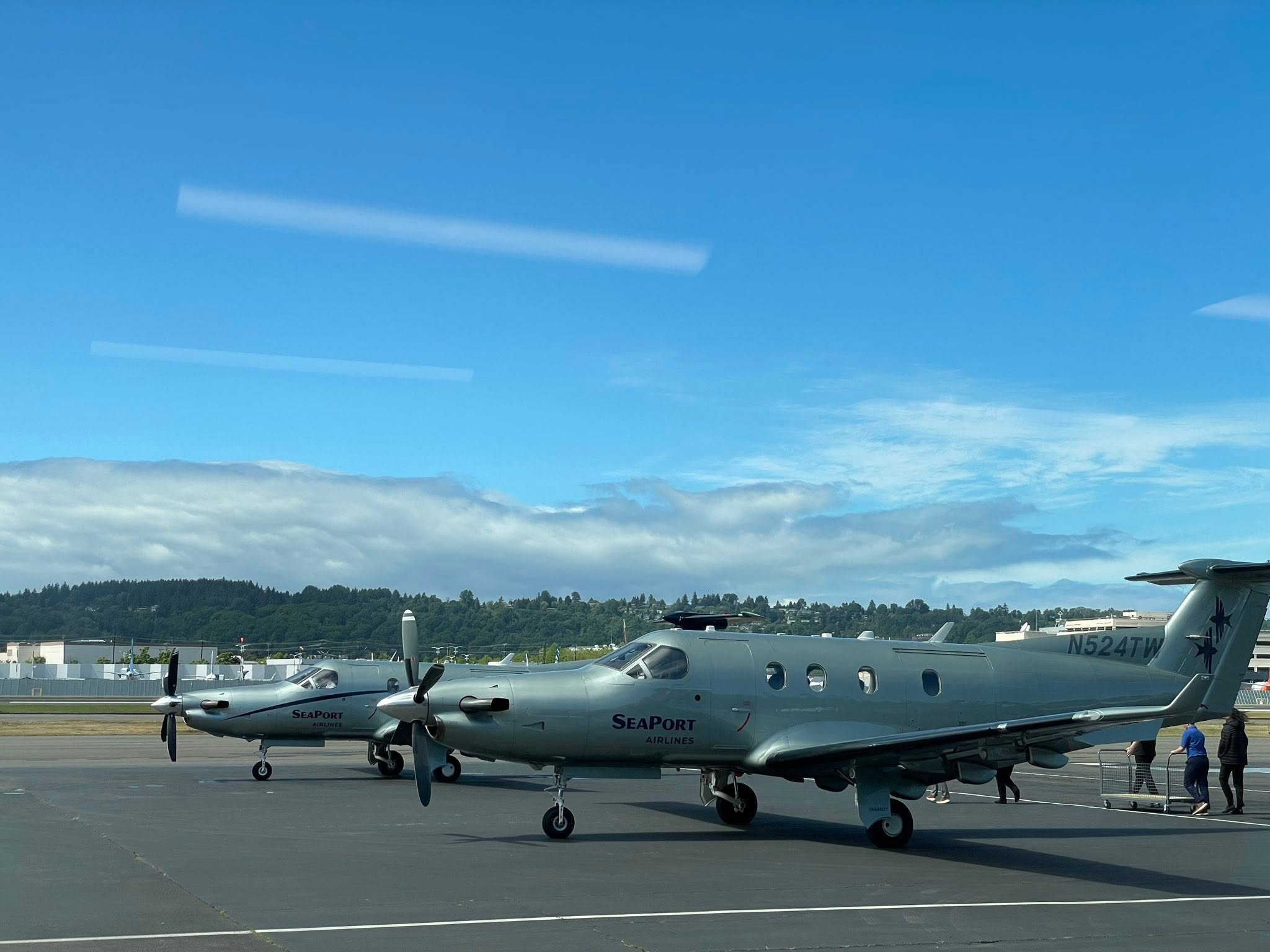
SeaPort Airlines flies the Portland–Seattle route on nine-seat Pilatus PC-12 turboprops between PDX Business Aviation and Boeing Field (BFI) — no TSA checkpoint, no shoe removal, no divestiture bins. Because the PC-12 carries fewer than 10 passengers, SeaPort operates under an alternative security program used by small commercial operators rather than a standard TSA checkpoint. The result: you arrive 20 minutes before departure, walk through a small private terminal, and step onto the airplane. Flight time between the two cities runs roughly 50 minutes, and SeaPort schedules up to 16 shuttle flights a day in each direction — frequent enough that CEO Kent Craford describes it as a “conveyor belt in the sky.”
For anyone who has spent three hours getting from downtown Portland to downtown Seattle by way of PDX’s main terminal, SeaTac’s security lines, and I-5, that’s a meaningfully different proposition. Here’s how it actually works.
How It Works: Check-In, the Terminal, and the Walk
The experience diverges from mainline air travel at the curb.
You don’t go to the main terminal. In Portland, SeaPort operates out of PDX Business Aviation, the general aviation facility on the Atlantic Aviation campus adjacent to PDX’s main terminal. In Seattle, it’s Boeing Field, King County International Airport — the field just south of downtown that most people associate with Boeing deliveries and private jets. Parking at both is straightforward and close, not a shuttle ride away.
Check-in is 20 minutes before departure. Not two hours. Not 90 minutes. Twenty. That single number is the core of SeaPort’s pitch, and it’s what makes the total door-to-door time competitive with — and often better than — driving.
There’s no TSA checkpoint. Because the PC-12 seats nine passengers, SeaPort falls below the threshold that triggers standard TSA screening requirements. Passengers are vetted in advance, with security procedures integrated into check-in and boarding rather than handled at a separate checkpoint. No liquids rules theater, no shoes off, no snaking queue.
Then you walk to the airplane. From the small terminal lobby, it’s a short walk across the ramp to the aircraft. There’s no jet bridge, no boarding groups, and no gate lice — nine people and two pilots.
The overall effect is closer to catching a train than catching a flight.
What the Flight Is Like
The aircraft is the Pilatus PC-12, a Swiss-built single-engine turboprop that SeaPort’s parent company operates across its fleet. It’s pressurized and climate-controlled, powered by the Pratt & Whitney PT6A — one of the most widely used and reliable turbine engines in aviation — and it’s a genuine workhorse, flown by operators ranging from air ambulance services to the U.S. Air Force.
The cabin seats nine in a configuration closer to a business aircraft than a regional jet. It’s a single-aisle-free layout with individual seats, and because there are so few passengers, boarding and deplaning take about as long as getting on a bus.
Two pilots fly each trip, and cruise puts you above most weather for the short hop up the I-5 corridor. On a clear day, the route runs past Mount St. Helens, Mount Rainier, and the Cascades — a view that alone distinguishes it from the same trip in an Airbus at 30,000 feet or a car on the freeway.
Schedule and Fares
Frequency is the selling point. SeaPort runs up to 16 shuttle flights daily between Boeing Field and Portland, with departures spaced roughly every 45 minutes across morning and evening peaks. That density means a missed flight isn’t a lost day — the next one is usually under an hour away.
Fares vary by demand and how far ahead you book. SeaPort positions its pricing as comparable to mainline carriers booked close to departure, which is where the comparison gets interesting: a walk-up mainline fare from PDX to SeaTac plus parking, plus TSA time, plus the SeaTac-to-downtown leg, often doesn’t come out ahead. Current fares and the booking engine are at flyseaportair.com.
The network has grown. Beyond Portland–Seattle, SeaPort added Spokane’s Felts Field (SFF) in March 2026 with eight daily flights — the first scheduled commercial service from that airport in roughly 80 years — and serves Redmond, Oregon (RDM) on a limited basis for Central Oregon travelers.
Promo codes appear periodically. SeaPort has run campaigns including a “NoTSA” code for 10% off during a period of long federal screening delays. Check the site before booking.
The Comeback Story
SeaPort Airlines has a history, and it isn’t a straight line.
The original SeaPort Airlines was co-founded by Kent Craford in 2008 to connect Portland and Seattle. Craford departed the following year after a falling out with the primary investor, and the company — after expanding well beyond the Pacific Northwest — eventually ceased operations in 2016.
In May 2025, Craford brought the name back. The new SeaPort operates as a division of Kalinin Holdings, a closely held Juneau, Alaska family business that also owns Alaska Seaplaneas — a regional carrier serving Southeast Alaska since 1997 — and Island Air Express. Together the group runs more than two dozen aircraft and employs roughly 300 people.
That Alaska lineage matters. In Southeast Alaska, small-aircraft scheduled service isn’t a novelty product — it’s basic transportation infrastructure, used for medical appointments and daily business. SeaPort is applying that operating model to a Lower 48 corridor where the alternative is a congested interstate and two large hub airports.
Craford’s framing is that Boeing Field shouldn’t be reserved for the private jet set, and that the right-sized airport is the point. Seventeen years after the original idea, the relaunched airline is running the route its founder first drew up.
Who It’s Best For
Business travelers making day trips. This is the core use case. Leave Portland in the morning, work a full day in Seattle, be home for dinner — without losing three hours to security and ground transport on each end. If you make the trip regularly, the time savings compound quickly.
Anyone visiting both cities. For travelers combining Portland and Seattle in one trip, the shuttle removes the worst segment of the itinerary. It’s faster than driving I-5 and dramatically less stressful than connecting through two hub terminals.
Teams and small groups. With only nine seats, a group of six to nine effectively has the airplane. SeaPort’s parent company operates charter as well, so booking the full aircraft is a realistic option for teams traveling together on a schedule that doesn’t match the published timetable.
Travelers who value predictability. The strongest argument isn’t raw speed — it’s variance. A mainline itinerary can take two hours or five depending on security lines and traffic. A 20-minute check-in at a nine-gate general aviation terminal is far more predictable, which matters most when you have a meeting at the other end.
Who it’s probably not for: travelers with heavy baggage, anyone needing to connect to an onward mainline flight from SeaTac, and price-sensitive leisure travelers who can book a discount fare well in advance and don’t mind the hassle.
The Bottom Line
Flying Portland to Seattle without TSA is straightforward: book SeaPort Airlines, show up at PDX Business Aviation 20 minutes before departure, walk across the ramp to a nine-seat Pilatus PC-12, and land at Boeing Field roughly 50 minutes later — a short drive from downtown Seattle.
The model works because of aircraft size. Under 10 seats means no standard TSA checkpoint, which means a 20-minute arrival window instead of a two-hour one. Add up to 16 daily departures and two conveniently located airports, and the total door-to-door time becomes genuinely competitive with driving — without the drive.
For Pacific Northwest business travelers who have written off the Portland–Seattle air shuttle as not worth the hassle, it’s worth a fresh look.
Frequently Asked Questions
Is there really no TSA screening on SeaPort flights? There’s no standard TSA checkpoint. Because SeaPort’s Pilatus PC-12 aircraft seat nine passengers — below the threshold that triggers standard TSA checkpoint requirements — the airline operates under an alternative security program used by small commercial operators. Passengers are vetted in advance and security procedures are integrated into check-in and boarding rather than handled at a separate checkpoint. That means no shoe removal, no divestiture bins, and no security queue.
How early do I need to arrive for a SeaPort flight? SeaPort asks passengers to check in 20 minutes before departure. That’s the central advantage of the model — combined with close-in parking at PDX Business Aviation and Boeing Field, it removes most of the buffer time a mainline itinerary requires.
What is the baggage limit? SeaPort operates a nine-seat turboprop, so baggage allowances are more restrictive than on a mainline jet, with weight and size limits driven by aircraft performance. Check the current baggage policy on flyseaportair.com before booking, particularly if you’re traveling with sports equipment, oversized items, or more than a standard carry-on and small checked bag.
Can I charter the whole airplane? Effectively, yes. With only nine seats, a group of six to nine largely fills the aircraft on a scheduled departure. SeaPort’s parent company, Kalinin Holdings, operates charter services across its group of regional airlines, so booking a full aircraft for a team or a schedule outside the published timetable is a realistic option. Contact the airline directly for charter arrangements.
What airports does SeaPort serve? SeaPort operates from PDX Business Aviation in Portland, Boeing Field (BFI) in Seattle, and Felts Field (SFF) in Spokane, with limited service to Redmond, Oregon (RDM) for Central Oregon. All are right-sized general aviation facilities rather than large hub terminals, which is central to the airline’s fast-turnaround model.
Sources:
- SeaPort Airlines — Official Site
- GeekWire — SeaPort Airlines to Offer Daily Flights Between Seattle’s Boeing Field and Spokane (March 4, 2026)
- The Spokesman-Review — Airline to Offer Nine-Person, TSA-Free Flights From Felts Field to Seattle (March 3, 2026)
- Northwest Aerospace News — SeaPort Airlines Offers Fast Commuter Air Transport Between Regional Pacific Northwest Cities
- Business Wire — SeaPort Airlines Promotes “NoTSA” at Boeing Field (March 12, 2026)