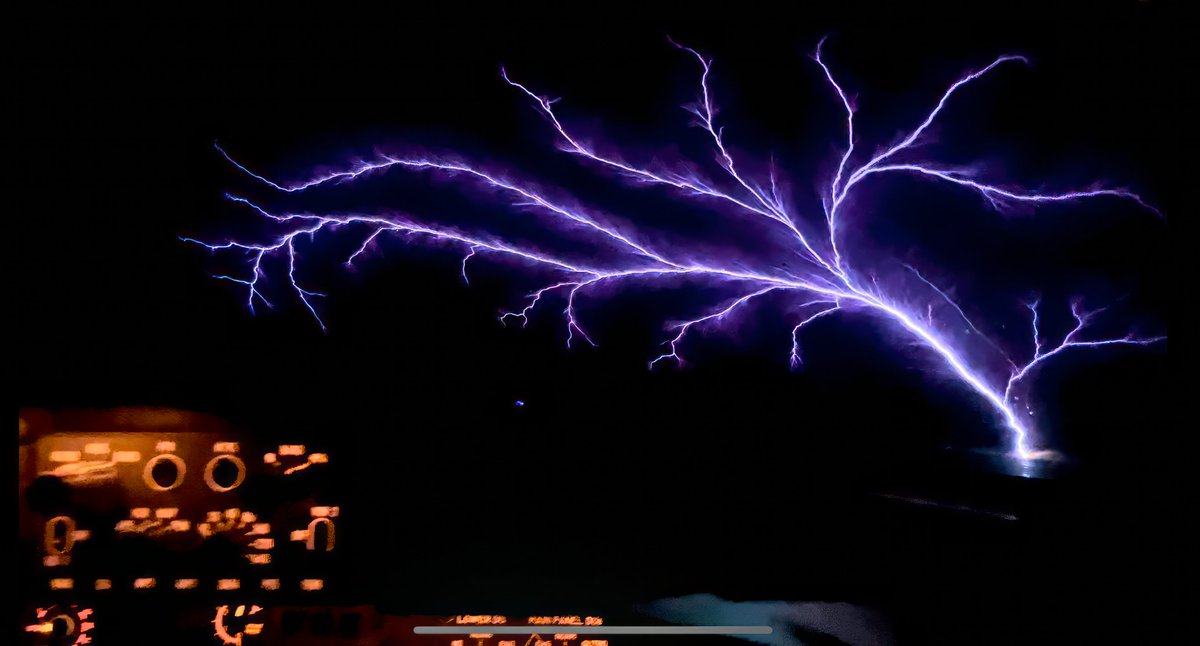
St. Elmo’s Fire is a weather phenomenon in which luminous blue or violet plasma forms a glowing corona discharge around pointed objects — including aircraft wing tips, antennas, propellers, nose cones, and windscreens — when those objects sit inside a strong atmospheric electric field. It typically appears during thunderstorm conditions when an aircraft accumulates a significant electrostatic charge, and it is generally harmless to the aircraft itself. But for pilots, it is a clear visual warning that the airplane is operating in heavily charged airspace where lightning, turbulence, and severe weather are likely.
The phenomenon has been observed by sailors for thousands of years and by pilots since the earliest days of powered flight. Here’s the full picture: what causes it, why it matters operationally, and what pilots should do when they see it.
What Causes St. Elmo’s Fire?
St. Elmo’s Fire is a corona discharge — the same physical process that makes neon signs glow. The mechanics work like this:
Step 1: Charge buildup. An aircraft flying through stormy weather or near cumulonimbus clouds accumulates a high electrostatic charge through friction with charged ice crystals and water droplets in the air. The aircraft itself becomes part of a much larger electrical system.
Step 2: Electric field formation. The atmosphere around the aircraft becomes strongly charged, creating an electric field between the aircraft and the surrounding air.
Step 3: Dielectric breakdown. When the electric field exceeds the dielectric breakdown strength of air — roughly 30 kilovolts per centimeter at sea level — the air molecules begin to ionize. Pointed objects on the aircraft (where the electric field concentrates most intensely) experience this ionization first.
Step 4: Plasma formation. The ionized air becomes plasma — the fourth state of matter, in which atoms have lost their electrons and exist as a luminous gas of ions and free electrons. Plasma emits light when those electrons recombine with ions, producing the characteristic blue, violet, or sometimes greenish glow.
Step 5: Continuous discharge. Unlike lightning, which is a single rapid discharge of accumulated charge, St. Elmo’s Fire is a continuous corona discharge that can last for several minutes as long as the conditions persist. The glow is often accompanied by a hissing, buzzing, or crackling sound.
The phenomenon takes its name from St. Erasmus of Formia — also known as St. Elmo, the patron saint of sailors. Centuries of mariners observed the glow appearing on ships’ masts during storms and interpreted it as a sign of saintly protection.
What St. Elmo’s Fire Looks Like on Aircraft
Pilots who have experienced St. Elmo’s Fire describe a consistent set of visual and auditory characteristics:
Color. Most commonly bluish or violet. Sometimes greenish. The exact color depends on the gases present and the intensity of the discharge.
Location on the aircraft. Forms most prominently on pointed or sharp-edged surfaces — wing tips, static dischargers, nose cones, propeller tips, antennas, pitot tubes, windscreen edges, and occasionally the edges of cockpit windows.
Movement. Often described as “dancing” or “snaking” across surfaces. Brushlike fiery jets can extend several inches from antennas or wingtips.
Sound. A buzzing, hissing, or crackling sound often heard through aircraft radios — sometimes described as “frying” or as a tone “running up and down the musical scale.”
Smell. Pilots and crew sometimes report an electrical or ozone-like smell in the cockpit immediately before St. Elmo’s Fire becomes visible — a result of ionization producing ozone (O₃) from the surrounding atmospheric oxygen (O₂).
Visibility conditions. Generally only visible at night or in very dark cockpit conditions. The plasma’s glow is faint relative to daylight and is often invisible during normal daytime operations even when occurring.
Is St. Elmo’s Fire Dangerous?
The phenomenon itself is not dangerous to a modern aircraft. Aircraft are designed to handle electrical charges and routinely operate in conditions where corona discharge can occur. Several design features specifically mitigate the effects:
Static discharger wicks. Most aircraft have small fiberglass or carbon-impregnated discharger wicks installed on the trailing edges of wings and the empennage. These wicks bleed off accumulated static charge into the surrounding atmosphere, helping to prevent the kind of charge buildup that produces strong corona discharge.
Composite radomes. The nose cone (radome) is typically built from composite materials specifically chosen to handle electrostatic effects without interfering with the weather radar inside.
Bonded structure. All major aircraft components are electrically bonded together so static charges distribute evenly across the airframe rather than concentrating at specific points.
Lightning protection. Modern aircraft are designed to handle direct lightning strikes — and St. Elmo’s Fire is a much milder phenomenon than a strike. Aircraft are routinely struck by lightning during operations and continue safely.
That said, there are a few secondary considerations:
Radio interference. The plasma’s electrical activity can interfere with radio communications, producing the hissing and frying sounds pilots hear. In strong corona discharge events, radio transmission may become temporarily unreliable.
Instrument anomalies. If the magnetic field generated by the corona discharge current is strong enough, temporary anomalies in some on-board instruments are possible — though this is uncommon in modern aircraft with shielded electronics.
Lightning indicator. This is the most important operational consideration. St. Elmo’s Fire indicates that the aircraft is operating in atmospheric conditions where the electric field is strong enough to produce corona discharge — exactly the conditions in which lightning can also occur.
What Pilots Should Do When They See St. Elmo’s Fire
The phenomenon itself doesn’t require an emergency response, but it’s a meaningful weather cue that warrants action. Here’s what experienced pilots and operational guidance recommend:
Treat it as a thunderstorm warning. St. Elmo’s Fire is one of the clearest visual indications that you are flying through or near a thunderstorm cell. NOAA cautions that on ships, lightning may strike within five minutes after the glow begins. The same atmospheric conditions exist around an aircraft.
Monitor weather radar. Cross-check the cockpit weather radar for storm cells in your immediate vicinity. The radar often shows the convective activity that’s producing the electric field, even if you can’t see it through the windscreen.
Consult datalink weather. If equipped, check ADS-B weather, XM Weather, or datalink products for the broader weather picture. Look for nearby cells, weather warnings, and any reported turbulence or icing.
Consider deviating. If the weather picture supports a deviation around the affected area, request a deviation from ATC. Even if the aircraft can safely operate in the current conditions, avoiding the heart of a thunderstorm is always the conservative choice.
Monitor radio communications. Be aware that radio reception may degrade. Keep transmissions clear, repeat readbacks if needed, and stay vigilant for ATC calls.
Watch for icing and turbulence. Thunderstorm conditions that produce St. Elmo’s Fire are often associated with severe icing, turbulence, and microbursts in adjacent airspace. Maintain awareness of all weather hazards, not just the visible glow.
Document for the post-flight debrief. St. Elmo’s Fire is a relatively rare phenomenon. Note the conditions, location, altitude, and time. The information is useful for personal pilot logs, training discussions, and — if conditions warrant — voluntary safety reporting through programs like NASA’s Aviation Safety Reporting System (ASRS).
Where St. Elmo’s Fire Is Most Often Observed
Geography matters. The phenomenon occurs more frequently in regions with strong convective weather patterns:
Equatorial Africa. Routes from Johannesburg to Europe pass through some of the most active thunderstorm regions in the world, including the Intertropical Convergence Zone (ITCZ) over central Africa.
Southeast Asia. Routes to and from Singapore, Hong Kong, and Bangkok cross regions with warm, humid climates that produce intense thunderstorm activity year-round.
The U.S. Gulf Coast and Southeast. Florida, Louisiana, and Texas routinely produce strong thunderstorm conditions, particularly during hurricane season. The most widely-shared modern footage of St. Elmo’s Fire came from Air Force pilots evacuating MacDill Air Force Base in Tampa ahead of Hurricane Idalia in August 2023.
Volcanic regions. Volcanic eruptions create heavily charged ash clouds that can produce St. Elmo’s Fire. British Airways Flight 9 in June 1982 — the famous “all four engines flamed out from volcanic ash” incident over Indonesia — included St. Elmo’s Fire-like glowing along the leading edges of the aircraft. Subsequent analysis attributed the specific glow on that flight to volcanic ash impact rather than classical corona discharge, but the phenomena are related.
Pilots flying over Europe, the U.S. Pacific Northwest, and Canada are less likely to encounter St. Elmo’s Fire because of the lower density of intense convective weather.
St. Elmo’s Fire vs. Ball Lightning vs. Lightning
Three atmospheric electrical phenomena often get confused. The differences matter:
St. Elmo’s Fire is a continuous corona discharge that produces a steady or slowly-moving glow attached to objects. Duration: seconds to several minutes. Visual appearance: glowing plasma around pointed objects. Safety: generally harmless.
Ball lightning is a rare, poorly understood phenomenon in which a glowing sphere of light moves independently through the air for several seconds. Duration: typically 1-10 seconds. Visual appearance: a freely-moving spherical glow. Safety: potentially dangerous depending on the specific phenomenon. (The scientific community continues to debate the exact mechanism behind ball lightning.)
Lightning is a massive single-event electrical discharge between clouds and ground or between clouds. Duration: milliseconds to tenths of a second. Visual appearance: brilliant flash, often branched. Safety: extremely dangerous to people; generally survivable for aircraft due to design protections.
Sailors and pilots have historically conflated these phenomena, which is why St. Elmo’s Fire is sometimes described in older literature as “ball lightning.” Modern atmospheric science distinguishes between them.
Historical and Cultural Context
St. Elmo’s Fire has been observed and recorded for thousands of years. Ancient Greek and Roman texts describe the phenomenon on ships. The voyages of Magellan and the siege of Constantinople include observations of the glow on masts and military equipment. Richard Henry Dana Jr.’s 1840 memoir “Two Years Before the Mast” includes a vivid first-person description of corposants (St. Elmo’s Fire) on a sailing ship in the Atlantic.
Sailors traditionally interpreted the appearance of St. Elmo’s Fire as a sign of saintly protection — specifically from St. Elmo, the patron saint of sailors. Folk belief held that if the corposant rose in the rigging, fair weather would follow; if it descended, a storm was approaching.
In aviation, the phenomenon has been observed since the early days of flight. Early pilots often described it as a reassuring sign that their aircraft would withstand the surrounding turbulence — though modern pilots correctly interpret it as a warning to exercise heightened weather caution.
The 1985 Brat Pack film “St. Elmo’s Fire” took its name from the phenomenon, dramatically expanding public awareness even among people who have never seen the glow itself.
The Bottom Line
St. Elmo’s Fire is a visually striking but generally harmless atmospheric phenomenon caused by corona discharge in strong electric fields. It typically indicates that an aircraft is operating in thunderstorm conditions where lightning, turbulence, and severe weather are likely. Modern aircraft are well-equipped to handle the phenomenon itself, but pilots who see it should treat it as a clear cue to check weather radar, evaluate deviation options, and exercise the heightened situational awareness that thunderstorm conditions demand.
For pilots who haven’t seen it: keep watching out the windscreen during night flights through convective weather. The glow is rare enough that many career pilots fly entire careers without encountering it — and memorable enough that those who do tend to remember exactly when and where.
Frequently Asked Questions
What is St. Elmo’s Fire? St. Elmo’s Fire is a weather phenomenon in which luminous blue or violet plasma forms around pointed objects — including aircraft wing tips, antennas, nose cones, propellers, and windscreens — when those objects sit inside a strong atmospheric electric field. It is a continuous corona discharge caused by ionization of air molecules and is typically observed during thunderstorm conditions. The name comes from St. Erasmus of Formia, known as St. Elmo, the patron saint of sailors.
Is St. Elmo’s Fire dangerous to aircraft? No, the phenomenon itself is not dangerous to modern aircraft. Aircraft are designed with static discharger wicks, electrical bonding, and lightning protection that handle corona discharge effects. However, St. Elmo’s Fire indicates that the aircraft is operating in conditions where lightning, severe turbulence, and other thunderstorm hazards are likely — so it serves as an important visual warning that warrants caution.
What is the difference between St. Elmo’s Fire and lightning? Lightning is a massive single-event electrical discharge that lasts milliseconds, while St. Elmo’s Fire is a continuous corona discharge that can last for several minutes. Lightning produces a brilliant branched flash; St. Elmo’s Fire produces a steady or slowly-moving blue or violet glow attached to pointed objects. The two phenomena often occur in the same atmospheric conditions but represent different stages and intensities of electrical activity.
Why is St. Elmo’s Fire blue or violet? The blue or violet color comes from the ionization of atmospheric gases, primarily nitrogen and oxygen, in the plasma created by corona discharge. When the ionized molecules recombine, they emit light at specific wavelengths that fall in the blue-violet portion of the visible spectrum. The exact color can vary slightly depending on the gases present and the intensity of the discharge.
What should pilots do if they see St. Elmo’s Fire? Treat the phenomenon as a clear indicator of thunderstorm conditions. Monitor cockpit weather radar for nearby convective activity, check datalink weather products for the broader picture, consider requesting a deviation around the affected area, monitor radio communications for interference, and stay alert for associated hazards like severe turbulence and icing. The phenomenon itself is not an emergency, but it’s a meaningful weather cue that warrants action.
Sources:
- SKYbrary — St. Elmo’s Fire
- Aviation File — St. Elmo’s Fire in Aviation: The Mysterious Glow Around Aircraft
- Wikipedia — St. Elmo’s Fire
- CNN — What is St. Elmo’s Fire? Pilots Observed the Lightning-Like Phenomenon (August 2023)
- Hong Kong Observatory — St. Elmo’s Fire as Seen from Aircraft
- CBS News — Air Force Crew Captures St. Elmo’s Fire Video During Hurricane Idalia Evacuation (August 2023)
- Swiss International Air Lines — St. Elmo’s Fire at the Cockpit Window
- Grupo One Air — St. Elmo’s Fire: A Natural Spectacle for Pilots and Sailors