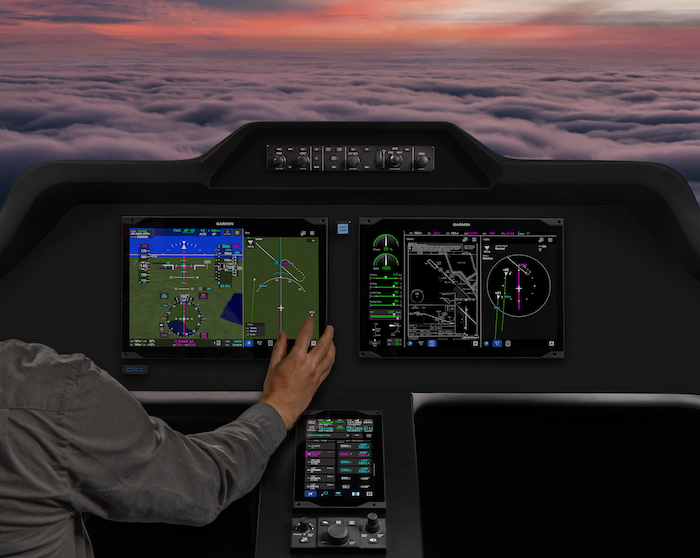
Garmin has introduced the G2000 PRIME, a new integrated flight deck designed for high-performance Class I/II piston and electric aircraft. Announced July 29, 2026, the G2000 PRIME brings the all-touchscreen architecture and advanced technology of Garmin’s flagship G3000 PRIME down to the piston and emerging electric-aircraft segment. It features 14-inch touchscreen primary displays with quadruple the memory and gigabit system connectivity up to 100 times faster than earlier systems, plus 7-inch secondary display units with a 40% larger screen area than prior Garmin touch controllers. A new multi-touch interface recognizes up to 10 simultaneous inputs, letting pilot and copilot interact with the same display at once. Critically, the G2000 PRIME makes Garmin’s full suite of safety technologies — including Garmin Autoland — available to this class of aircraft.
For owners of high-performance piston singles and the manufacturers building the next generation of electric aircraft, the G2000 PRIME represents a significant step up in cockpit capability. Here’s what it delivers and where it fits in Garmin’s lineup.
The PRIME Architecture Comes to Piston and Electric
The defining characteristic of Garmin’s PRIME flight decks is that they’re all-touchscreen. Traditional integrated flight decks pair large primary displays with separate physical touchscreen controllers mounted in the center console. The PRIME architecture eliminates those separate controllers — the displays themselves handle both flight information and system control.
The G2000 PRIME inherits this architecture directly from the G3000 PRIME, which Garmin unveiled in October 2024 and which was selected by Pilatus for its new PC-12 PRO turboprop. Where the G3000 PRIME targets Part 23 turbine aircraft, military applications, and advanced air mobility, the G2000 PRIME brings the same core technology to high-performance Class I/II piston and electric aircraft — a tier down in the market, but one that represents a huge population of aircraft.
By leveraging features from the G3000 PRIME, Garmin can offer piston and electric aircraft manufacturers a flight deck with genuinely flagship-derived technology at a positioning appropriate to their segment.
The Displays: 14-Inch Primary, 7-Inch Secondary
The G2000 PRIME’s display system centers on two sizes.
14-inch touchscreen primary displays. These are the main flight displays, featuring quadruple the memory of earlier systems and gigabit system connectivity up to 100 times faster than prior Garmin architectures. The performance gains support crisp, responsive, fluid interactions — a meaningful upgrade in the day-to-day feel of operating the flight deck.
7-inch secondary display units (SDUs). The SDU provides data entry and system control, and can also display multi-function applications. Garmin notes the 7-inch SDUs boast a 40% increase in screen area over prior Garmin touch controllers — more usable space for the tasks pilots perform most frequently.
The displays are organized into Primary Flight Windows (PFW) and Multi-Function Windows (MFW), which can be shown full-screen or split-screen to maximize situational awareness and let pilots configure the cockpit to their preferences and phase of flight.
The Multi-Touch Interface
One of the more notable features is the G2000 PRIME’s multi-touch touchscreen, capable of recognizing up to 10 touchscreen inputs at once. The practical benefit: both pilot and copilot can interact with the same display simultaneously, rather than one person having to wait while the other completes an input.
Garmin has built several usability features around the touchscreen:
Quick access bars. New quick access bars let pilots open common applications — maps, traffic, weather, and charts — with a single touch, reducing the taps required to reach frequently-used functions.
Radial menus on the map. While viewing maps, pilots can touch anywhere to open a radial menu with options for accessing additional airport, weather, or airspace information — or for adjusting a flight plan through graphical editing. Graphical flight-plan editing (dragging a route directly on the map) is a genuine workload-reducer compared to typing waypoint changes.
These interaction refinements reflect years of Garmin touchscreen development, aimed at making the interface feel fast and natural in a high-workload cockpit environment.
The Full Safety Suite — Including Autoland
Perhaps the most significant aspect of the G2000 PRIME is that it makes Garmin’s complete array of safety-enhancing technologies available to high-performance piston and electric aircraft. The suite includes:
Garmin Autoland. The headline capability. Autoland is the world’s first certified system that can autonomously control and land an aircraft without human intervention in an emergency — for example, if the pilot becomes incapacitated. A passenger can activate it with a single button, and the system navigates to a suitable airport, communicates its intentions, lands the aircraft, and stops it on the runway. Autoland earned Garmin the prestigious Collier Trophy. Bringing this capability to the piston and electric segment is a substantial safety advancement.
Smart Glide. Assists during a loss of engine power by identifying a suitable airport within glide range, automatically navigating toward it, and providing critical information to help the pilot manage the emergency.
Smart Rudder Bias. Helps pilots maintain control during an engine failure in a multi-engine aircraft by reducing the adverse yaw and assisting with rudder input toward the operating engine.
Electronic Stability Protection (ESP). Works in the background to help keep the aircraft within a stable flight envelope, gently nudging the controls back toward safe parameters if the aircraft approaches unusual attitudes or excessive bank/pitch.
Emergency Descent Mode (EDM). In the event of a loss of cabin pressurization, EDM can automatically descend the aircraft to a safer altitude without pilot input.
Garmin Autothrottle. Automatically manages engine power to maintain selected speeds and profiles, reducing pilot workload and adding flight-envelope protection.
Taken together, this is the kind of safety technology that was, until recently, reserved for turbine aircraft with flagship flight decks. Making it available to high-performance piston and electric aircraft continues a clear Garmin strategy: pushing airline- and turbine-class safety capability progressively down into smaller, more accessible aircraft.
Where the G2000 PRIME Fits in Garmin’s Lineup
The G2000 PRIME occupies a specific position in Garmin’s integrated flight deck family:
- G3000 PRIME — the flagship, for Part 23 turbine aircraft, military, and advanced air mobility (announced October 2024; selected for the Pilatus PC-12 PRO)
- G2000 PRIME — the new offering, for high-performance Class I/II piston and electric aircraft (announced July 2026)
- G1000 NXi / G3000 / G5000 — the established integrated flight decks that have equipped GA and business aircraft for years
- G3X Touch and the new AXIS — displays serving the experimental, light-sport, and certified retrofit markets
The G2000 name itself has history — the original G2000 was Garmin’s integrated flight deck for high-performance piston aircraft like the Cessna TTx and Mooney M10. The G2000 PRIME modernizes that positioning with the all-touchscreen PRIME architecture, targeting the same high-performance piston tier plus the emerging electric-aircraft market.
The electric-aircraft inclusion is strategically notable. As electric and hybrid-electric aircraft move toward production, they need modern, capable, certifiable flight decks. By explicitly designing the G2000 PRIME for electric aircraft alongside high-performance pistons, Garmin is positioning to equip the next generation of clean-sheet electric designs.
How This Fits Garmin’s 2026 Cockpit Push
The G2000 PRIME is the latest in a remarkable run of Garmin avionics announcements in 2026. Earlier in the year, Garmin introduced AXIS, a new generation of highly integrated flight displays that combine PFD, MFD, IFR GPS, NAV/COMM, and audio panel into a single unit for certified piston singles, experimental, and light-sport aircraft. Garmin has also expanded its safety technologies — including Runway Occupancy Awareness (ROA), which uses GPS and ADS-B data to alert crews to potential runway incursions.
Across these announcements, a consistent Garmin strategy is visible: modernize the cockpit at every tier of the market, and push advanced safety capability — Autoland, Smart Glide, envelope protection, runway-incursion awareness — progressively downward from turbine aircraft into pistons, experimentals, and light-sport aircraft. The G2000 PRIME extends that strategy into the high-performance piston and electric segment specifically.
It also arrives during a broader wave of GA cockpit and operations modernization in 2026 — from the FAA’s Mobile Clearance system delivering digital IFR clearances, to Jeppesen ForeFlight’s AI-powered ClearNOTAMs, to the ongoing air traffic control modernization effort. Together, these developments point to a general aviation cockpit that is rapidly becoming more capable, more connected, and more safety-focused.
What This Means for Pilots and Manufacturers
For aircraft manufacturers: The G2000 PRIME gives builders of high-performance piston and electric aircraft a flagship-derived, all-touchscreen flight deck with a full safety suite. For clean-sheet electric designs in particular, it offers a certifiable, modern avionics option from an established vendor.
For pilots: If you fly or plan to buy a high-performance piston aircraft equipped with the G2000 PRIME, you’ll get flagship-class displays, an intuitive multi-touch interface, and — most importantly — access to Autoland and the full Garmin safety suite that until recently was reserved for turbine aircraft.
For the used market: As with any significant avionics advancement, aircraft equipped with the latest flight decks tend to command premium value. Over time, G2000 PRIME-equipped aircraft will likely be sought-after in the high-performance piston market.
A note on availability: As a newly announced flight deck, the G2000 PRIME will reach the market as manufacturers select it for specific aircraft and those aircraft achieve certification. Pilots interested in the system should watch for aircraft announcements and consult Garmin for the latest availability information.
The Bottom Line
Garmin’s G2000 PRIME brings the company’s flagship all-touchscreen PRIME architecture — 14-inch primary displays, multi-touch interaction, graphical flight planning, and gigabit connectivity — to high-performance Class I/II piston and electric aircraft. Most significantly, it makes Garmin’s complete safety suite, including the Collier Trophy-winning Autoland, available to a class of aircraft that historically lacked such capabilities.
The announcement continues Garmin’s clear 2026 strategy of modernizing cockpits at every market tier and pushing advanced safety technology progressively downward from turbine aircraft into the broader GA fleet. For manufacturers of high-performance pistons and the emerging generation of electric aircraft, the G2000 PRIME offers a modern, capable, safety-rich flight deck option. For pilots, it means the kind of cockpit technology and autonomous safety capability once exclusive to business jets is increasingly within reach — a genuinely positive trajectory for general aviation safety.
Frequently Asked Questions
What is the Garmin G2000 PRIME? The Garmin G2000 PRIME is an integrated flight deck announced July 29, 2026, designed for high-performance Class I/II piston and electric aircraft. It features an all-touchscreen architecture derived from Garmin’s flagship G3000 PRIME, with 14-inch touchscreen primary displays, 7-inch secondary display units, a multi-touch interface recognizing up to 10 simultaneous inputs, and Garmin’s full suite of safety technologies including Autoland, Smart Glide, and Emergency Descent Mode.
How is the G2000 PRIME different from the G3000 PRIME? Both flight decks share the same all-touchscreen PRIME architecture and core technology. The G3000 PRIME (announced October 2024) is Garmin’s flagship, designed for Part 23 turbine aircraft, military applications, and advanced air mobility — it was selected for the Pilatus PC-12 PRO. The G2000 PRIME (announced July 2026) brings that same architecture to high-performance Class I/II piston and electric aircraft, a tier down in the market. The G2000 PRIME leverages features from the G3000 PRIME while targeting a different aircraft segment.
What safety features does the G2000 PRIME include? The G2000 PRIME includes Garmin’s full array of safety-enhancing technologies: Garmin Autoland (autonomous emergency landing), Smart Glide (engine-out airport guidance), Smart Rudder Bias (multi-engine control assistance), Electronic Stability Protection (ESP), Emergency Descent Mode (EDM, for loss of pressurization), and Garmin Autothrottle. Many of these capabilities were previously available primarily on turbine aircraft with flagship flight decks.
What is Garmin Autoland? Garmin Autoland is the world’s first certified system that can autonomously control and land an aircraft without human intervention during an emergency, such as pilot incapacitation. A passenger can activate it with a single button press, and the system navigates to a suitable airport, communicates with air traffic control, lands the aircraft, and brings it to a stop. Autoland earned Garmin the prestigious Collier Trophy. Its inclusion in the G2000 PRIME brings this capability to high-performance piston and electric aircraft.
What aircraft will use the Garmin G2000 PRIME? As a newly announced flight deck, the G2000 PRIME will appear in specific aircraft as manufacturers select it and those aircraft achieve certification. It is designed for high-performance Class I/II piston aircraft and electric aircraft. The original G2000 equipped high-performance pistons such as the Cessna TTx and Mooney M10, and the G2000 PRIME targets that same high-performance piston tier plus the emerging electric-aircraft market. Pilots should consult Garmin and watch for aircraft manufacturer announcements for specific availability.
Sources:
- General Aviation News — Garmin Unveils G2000 PRIME Integrated Flight Deck (July 29, 2026)
- Garmin — G2000 PRIME Integrated Flight Deck
- Garmin Newsroom — Garmin Unveils Its New, Industry-Leading Integrated Flight Deck: G3000 PRIME (October 2024)
- Garmin Newsroom — Garmin G3000 PRIME Unveiled as Integrated Flight Deck for the New Pilatus PC-12 PRO Aircraft (March 2025)
- AVweb — Garmin Unveils G3000 PRIME Flight Deck