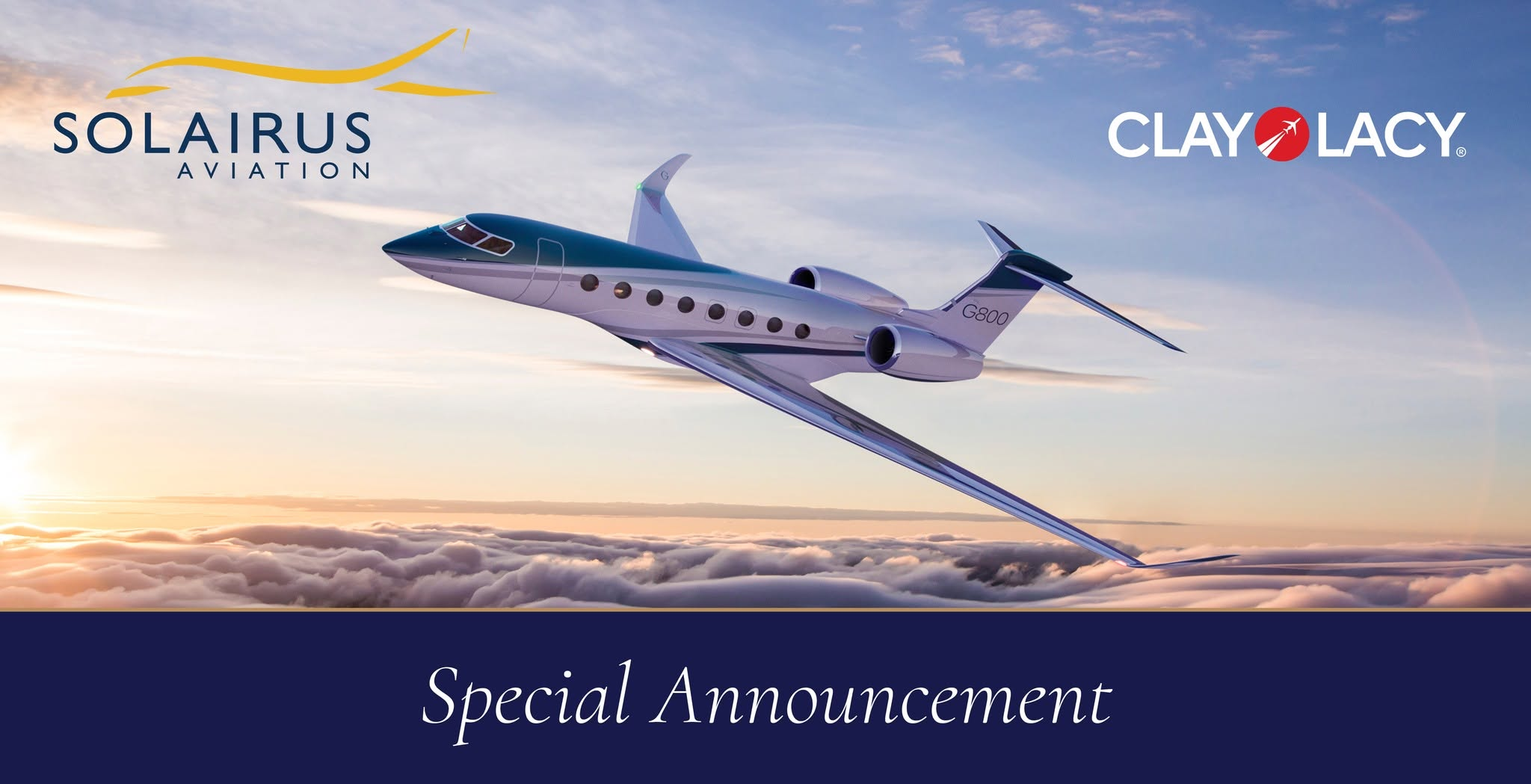
Solairus Aviation announced August 6, 2026, that it has agreed to acquire the aircraft management and charter divisions of Clay Lacy Aviation — a deal that will create the world’s first managed private-jet fleet exceeding 500 aircraft. Solairus, already the largest pure-play aircraft manager in the world with roughly 360 managed aircraft, will absorb Clay Lacy’s approximately 140 managed jets, bringing the combined managed fleet to more than 500 aircraft, including nearly 200 available for on-demand charter. Notably, the transaction does not include Clay Lacy’s FBO, maintenance, and real estate businesses, which will remain independent under the Clay Lacy name and its current ownership. The deal is expected to close at the end of September 2026, subject to regulatory approvals. Financial terms were not disclosed.
For the business aviation community — and for the high-net-worth owners whose aircraft these companies manage — the combination is one of the most significant consolidation moves in the private-jet management sector in years. Here’s what the deal involves and what it signals.
What the Deal Actually Covers
The transaction is a divisional acquisition, not a full-company merger, and understanding that distinction is key to the story.
Solairus is acquiring two specific parts of Clay Lacy’s business:
Aircraft management. The business of managing jets on behalf of their owners — handling crewing, maintenance oversight, scheduling, regulatory compliance, and day-to-day operation. Owners keep ownership of their aircraft; the manager runs them.
Charter. The Part 135 on-demand charter operation, in which owners allow their managed aircraft to be chartered to third parties when they aren’t using them, generating revenue that offsets ownership costs.
What Solairus is not acquiring — and what stays with Clay Lacy under current ownership — is arguably just as important:
FBO operations, maintenance, and real estate. Clay Lacy will continue as what its chairman described as “a focused aviation infrastructure platform built around FBOs, aviation real estate, and aircraft maintenance.”
In other words, Clay Lacy is exiting the aircraft-management and charter business to concentrate on the fixed, infrastructure side of aviation — the hangars, terminals, real estate, and MRO (maintenance, repair, and overhaul) operations that represent durable, asset-backed businesses.
The Numbers Behind the Combined Fleet
The scale of the combined operation is substantial:
- Solairus managed fleet: ~360 aircraft, from more than 100 base locations across North America
- Clay Lacy managed fleet: ~140 aircraft
- Combined managed fleet: more than 500 aircraft — the world’s largest managed fleet
- Charter availability: nearly 200 aircraft available for charter, including more than 150 large-cabin and ultra-long-haul jets
The charter fleet is heavily weighted toward the top of the market. According to industry reporting, the combined companies operate roughly 71 large-cabin Gulfstream jets, 36 Bombardier Global ultra-long-range jets, and 34 Dassault Falcon large-cabin jets on their charter certificates — aircraft like the Global 7500 and Gulfstream G650 capable of flying nonstop from the U.S. West Coast to Southeast Asia or Europe. Clay Lacy’s managed aircraft alone are valued at more than $3 billion, per the company’s website.
By charter and fractional flight hours, the combination reshuffles the industry rankings. Per ARGUS data cited by Private Jet Card Comparisons, Solairus ranked 7th among U.S. operators in 2025 with 57,517 flight hours, while Clay Lacy ranked 17th with 12,237 hours. Combined, their roughly 69,754 hours would move the merged entity into 6th place — behind flyExclusive and ahead of PlaneSense.
It’s worth noting that these flight-hour figures reflect only Part 135 charter and fractional flying, not the much larger volume of Part 91 private flights the managed aircraft fly for their owners. The full operational scale of a 500-aircraft managed fleet is considerably larger than the charter hours suggest.
Why “Pure-Play” Matters
Solairus CEO Dan Drohan framed the deal around the company’s identity as a “pure-play” aircraft manager. “With this transaction, Solairus solidifies its position as the leading pure-play aircraft management company in the world,” Drohan said.
The “pure-play” distinction is meaningful in this industry. Some large players in business aviation combine aircraft management with fractional ownership programs (like NetJets), jet cards, aircraft sales, or extensive FBO networks. A pure-play manager focuses specifically on managing and operating aircraft on behalf of individual owners — without the potential channel conflicts that can arise when a company both manages an owner’s aircraft and sells competing fractional shares or jet-card memberships.
By acquiring Clay Lacy’s management and charter divisions while leaving the FBO and infrastructure businesses behind, Solairus doubles down on that focused model. Drohan emphasized the service philosophy over the size: “As key players in the aircraft management business, Solairus and Clay Lacy Aviation have both been successful because of our fundamental belief that the aviation business is not simply about airplanes. It is about people, relationships, trust and service.”
Why Scale Matters in Aircraft Management
The strategic logic behind the deal centers on scale economics in a business where scale increasingly matters.
Aircraft management is a service business with significant fixed costs and thin margins. Larger managed fleets deliver several advantages:
Purchasing power. A manager operating 500 aircraft can negotiate better pricing on fuel, insurance, parts, maintenance, and crew resources than one operating 140. Those savings can be passed to owners or captured as margin.
Crew depth. A larger operation has a deeper pool of qualified pilots, making it easier to cover trips, manage scheduling, and handle irregular operations.
Operational resilience. More bases, more crews, and more aircraft mean greater ability to absorb disruptions and maintain service standards.
Cost management amid inflation. As Solairus noted, greater scale helps manage rising costs, negotiate improved pricing, expand access, and enhance service — all pressures that have intensified across aviation.
The company was direct about the industry dynamic: “The private aviation landscape is evolving, and scale is increasingly important to delivering an elevated client experience.”
The Consolidation Trend in Business Aviation
The Solairus–Clay Lacy deal is part of a broader wave of consolidation reshaping business aviation. Aircraft management, charter, and FBO businesses have all seen significant M&A activity as private equity capital flows into the sector and operators pursue scale.
Clay Lacy itself reflects that history — it merged with Connecticut-based Key Air in 2016 and has grown its FBO footprint over the years. Solairus, founded in 2009 and headquartered in Petaluma, California, has been backed by private equity firm AE Industrial Partners since early 2025. That backing is consistent with the capital-intensive, roll-up-oriented strategy the deal represents.
As one industry advisor quoted in trade coverage observed, Clay Lacy was among the last major independent aircraft managers not already absorbed into a larger platform — making its management and charter divisions a notable acquisition target. The deal continues a pattern in which the largest operators grow larger, and independent mid-sized managers become increasingly rare.
For the broader industry, consolidation cuts both ways. Proponents argue that scale delivers better pricing, safety infrastructure, and service consistency. Critics worry that reduced competition could eventually pressure the personalized service that has historically defined the segment — which is precisely why both companies emphasized their shared commitment to “high-touch, personalized” service in announcing the deal.
What It Means for Aircraft Owners and Charter Clients
For the owners whose aircraft are managed by the two companies, and for charter clients:
Continuity of service, near-term. Until the deal closes at the end of September 2026, Solairus and Clay Lacy will continue to operate as separate, independent companies. Owners should see no immediate change.
Potential cost and access benefits. The scale advantages — better pricing on fuel, insurance, and maintenance; a deeper crew pool; more base locations — could benefit owners over time if the combined company passes savings through and delivers on its service commitments.
A larger charter network. Charter clients gain access to a combined fleet of nearly 200 aircraft, weighted toward large-cabin and ultra-long-haul jets — potentially improving availability and route options.
Clay Lacy’s infrastructure continues. Owners who use Clay Lacy’s FBOs, maintenance, or real estate services will continue to do so under the Clay Lacy name, as those businesses remain independent.
As with any management transition, owners will want to monitor how the integration is handled — service quality, crew retention, and communication are the factors that determine whether a management consolidation benefits or frustrates clients.
The Safety and Ratings Picture
Both companies bring established safety credentials to the combination. Solairus holds IS-BAO Stage Three, ARG/US Platinum, and Wyvern Wingman safety ratings — the top tier of third-party business aviation safety certifications. Maintaining those standards across a larger combined fleet will be a key measure of the integration’s success, and both companies cited safety as foundational to the deal. Clay Lacy chairman Brian Kirkdoffer described “our common emphasis on safety, customer experience and employee culture” as the foundation of the transaction.
The Bottom Line
Solairus Aviation’s acquisition of Clay Lacy’s aircraft management and charter divisions creates the world’s largest managed private-jet fleet — more than 500 aircraft — and cements Solairus as the leading pure-play aircraft manager globally. The deal reflects the growing importance of scale in a service business facing rising costs, and it continues a consolidation trend that has been steadily reshaping business aviation.
For Clay Lacy, the transaction represents a strategic refocus onto its FBO, maintenance, and real estate infrastructure — durable, asset-backed businesses that will carry forward the name of the legendary aviator who founded the company. For Solairus, it’s a major step in a scale-driven strategy backed by private equity. And for the owners and charter clients both companies serve, it’s a development worth watching as the deal closes at the end of September and integration begins.
Whether bigger proves better in a business built on personalized service will be the story to follow — but the direction of the industry, toward larger and more consolidated management platforms, is unmistakable.
Frequently Asked Questions
What did Solairus and Clay Lacy announce? On August 6, 2026, Solairus Aviation announced an agreement to acquire the aircraft management and charter divisions of Clay Lacy Aviation. The deal combines Solairus’s roughly 360 managed aircraft with Clay Lacy’s approximately 140, creating the world’s largest managed private-jet fleet at more than 500 aircraft, including nearly 200 available for charter. The transaction is expected to close at the end of September 2026, pending regulatory approvals. Financial terms were not disclosed.
Does the deal include Clay Lacy’s FBOs and maintenance business? No. The acquisition covers only Clay Lacy’s aircraft management and charter divisions. Clay Lacy’s fixed-base operator (FBO), maintenance, and real estate businesses are not part of the transaction and will remain independent, standalone entities under the Clay Lacy name and its current ownership. Clay Lacy chairman Brian Kirkdoffer said the company will move forward as “a focused aviation infrastructure platform built around FBOs, aviation real estate, and aircraft maintenance.”
How big will the combined Solairus fleet be? The combined managed fleet will exceed 500 aircraft, making it the world’s largest managed private-jet fleet and the largest pure-play aircraft management operation globally. Nearly 200 of those aircraft will be available for on-demand charter, including more than 150 large-cabin and ultra-long-haul jets from Gulfstream, Bombardier, and Dassault. By comparison, NetJets operates a larger overall fleet but primarily through fractional ownership rather than pure management.
Why are Solairus and Clay Lacy combining? The deal is driven by the growing importance of scale in aircraft management, a service business with significant fixed costs. A larger managed fleet delivers advantages including greater purchasing power on fuel, insurance, and maintenance; a deeper pool of qualified crew; more base locations; and better ability to manage rising costs. Both companies emphasized shared philosophies around safety, personalized service, and employee culture as the foundation of the transaction.
When will the Solairus–Clay Lacy deal close? The transaction is expected to close at the end of September 2026, subject to regulatory approvals and customary closing conditions. Until then, Solairus and Clay Lacy will continue to operate as separate, independent companies. Jefferies acted as exclusive financial advisor to Clay Lacy Aviation on the deal.
Sources:
- Business Wire — Solairus To Acquire Clay Lacy’s Aircraft Management & Charter Divisions (August 7, 2026)
- Corporate Jet Investor — Solairus Buying Clay Lacy Aircraft Management and Charter, Getting It Past 500 Aircraft (August 6, 2026)
- Forbes — Two Top U.S. Private Jet Companies Agree To Combine With Over 500 Jets (August 6, 2026)
- Private Jet Card Comparisons — Solairus Agrees to Buy Clay Lacy Aviation in Mega-Deal (August 6, 2026)