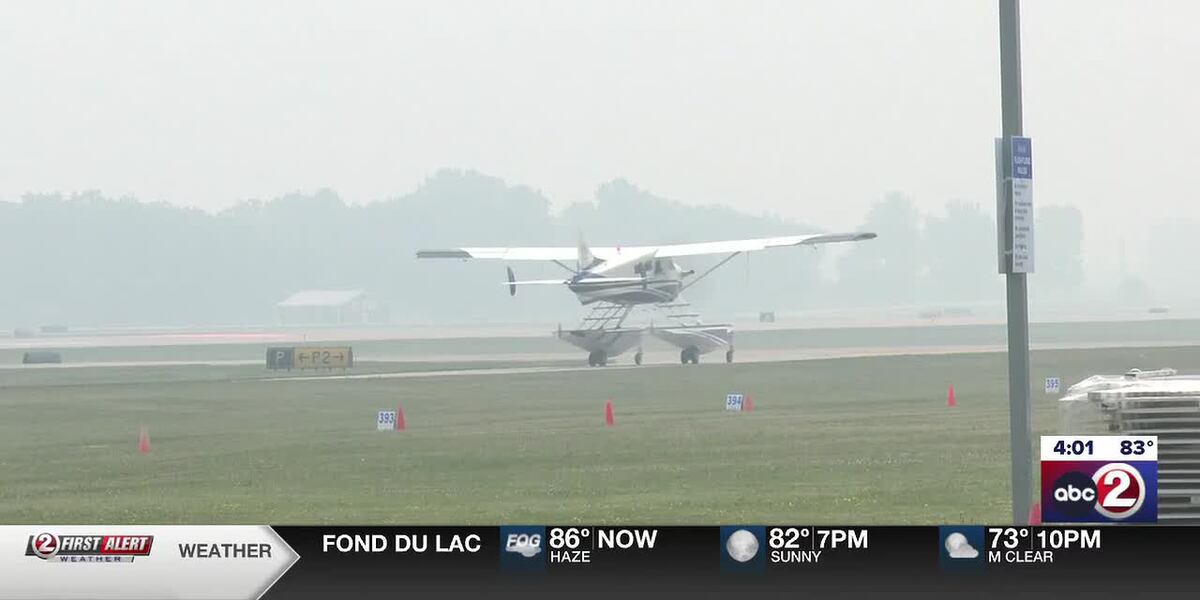
Smoke from hundreds of wildfires burning across Canada and northern Minnesota has pushed visibility at Wittman Regional Airport (KOSH) down to roughly one mile at times, forcing the airport into instrument-only operations on Thursday, July 16, 2026, and prompting pilots to delay arrivals ahead of EAA AirVenture Oshkosh. Oshkosh registered a “Hazardous” Air Quality Index of 414 at the peak, with roughly half of Wisconsin sitting in the “very unhealthy” AQI category. The National Weather Service forecast smoke and haze to persist across northeast Wisconsin through Friday, July 17 — precisely as the first major wave of aircraft begins converging on the field. NOAA expects visibility and air quality to improve around noon Friday.
AirVenture 2026 runs July 20–26. Mass arrivals begin Saturday. For the thousands of pilots currently making go/no-go decisions, here’s what’s happening and what it means.
Why This Smoke Event Is Different
Canadian wildfire smoke has become an almost routine summer feature across the Upper Midwest. This one isn’t routine.
Jack Pelton, EAA’s CEO and chairman, put it bluntly to Aviation Week: “We’ve had Canadian smoke multiple times over the last few years. This one really is different. It’s thicker than the ones in the past. You can taste it.”
The source is a combination of hundreds of fires burning across Ontario, Manitoba, Saskatchewan, and northern Minnesota, with Canada experiencing a record wildfire season. AccuWeather’s air quality mapping shows the plume reaching across the Midwest and stretching into the Northeast.
The operational impact was immediate. Pelton described Thursday’s conditions in stark terms: “On Thursday at noon, the only way to get into Oshkosh is IFR.”
The Fisk Arrival Problem
The reason smoke hits AirVenture harder than it hits a normal airport comes down to how pilots actually get into Oshkosh.
The FAA’s special AirVenture procedures — which went into effect Thursday — center on the famous visual Fisk arrival. Pilots follow a published routing, hold specific altitudes and airspeeds, identify themselves by aircraft type and color, and receive instructions via rocking their wings. The entire procedure depends on maintaining visual contact with ground landmarks and with other aircraft.
Smoke destroys exactly that. Reduced visibility doesn’t just make the arrival uncomfortable — it makes the core mechanism of the procedure unworkable. You cannot follow a visual arrival you cannot see, and you cannot maintain safe separation from traffic you cannot spot.
Air traffic controllers managing traffic into Wittman emphasized that the combination of reduced visibility plus the sheer volume of arriving aircraft is what makes this dangerous. AirVenture draws more than 10,000 aircraft across the week. Wittman becomes, briefly, the busiest control tower in the world. Degraded visibility in that environment is a fundamentally different risk than degraded visibility on a quiet cross-country.
Controllers also cautioned that conditions were changing rapidly, and that an arrival that begins as comfortably visual can deteriorate into something marginal or unsafe with little warning.
The IFR Slot Squeeze
Here’s the trap: when VFR arrivals become impossible, IFR isn’t a simple fallback.
Flying IFR into Wittman Regional Airport during the AirVenture period requires a reservation with the FAA. Per Pelton, those slots are already booked.
That leaves pilots who planned a VFR Fisk arrival with a narrow set of real options:
- Wait for conditions to improve before departing
- Divert to an alternate and drive in
- Cancel the flight entirely
None of those are the plan anyone filed. But all three are better than pressing a visual arrival into a one-mile-visibility, high-density traffic environment.
What EAA and Controllers Are Telling Pilots
EAA’s public posture has been consistent and appropriately hands-off: this is a pilot-in-command decision.
Dick Knapinski, EAA’s director of communications, framed it in terms of personal minimums: “Pilots will do their flight planning on to what their minimums are, what they feel comfortable with, and then plan accordingly before making their flight here to AirVenture.”
He was equally direct with FOX 11 about the limits of anyone’s control: “The weather patterns are the weather patterns. There are some things you absolutely cannot control whatsoever. And so pilots take that into account as they fly in to the event.”
EAA has noted that pilots are adjusting flight plans around the haze much as they would around a large storm system — which is the correct mental model. Smoke is weather. It goes in the same decision bucket as a squall line or an icing layer.
Air traffic controllers involved in AirVenture preparations urged pilots to remain conservative and to be prepared for diversions. They specifically flagged the alternates: Fond du Lac (KFLD), Appleton (KATW), and Green Bay (KGRB).
Controllers added a second warning for July 17: do not attempt to thread between the thunderstorms forecast south of Oshkosh. Smoke plus convective activity is a combination that has ended badly for pilots determined to make an event on schedule.
The Mass Arrival Schedule at Risk
The timing is unfortunate. The first scheduled mass arrivals — the coordinated type-club formations that are among AirVenture’s signature events — begin Saturday:
- Up to 70 Mooneys at 10:00 local time Saturday
- 130 Bonanzas following
- 90 Cessnas following
- Cirrus and Cherokee arrivals continuing Sunday
Mass arrivals are formation operations. They require even more visual reference than a standard Fisk arrival — pilots are maintaining position relative to dozens of other aircraft in a choreographed sequence. If visibility hasn’t recovered, these are among the first operations that become untenable.
Practical Guidance for Pilots Still Planning to Fly In
If you’re flying to Oshkosh in the next several days:
Check the NOTAM again. The AirVenture NOTAM is the authoritative source for arrival procedures. Conditions and procedures can change. Read it before every departure, not once a week ago.
Treat smoke as weather, because it is. Apply the same personal minimums, the same go/no-go discipline, and the same alternate planning you’d apply to a frontal system. “It’s just haze” is how people fly into terrain.
Have a real alternate, and be willing to use it. Fond du Lac, Appleton, and Green Bay are the named diversions. Fuel to reach them with reserves, and decide before you launch what conditions would trigger the diversion.
Watch the AQI, not just the METAR. Air quality and flight visibility are related but not identical. AccuWeather, AirNow, and NWS Green Bay products give a fuller picture than a single visibility number.
Don’t count on IFR as a backup. Slots are booked. If your VFR plan fails, IFR into KOSH likely isn’t available to you.
Beware get-there-itis. AirVenture happens every year. This is the single highest-risk psychological factor in the entire event — thousands of pilots with a fixed date, camping reservations, friends waiting, and a week of vacation booked. That pressure has killed people. The show will still be there Tuesday.
Consider arriving later in the week. The smoke is forecast to improve. Arriving Tuesday or Wednesday in clear air is strictly better than arriving Saturday in one mile of haze.
Health Considerations for Everyone on the Ground
The AQI numbers matter for attendees as much as pilots. An AQI of 414 is “Hazardous” — the top of the scale, at which health warnings of emergency conditions apply and the entire population is likely to be affected, not just sensitive groups.
EAA has said it is monitoring whether the smoke affects attendance and has recommended that visitors make personal health decisions if the haze continues.
For attendees with asthma, COPD, cardiovascular conditions, or other respiratory sensitivity — and for anyone bringing children or older family members — the calculus is worth running honestly. AirVenture is largely an outdoor event. There is limited ability to escape ambient air quality across a week of walking the grounds.
N95 masks filter fine particulates effectively. If the haze persists into show week, they are worth packing.
The Outlook
The near-term forecast is cautiously positive. NOAA expects visibility and air quality to improve around noon on Friday, July 17 — Pelton said he’d just hung up with NOAA when he shared that timing, and he was “crossing his fingers.”
That would put conditions on an improving trend heading into the Saturday mass arrivals and Monday’s opening. The National Weather Service had forecast smoke and haze to persist through Friday, so the two align.
The caveat: Canada’s wildfire season is ongoing and severe. Forecasts don’t extend far, and the same northerly flow that brings pleasant summer temperatures to Wisconsin is exactly what carries the smoke south. A clear Friday does not guarantee a clear week.
The Bottom Line
Wildfire smoke has already forced Wittman Regional Airport into IFR-only operations and pushed visibility to around one mile at times, delaying arrivals ahead of AirVenture 2026. The visual Fisk arrival — the procedure that makes Oshkosh’s extraordinary traffic volume work — depends on visibility that the smoke has taken away. IFR slots are booked. The named diversions are Fond du Lac, Appleton, and Green Bay.
Conditions are forecast to improve around midday Friday, and EAA is proceeding with the show as planned. AirVenture 2026 runs July 20–26 and is still expected to draw more than 700,000 attendees, 10,000-plus aircraft, nearly 6,000 volunteers, and 900 exhibitors.
For pilots: smoke is weather. Fly it like weather. Set your minimums before you launch, name your alternate, and remember that the single most dangerous thing at Oshkosh has never been the traffic — it’s the pilot who decided they had to be there today.
This is a developing situation. Check the current AirVenture NOTAM, METARs, TAFs, and air quality products before every departure.
Frequently Asked Questions
Is wildfire smoke affecting EAA AirVenture Oshkosh 2026? Yes. Smoke from hundreds of wildfires burning across Canada and northern Minnesota reduced visibility at Wittman Regional Airport to around one mile at times on July 16, 2026, forcing the airport into instrument-only operations and prompting some pilots to delay arrivals. Oshkosh registered a “Hazardous” Air Quality Index of 414 at the peak, with roughly half of Wisconsin in the “very unhealthy” category. NOAA expected conditions to improve around noon on Friday, July 17.
Can pilots still fly VFR into Oshkosh during the smoke? It depends entirely on conditions at the time of the flight, and VFR arrivals were not possible at Wittman on July 16. The FAA’s special AirVenture procedures center on the visual Fisk arrival, which requires maintaining visual contact with ground landmarks and other aircraft. Reduced visibility makes that procedure unworkable. Air traffic controllers have urged pilots to remain conservative and be prepared to divert to Fond du Lac (KFLD), Appleton (KATW), or Green Bay (KGRB).
Can pilots fly IFR into AirVenture instead? Not easily. Flying IFR into Wittman Regional Airport during the AirVenture period requires a reservation with the FAA, and EAA CEO Jack Pelton stated those slots are already booked. Pilots whose VFR plans are disrupted by smoke should generally plan to wait for improving conditions, divert to an alternate airport, or delay their trip rather than assume IFR is available as a fallback.
Will AirVenture 2026 still happen? Yes. EAA AirVenture Oshkosh 2026 runs July 20–26, 2026, at Wittman Regional Airport in Oshkosh, Wisconsin, and EAA is proceeding as planned. The event typically draws more than 700,000 attendees, over 10,000 aircraft, nearly 6,000 volunteers, and 900 exhibitors. EAA has said it is monitoring whether the smoke affects attendance and recommends that visitors make personal health decisions if the haze continues.
What air quality precautions should AirVenture attendees take? An Air Quality Index of 414 falls in the “Hazardous” category, at which health warnings of emergency conditions apply and the entire population may be affected. AirVenture is largely an outdoor event with limited ability to escape ambient air quality. Attendees with asthma, COPD, cardiovascular conditions, or respiratory sensitivity — and those bringing children or older family members — should monitor conditions closely. N95 masks filter fine particulate matter effectively and are worth packing if the haze persists.
Sources:
- Aviation Week — Wildfire Smoke Impacts Early AirVenture Arrivals, Organizers
- AVweb — Wildfire Smoke Delays Oshkosh Arrivals
- WBAY — Wildfire Smoke Reduces Visibility Ahead of EAA AirVenture in Oshkosh (July 16, 2026)
- FOX 11 — EAA Prepared for Wildfire Haze as Pilots Fly In for AirVenture
- AeroTime — Canadian Wildfire Smoke Raises Oshkosh Arrival Concerns
- EAA — AirVenture NOTAM and Flight Planning
- AirNow — Air Quality Index