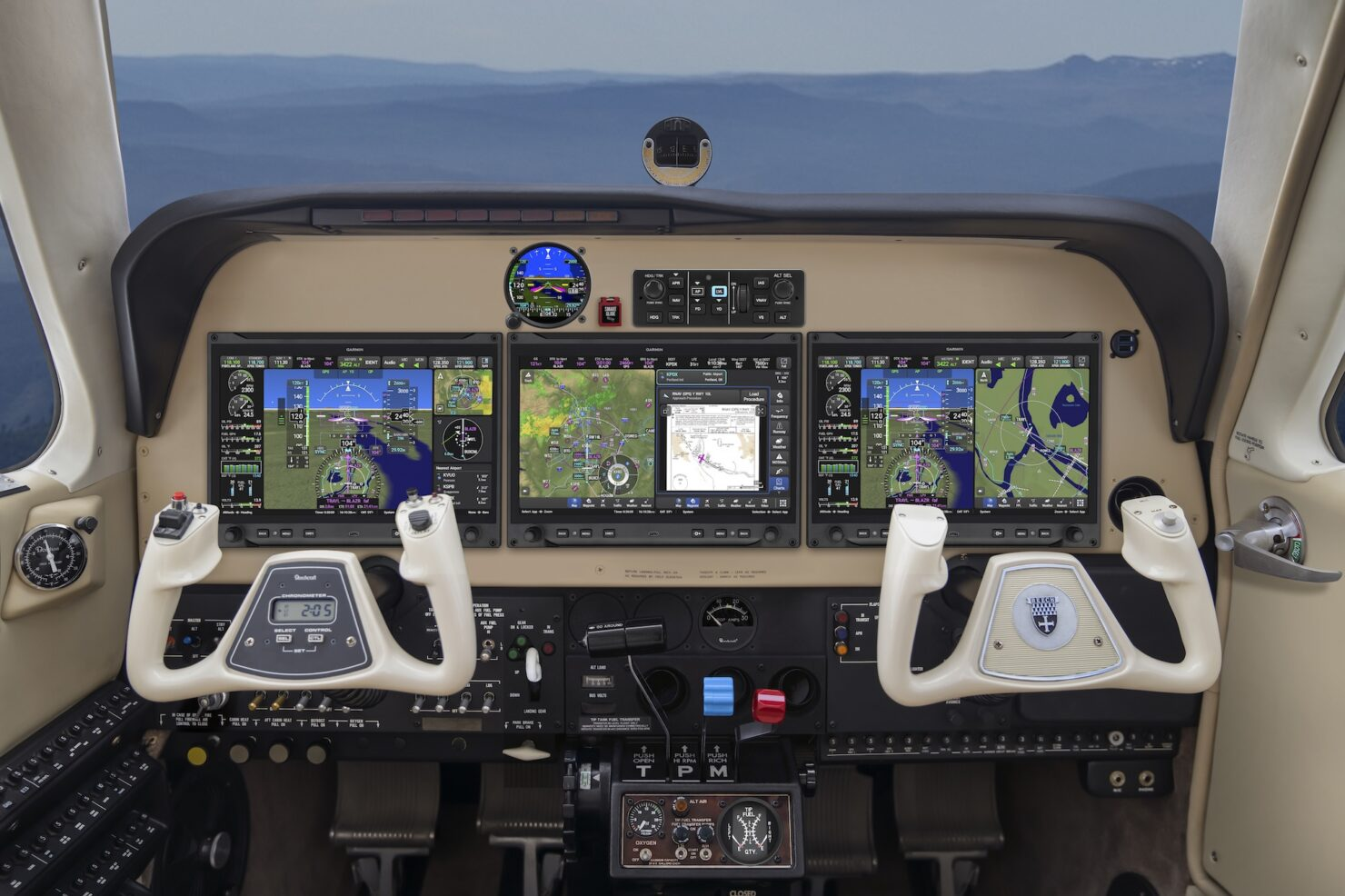
Garmin unveiled AXIS on July 8, 2026 — a first-of-its-kind family of integrated flight displays that combines a primary flight display (PFD), multifunction display (MFD), IFR GPS, NAV/COMM radio, and audio panel into a single unit for certified piston singles and light twins, experimental aircraft, and light-sport aircraft under the FAA’s MOSAIC framework. The 11.6-inch AXIS displays have received FAA/EASA Technical Standard Order (TSO) authorization and are available this month. Eight-inch landscape and portrait displays follow in early 2027. Pricing ranges from approximately $8,000 for entry-level experimental configurations to $23,400 for fully-integrated certified installations, with the AXIS system covered by an Approved Model List Supplemental Type Certificate (AML STC) spanning hundreds of Part 23 Class I/II certified aircraft models.
For pilots and aircraft owners considering panel upgrades — and for the roughly 200,000 certified GA piston aircraft still flying with older analog or partial-glass panels — AXIS represents one of the more consequential avionics launches in years. Here’s what AXIS actually delivers, how it compares to existing panels, and what it means for the broader GA market.
What Makes AXIS Different
The core innovation of AXIS is radical integration. Traditional GA panels — even modern glass ones — typically include a flight display, a separate IFR GPS navigator, a separate NAV/COMM radio, and a separate audio panel. That’s four boxes, four sets of wiring, four installation costs, and four failure modes. AXIS collapses all four into one unit.
Scott McCurley, Garmin’s manager of aviation marketing, framed the strategic reframing directly: “One of the things that this product has the potential to change across the GA fleet is the radio stack as we know it today. With AXIS there’s no need for it. And so that means that AXIS is now the center of the panel and that’s the thing that all the axes revolve around.”
The naming is a deliberate play on that positioning. AXIS is meant to become the axis around which the rest of the panel rotates — reducing the traditional center radio stack from four separate boxes to zero.
Carl Wolf, Garmin’s Vice President of Aviation Sales, Marketing, Programs & Support, framed the value proposition in terms of installation economics: “AXIS redefines Garmin’s flight display portfolio and brings industry-first capability to a single flight display. This game-changing flight display system delivers a modern, highly capable cockpit experience while significantly reducing time, complexity and cost of installation through integration of navigation, communication and audio functions into a single flight display.”
The Three Display Formats
AXIS comes in three physical configurations:
11.6-inch landscape display (available July 2026, TSO-certified). The flagship option. Available in versions that include the integrated IFR GPS, VHF COMM radio, NAV radio, and audio panel. This is the model targeting owners who want to consolidate a full panel into fewer boxes.
8-inch portrait display (available early 2027). Fits vertical panel space more common in older Cessna, Piper, and Beechcraft models.
8-inch landscape display (available early 2027). Horizontal orientation for other panel layouts.
Each display can be configured as a PFD, MFD, or engine indication system (EIS) depending on installation and pilot preference. All three sizes support touchscreen operation backed by dedicated physical controls (knobs and buttons) for high-workload situations where touch input becomes impractical.
The Integrated 11.6-Inch: What’s Inside
For the fully-featured 11.6-inch model, the integrated capabilities are substantial:
IFR GPS. TSO-certified integrated IFR GPS navigator — replaces standalone GNC 355, GPS 175, GNX 375, or GTN 650/750 Xi navigators in many installations.
VHF COMM radio. 10 watts of transmit power, 8.33 kHz frequency spacing (matching European requirements), standby COMM monitoring, and dual-COMM switching for one external radio. Replaces a standalone COMM radio.
NAV radio. VOR/ILS/glideslope navigation. Replaces standalone VHF NAV radios.
Four-place audio panel. Integrated intercom for pilot, copilot, and two passengers. COMM playback, Bluetooth music and phone support, and standard audio panel switching functions. Replaces standalone Garmin GMA 245 or comparable audio panels.
PFD. Primary flight display with attitude, airspeed, altitude, heading, and Enhanced Synthetic Vision Technology (SVT) with 3D terrain, obstacles, runways, taxiway markings, and pathway rectangles showing the aircraft’s programmed flight path.
MFD. Multifunction display with map, flight plan, weather, traffic, and other reference data. Full-screen or split-screen views.
EIS. Engine indication system with color-coded gauges, precise numerical values, and integrated interface to normally-aspirated or turbocharged 4- to 6-cylinder engines, plus radial and turbine engines in experimental configurations.
This is essentially an entire integrated avionics suite in one 11.6-inch display.
Safety Systems That Redefine the Category
AXIS integrates a suite of safety technologies that Garmin has previously reserved for higher-tier integrated flight decks:
Dedicated emergency button. Located on the display bezel, giving pilots one-touch access to emergency procedures — Smart Glide activation, level mode, 180-degree turn function, and the shortcut for selecting the emergency frequency.
Smart Glide. Garmin’s Autonomí technology that helps pilots handle loss-of-engine-power emergencies by identifying the nearest suitable airport, calculating a glide path, and — if the aircraft is equipped with a GFC 500 or GFC 600 autopilot — automatically flying the aircraft en route to the runway.
Runway Occupancy Awareness (ROA). Uses ADS-B traffic data to detect potential runway incursions caused by nearby airborne aircraft, taxiing aircraft, and ground vehicles. Provides visual and audio warnings. This is a genuinely rare capability in the GA class.
SurfaceWatch. Optional runway monitoring technology providing visual and aural cues to prevent takeoff or landing on the wrong runway or a taxiway. Addresses one of the most persistent categories of GA operational error.
3D SafeTaxi. Airport surface navigation with 3D graphics showing runway occupancy, taxiway signage, and other critical ground-operations information.
Enhanced Synthetic Vision. Full 3D depiction of terrain, obstacles, and runway environments with pathway rectangles showing programmed flight path — including en-route legs, flight track, and course intercepts.
HDMI video input. For installing forward-facing cameras or other video sources — a capability requested by pilots for years.
For an aircraft class that has historically lacked runway incursion prevention, terrain awareness, and one-touch emergency response, AXIS brings capabilities more commonly found on airliner-class integrated flight decks down to a $10,000-to-$25,000 price point.
The G3X Touch Upgrade Path
One of AXIS’s most strategically important design choices is its compatibility with existing Garmin G3X Touch installations. Garmin has explicitly framed AXIS as an easy upgrade path for the roughly 40,000 experimental aircraft and thousands of certified aircraft flying with G3X Touch panels today.
Specific compatibility points:
- Same panel cutouts and mounting points. No new panel cuts required
- Compatible LRUs, sensors, and remote radios. Most existing components carry over
- Same wiring backbone. Main connector retains most of the same wiring, with specific interfaces requiring modification
- Compatible autopilots. GFC 500 and GFC 600 continue to work
Display-only upgrade pricing (moving from G3X Touch to AXIS without adding integrated NAV/COMM/audio) is $6,000 for experimental aircraft and $10,000 for certified aircraft. That’s a meaningful price point for owners considering fleet-wide upgrades or preparing to sell an aircraft in a market where “the latest thing” carries weight with buyers.
Note that if you have multiple G3X Touch displays, all displays in the installation must be replaced with AXIS. This is a source of some community concern — owners hoping to upgrade one display at a time are learning that AXIS requires full-display replacement.
Also worth noting: G3X Touch remains in production. AXIS is a new product category, not a replacement for G3X Touch. Owners who don’t need AXIS’s integrated capabilities may continue purchasing G3X Touch for many years to come.
Pricing and Market Positioning
AXIS pricing across the family:
- Experimental base 8-inch (VFR): ~$8,000 entry level
- Experimental 11.6-inch base: Higher, depending on configuration
- Certified 11.6-inch with integrated IFR GPS + NAV/COMM + audio: Up to $23,400 fully loaded
- G3X Touch display-only upgrades: $6,000 experimental / $10,000 certified
The Van’s Air Force builder community — one of the largest experimental aircraft communities in the world — noted a key nuance in early discussion: at the top of the range, the $18,000 delta from G3X Touch to a fully integrated AXIS includes what would otherwise be a $20,000 IFR GPS navigator (like a GTN 750 Xi) and a $2,000 audio panel. Under that math, AXIS is priced competitively against buying the components separately.
The experimental 8-inch VFR variant appears not to include the integrated IFR GPS, COMM, NAV, or audio panel — those are reserved for the TSO-certified variants. Experimental builders needing those capabilities can still connect existing standalone Garmin components (GNX 375, GTR 205X, etc.) to a base AXIS display.
What Gets Cheaper, and What Gets Better
For aircraft owners considering panel upgrades, AXIS creates several practical improvements:
Installation cost reduction. Consolidating four boxes into one meaningfully reduces installation labor. Panel refits that would take weeks with separate components can potentially be completed in significantly less time.
Panel real estate freed up. Removing the center radio stack opens panel space for other equipment — autopilot mode selectors, secondary displays, or simply cleaner cockpit ergonomics.
Weight reduction. Fewer separate boxes = less overall weight. Modest but not trivial in a class where useful load matters.
Single-source support. All components under Garmin support rather than mixed vendors reduces troubleshooting complexity.
Familiar user interface. For pilots already familiar with Garmin’s G1000, G3X Touch, or GTN series, the AXIS interface uses the same visual design language and control paradigm.
Data logging and analysis. Flight and engine data logs upload automatically to flyGarmin.com via Garmin Pilot or the GDL 60 datalink and PlaneSync service. Optional integration with FlySto or SavvyAviation supports advanced engine health analysis and flight review.
The MOSAIC Connection
AXIS’s compatibility with light-sport aircraft under the FAA’s MOSAIC framework is strategically significant. As of July 24, 2026, MOSAIC Phase 2 takes effect, opening the door to a new generation of light-sport category aircraft with expanded capabilities — including advanced avionics.
Garmin has positioned AXIS as ready for MOSAIC-era light-sport aircraft from day one. As new manufacturers develop aircraft under the expanded LSA framework, AXIS provides a certified glass panel option that meets the technical and cost profile these aircraft need.
For the aviation industry as a whole, this positions Garmin favorably as MOSAIC unlocks new aircraft designs over the next 12 to 24 months. Manufacturers designing new aircraft under MOSAIC will likely evaluate AXIS as a baseline integrated flight display option.
Where AXIS Fits in Garmin’s Product Portfolio
AXIS is Garmin’s newest addition to a family of integrated flight decks that has grown steadily since the G1000’s 2004 debut:
- G1000 / G1000 NXi (2004 / 2017): Original integrated flight deck, available primarily on new aircraft
- G500 / G600 (2009): Retrofittable integrated displays for existing certified aircraft
- G3X Touch (2013): Simpler integrated glass panel initially for experimental aircraft, later expanded to certified retrofit
- GTN Xi series (2019): Touchscreen GPS/NAV/COMM navigators for center-stack integration
- G1000 NXi Advanced Flight Deck (2020s): High-end iteration for premium GA and business aircraft
- AXIS (2026): New generation integrating flight display + NAV/COMM/audio into a single unit
The AXIS launch reflects Garmin’s continued strategic investment in the GA panel upgrade market — which as of 2026 remains substantial. There are approximately 200,000 certified GA piston aircraft flying in the U.S. alone, most with panels that could benefit from modern integrated avionics. AXIS gives Garmin a new flagship product to serve that market for the next decade.
What Pilots and Owners Should Do
For pilots and aircraft owners evaluating whether AXIS makes sense for their operation:
If you’re building an experimental aircraft. AXIS is now the newest Garmin option. Compare it against G3X Touch based on your feature needs. The 8-inch experimental base at $8,000 is competitive with G3X Touch at similar sizes; the integrated 11.6-inch offers substantially more capability.
If you have an existing G3X Touch installation. Consider whether AXIS’s added capabilities (IFR GPS, integrated NAV/COMM, audio panel, dedicated emergency button, ROA) justify the $6,000-$10,000 display upgrade. For most owners already flying with adequate secondary systems, upgrading may not be urgent. For owners with older separate GPS navigators approaching end-of-life, AXIS may be an attractive consolidation.
If you have an older certified aircraft with analog or partial-glass panels. AXIS is one of the more compelling panel refit options currently on the market. Get a quote from a Garmin dealer that includes installation labor, remaining component costs, and AML STC applicability.
If you’re buying an aircraft in the near future. Aircraft with AXIS installed will command premium prices in the used market for years to come. If you’re comparing aircraft, an existing AXIS installation is meaningful value.
If you plan to sell your aircraft. For older aircraft with dated panels, AXIS installation may substantially improve sale price and speed. Consult with a broker or dealer before committing to the upgrade to understand ROI in your specific market.
Where AXIS Sits in the Broader Aviation Modernization Wave
Garmin’s AXIS launch comes at a specific moment when GA aviation is seeing accelerated modernization on multiple fronts:
- MOSAIC Phase 2 takes effect July 24, 2026, enabling a new generation of light-sport aircraft with modern avionics
- The Cirrus TRAC10 launched July 6, 2026 with a Garmin flight deck (see our earlier coverage)
- FAA Part 25 Certification Modernization NPRM (June 26, 2026) modernizing transport airplane certification, harmonizing with EASA
- Jeppesen ForeFlight Airflow (July 1, 2026) introducing AI to pilot workflow across the industry
- eVTOL Integration Pilot Program advancing electric urban air mobility
- Supersonic flight returning to the U.S. under Executive Order 14304
Each of these developments reflects a broader trend: GA aviation is transitioning rapidly from the analog/pre-glass era into the fully integrated, connected, safety-enhanced era. AXIS is one of the more visible consumer-facing pieces of that transition — the panel that thousands of GA pilots will interact with every day for the next 20 years.
The Bottom Line
Garmin AXIS is a substantial evolution of GA integrated flight displays. By combining PFD, MFD, IFR GPS, NAV/COMM, and audio panel into a single 11.6-inch display — with the dedicated emergency button, Runway Occupancy Awareness, Smart Glide, and Enhanced Synthetic Vision that the class has historically lacked — AXIS collapses a traditional four-box panel into one integrated unit while adding safety capabilities previously reserved for higher-tier flight decks.
For pilots, aircraft owners, avionics shops, and the broader GA industry, AXIS creates real value: reduced installation cost, cleaner panels, meaningful safety improvements, and a familiar Garmin user interface. Pricing from $8,000 for experimental base configurations to $23,400 for fully-integrated certified installations positions AXIS competitively with the sum of components it replaces.
For the millions of hours GA pilots will fly with AXIS in their panels over the coming decades, the answer to the perennial “what should I put in my panel?” question just got a lot more interesting. Whether AXIS becomes the industry standard for GA panel upgrades will play out over the next several years — but the strategic ambition of the launch is clear. Garmin has redefined what a single flight display can do, and the rest of the market will need to respond.
Frequently Asked Questions
What is Garmin AXIS? Garmin AXIS is a new family of integrated flight displays announced by Garmin on July 8, 2026. AXIS combines a primary flight display (PFD), multifunction display (MFD), IFR GPS, NAV/COMM radio, and audio panel capability into a single unit. AXIS is designed for certified piston singles and light twins, experimental aircraft, and light-sport aircraft under the FAA’s MOSAIC framework. The 11.6-inch AXIS displays have received FAA/EASA TSO certification and are available in July 2026, with 8-inch versions following in early 2027.
How much does Garmin AXIS cost? AXIS pricing ranges from approximately $8,000 for basic entry-level experimental configurations to $23,400 for fully-integrated certified installations with IFR GPS, NAV/COMM, and audio panel. Display-only upgrades from Garmin G3X Touch to AXIS are priced at $6,000 for experimental aircraft and $10,000 for certified aircraft. Actual installation costs vary based on the specific aircraft and remaining panel components.
How does AXIS differ from Garmin G3X Touch? AXIS is Garmin’s newest generation of integrated flight displays and is compatible with G3X Touch panel cutouts, mounting points, and many existing sensors and radios. Unlike G3X Touch, which is primarily a flight display that requires separate IFR GPS, NAV/COMM, and audio panel components, AXIS can integrate all of those functions into a single 11.6-inch display (in the TSO-certified version). Garmin will continue to produce G3X Touch alongside AXIS; the two products serve different needs at different price points.
What aircraft can install Garmin AXIS? AXIS is designed for certified piston singles and light twins (Class I and II Part 23 aircraft) through an Approved Model List Supplemental Type Certificate (AML STC) that Garmin says covers hundreds of models. AXIS is also compatible with experimental aircraft and light-sport aircraft under the FAA’s MOSAIC framework (Phase 2 effective July 24, 2026). Contact your Garmin dealer for aircraft-specific approval information.
What safety features does Garmin AXIS include? AXIS integrates a comprehensive safety suite that includes a dedicated emergency button on the display bezel, Smart Glide (automated glide-to-airport in engine-out situations), Runway Occupancy Awareness (ROA) using ADS-B to alert of potential runway incursions, SurfaceWatch runway monitoring, 3D SafeTaxi airport surface navigation, Enhanced Synthetic Vision Technology with terrain and obstacle depiction, and HDMI video input for cameras. Many of these features have historically been reserved for higher-tier integrated flight decks.
Sources:
- Garmin — Garmin Unveils AXIS, A New Generation of Highly Integrated Flight Displays (July 8, 2026)
- AVweb — Garmin Debuts AXIS For GA Panels (July 8, 2026)
- AOPA — Center Stack Not Required (July 8, 2026)
- Aviation International News — Garmin Unveils Axis Avionics with Prime Elements for GA (July 8, 2026)
- AeroTime — Garmin Unveils AXIS Integrated Flight Displays (July 8, 2026)
- FLYER Magazine — Garmin Unveils AXIS, a New Generation of Highly Integrated Flight Displays (July 8, 2026)
- Van’s Air Force — Garmin AXIS, Next Generation Integrated Flight Display