
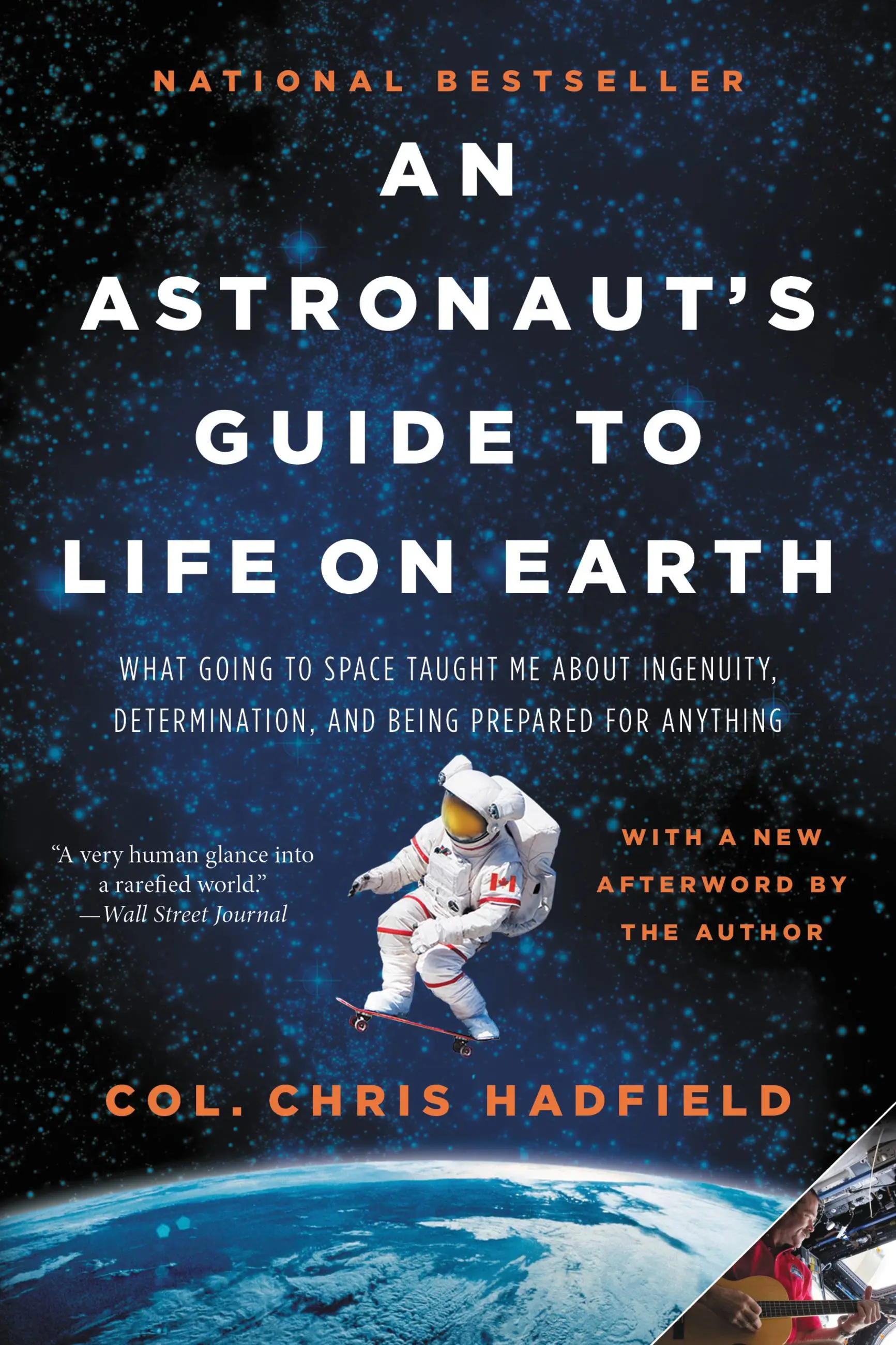

Chris Hadfield spent 21 years as an astronaut, flew two Space Shuttle missions, became the first Canadian to walk in space, and commanded the International Space Station. Before any of that, he was a Royal Canadian Air Force fighter pilot and test pilot.
His 2013 book, An Astronaut’s Guide to Life on Earth, is nominally a memoir. It’s more accurately a manual on how to prepare for things that can kill you — which makes it one of the more useful books a pilot can read, regardless of how far above the ground they intend to go.
The ideas in it map onto flight training with almost no translation required.
The Decision at Nine Years Old
Hadfield watched the Apollo 11 moon landing in July 1969 as a nine-year-old on a farm in Ontario and decided he would become an astronaut.
There was one problem: Canada had no astronaut program, and Canadians were not eligible to become NASA astronauts. The goal wasn’t difficult. It was, at the time, impossible.
His response was to ask what an astronaut would do — and then do that, continuously, for decades, without any guarantee it would matter. Study science. Learn to fly. Become a fighter pilot, then a test pilot. Stay fit. Keep learning.
When Canada created an astronaut corps in 1983, he was qualified. Not because he’d gambled correctly, but because the preparation had made him good at things worth being good at either way.
That’s the book’s foundational argument, and it’s a useful one for anyone pursuing an aviation career on an uncertain timeline: prepare in ways that pay off even if the specific goal never arrives.
Sweat the Small Stuff
The most counterintuitive idea in the book is a direct inversion of standard advice.
Popular wisdom says don’t sweat the small stuff. Hadfield’s position, formed in environments where small details kill people, is the opposite: sweat the small stuff relentlessly, because the small stuff is what gets you.
Spacecraft don’t usually fail dramatically. They fail because a seal was installed incorrectly, a checklist item was skipped, or a procedure was assumed rather than verified. The same is true of aircraft.
Any pilot who has read an NTSB report recognizes this. The chain almost never starts with something dramatic. It starts with fuel not verified, a checklist run from memory, a squawk deferred, a weather product not checked.
Hadfield’s framing turns attention to detail from tedium into the actual substance of competence.
Aim to Be a Zero
This is the concept most often quoted from the book, and the most useful for anyone new to an organization.
Hadfield’s model divides people into three categories in any new environment. A minus one actively creates problems — through incompetence, ego, or disruption. A plus one adds genuine value. A zero is neutral: competent, unobtrusive, neither helping nor hurting.
The instinct on arriving somewhere new is to demonstrate that you’re a plus one. Hadfield’s argument is that this usually backfires — you don’t yet know enough to add value, and attempting it creates work for everyone else.
Aim to be a zero first. Learn the environment. Don’t create problems. Earn the standing to contribute later.
For a new CFI joining a school, a low-time pilot arriving at a first flying job, or a student entering an unfamiliar training environment, that’s better advice than most of what gets offered.
The Power of Negative Thinking
Astronauts spend enormous amounts of time rehearsing failure. Hadfield describes simulation sessions built entirely around cascading malfunctions, and a working habit of continuously asking what’s the next thing that could kill me — and what the response would be.
The conventional read is that this sounds miserable and anxious. Hadfield’s argument is the reverse: rehearsing failure is what produces calm. Anxiety comes from feeling unprepared. A person who has thought through the engine failure, the electrical fire, and the inadvertent IMC encounter — and knows their first three actions in each — isn’t frightened by the possibility. They’ve already handled it in their head.
This is precisely the argument for chair flying, for memory items, for scenario-based training, and for briefing the missed approach before the final approach fix. Pilots who do those things aren’t pessimists. They’re buying calm in advance.
Work the Problem
The operational core of the book is a phrase familiar from spaceflight: when something goes wrong, work the problem.
Not panic. Not narrate. Not search for someone to blame. Identify what’s actually happening, determine the next correct action, take it, reassess.
Hadfield also offers a corollary worth memorizing: there is no problem so bad that you can’t make it worse. Which is an argument for the deliberate pause — the moment before acting where you confirm you’re solving the right problem.
Aviation has its own versions: aviate, navigate, communicate. Wind the clock. Fly the airplane first. Hadfield’s framing arrives from a different direction and reinforces all of them.
Why This Lands for Pilots
Hadfield was a fighter pilot and test pilot before he was an astronaut, and it shows throughout. The book’s instincts are aviation instincts.
Checklists are treated as respect for complexity, not bureaucracy.
Simulation is where competence is built, with the actual event treated as a performance of something already rehearsed.
Crew coordination is assumed, not optional. The book’s treatment of working alongside people you didn’t choose, in confined conditions, under pressure, is essentially advanced CRM.
Competence is framed as a duty to others, not a personal achievement. You prepare because other people depend on you.
None of that requires a spacecraft.
The Reservations
Two honest notes.
It’s a memoir with a philosophy woven through it, not a structured framework. Readers looking for a systematic method will find the ideas distributed across stories rather than organized into chapters of instruction.
And Hadfield’s circumstances were extraordinary — decades of institutional training, world-class simulation resources, and a career selected for from an enormous applicant pool. The principles transfer; the resources don’t. A student pilot chair flying at the kitchen table is applying the same idea with considerably less support.
Neither is disqualifying. But the book works better as a lens than a checklist.
Worth Knowing
Hadfield commanded Expedition 35 aboard the International Space Station in 2012–13, becoming the first Canadian to command a spacecraft. During that mission he produced a substantial body of educational and musical content from orbit — including a widely viewed music video recorded aboard the station — which brought spaceflight to an audience that hadn’t been paying attention.
That outreach is itself an illustration of the book’s argument: he was able to do it because he’d spent decades becoming competent enough that there was room for something extra.
The Bottom Line
An Astronaut’s Guide to Life on Earth is a book about preparation written by someone whose survival depended on it. Sweat the small details because the small details are what fail. Aim to be a zero before you try to be a plus one. Rehearse failure deliberately, because that rehearsal is where calm comes from. When something goes wrong, work the problem — and remember you can always make it worse.
For pilots, none of that is new in principle. What the book does is articulate it clearly, from outside aviation’s own vocabulary, in a way that tends to stick.
It’s also, worth saying, genuinely enjoyable to read — which is not a quality most books about rigorous preparation can claim.
Frequently Asked Questions
What is An Astronaut’s Guide to Life on Earth about? Published in 2013, it is Chris Hadfield’s memoir and philosophy of preparation, drawn from 21 years as an astronaut and his earlier career as a Royal Canadian Air Force fighter pilot and test pilot. It covers how astronauts train, how they think about risk and failure, and how those approaches apply to ordinary life and work — including sweating small details, rehearsing failure deliberately, and working problems methodically under pressure.
Who is Chris Hadfield? Chris Hadfield is a retired Canadian astronaut who flew two Space Shuttle missions, became the first Canadian to perform a spacewalk, and commanded the International Space Station during Expedition 35 in 2012–13. Before joining the Canadian astronaut corps, he served as a Royal Canadian Air Force fighter pilot and test pilot. He decided to pursue spaceflight at age nine while watching the Apollo 11 moon landing, at a time when Canadians were not eligible to become astronauts.
What does “aim to be a zero” mean? It is Hadfield’s framework for entering a new environment. A minus one actively creates problems, a plus one adds genuine value, and a zero is competent and neutral. His argument is that newcomers should aim to be a zero first — learning the environment and avoiding creating work for others — rather than trying to demonstrate value before they understand the situation well enough to add any.
Why is this book relevant to pilots? Hadfield’s background as a fighter pilot and test pilot shapes the book throughout. Its treatment of checklist discipline, simulation as the place competence is built, crew coordination under pressure, and deliberate rehearsal of emergencies maps directly onto flight training practices including chair flying, memory items, scenario-based training, and briefing procedures before they are needed.
What does “work the problem” mean? It is a spaceflight and aviation approach to emergencies: rather than panicking or seeking blame, identify what is actually happening, determine the next correct action, take it, and reassess. Hadfield pairs it with the reminder that no situation is so bad that it cannot be made worse — an argument for pausing to confirm you are solving the correct problem before acting.
Sources:

