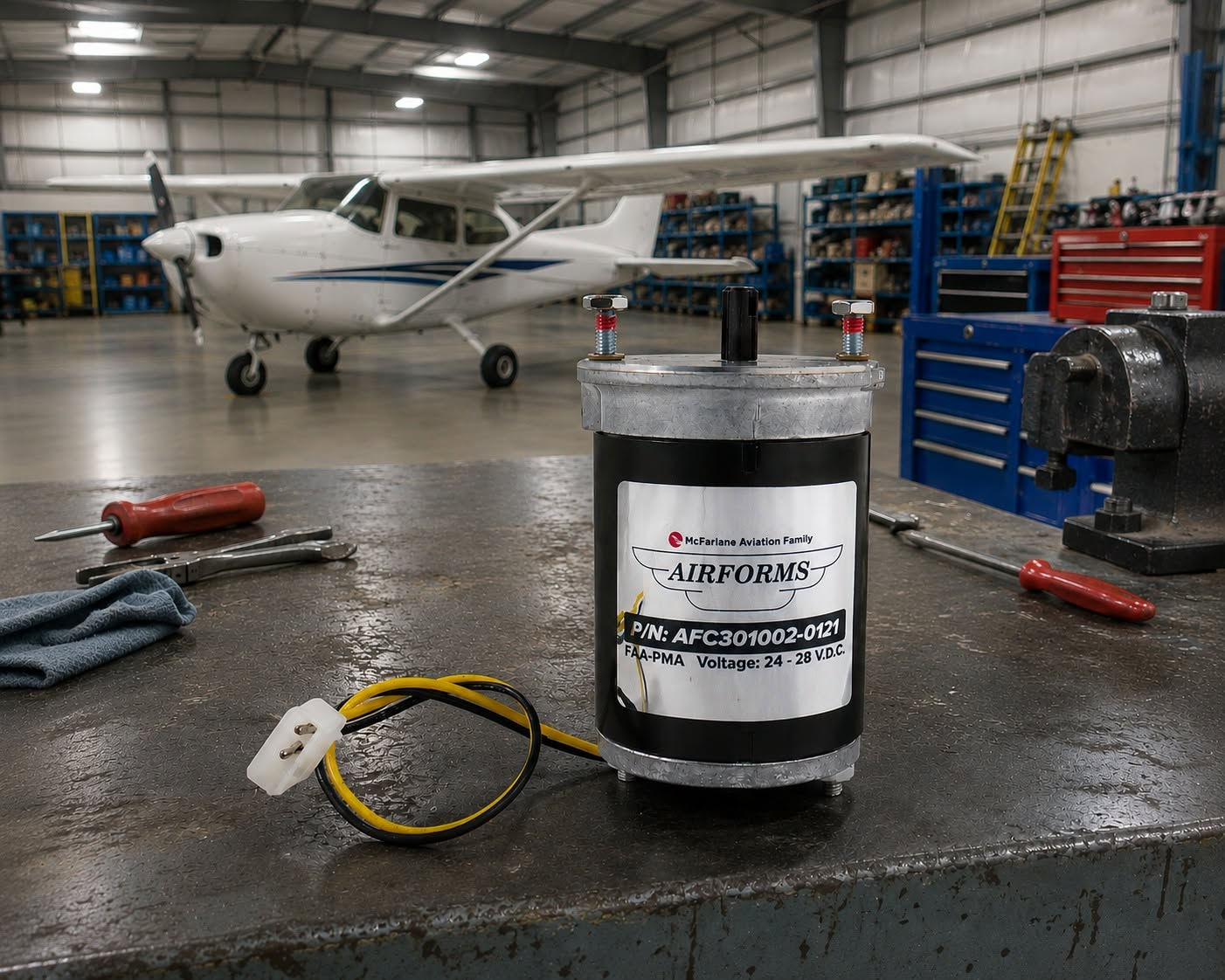
McFarlane Aviation has introduced an FAA-PMA approved 24–28V flap motor that serves as a direct replacement for the original equipment part on more than 80 Cessna and Beechcraft models. The company says it’s engineered to be more reliable, more durable, and better suited for demanding operating conditions than the original — and it specifically targets two complaints owners of these airplanes have lived with for decades: nuisance circuit-breaker trips and cold-weather performance loss.
On its face, a flap motor is a small, unglamorous component. But this release is a useful window into something larger: how the FAA-PMA aftermarket quietly keeps an aging general aviation fleet flying by re-engineering the parts that the original manufacturers designed half a century ago. Here’s what McFarlane changed, why these motors fail, which airplanes are eligible, and what “FAA-PMA” actually means for the owner writing the check.
What McFarlane Actually Changed
This isn’t a clone of the OEM motor. McFarlane’s stated approach across its product line is to study decades of service history and known maintenance problems, then redesign the part to address weaknesses the original engineers couldn’t foresee. The flap motor reflects two targeted improvements:
Reduced circuit-breaker tripping. The headline fix addresses the motor’s tendency to trip the aircraft’s flap motor circuit breaker — a persistent annoyance for owners of affected Cessnas and Beechcraft. A breaker that pops mid-flap-cycle isn’t just irritating; it interrupts a configuration change at a moment when the pilot is usually busy.
Resistance to cold-weather demagnetization. The redesigned motor resists demagnetization of its permanent magnets at low subzero temperatures. That matters for pilots operating in genuinely cold climates, where a weakened magnetic field degrades motor performance exactly when reliable flap operation is most useful.
Direct, drop-in replacement. Because it’s a direct replacement for the OEM part and carries FAA-PMA approval, it installs in place of the factory motor without a separate field approval or major paperwork burden — the same role the original part filled, with the engineering updated.
Why Flap Motors Trip the Breaker in the First Place
The circuit-breaker problem is worth understanding, because it’s a textbook example of why the aftermarket exists.
Electric flap systems on these aircraft use a permanent-magnet DC motor. When everything is healthy, the motor draws a predictable amount of current to drive the flaps up and down against aerodynamic load. The circuit breaker is sized to protect that circuit — it trips when current climbs past a safe threshold.
The trouble is that current draw isn’t static over the life of the motor. As brushes wear, bearings age, and the gear train accumulates friction, the motor has to work harder to do the same job, and it pulls more current. Add the aerodynamic load of flaps deploying into the airflow, and a tired motor can edge past the breaker’s threshold and pop it. Owners often experience this as an intermittent gremlin: the flaps work fine most days, then trip the breaker on a cold morning or under load.
Cold weather makes it worse, which is where the second improvement comes in. Permanent magnets can lose some of their field strength at extreme low temperatures. A weaker magnetic field means the motor has to draw still more current to produce the same torque — compounding the very condition that trips the breaker. By engineering the motor to resist that cold-temperature demagnetization, McFarlane is attacking both problems at their shared root: excess current draw.
None of this is purely cosmetic. Flaps shorten takeoff and landing distances and lower approach speeds; a flap system that can’t be trusted in cold conditions or under load is a real operational limitation, not just a maintenance nuisance.
Which Aircraft Are Eligible
McFarlane lists eligibility across a broad swath of the Cessna and Beechcraft piston and light-twin fleet:
Cessna: 152, 172, 177RG, 182, 206, 207, 208, 210, 303, 336, and 337.
Beechcraft: C23, C24R, F33A, F33C, V35B, A36, A36TC, B36TC, G36, 95-B55, 95-B55A, E55, E55A, 58, 58A, 58P, 58TC, and G58.
That range covers everything from primary trainers (the 152 and 172) through high-performance singles (210, A36 Bonanza) and light twins (Baron 58, Cessna 337 Skymaster). As always with replacement parts, eligibility can hinge on serial number and the specific part number installed, so owners should confirm fitment for their exact airframe directly with McFarlane before ordering. Early reader reaction to the announcement put the motor’s price in the neighborhood of $1,200 — confirm current pricing and eligibility with the manufacturer.
What “FAA-PMA” Means — and Why It Matters for Owners
If you’ve ever wondered whether it’s legal to bolt a non-factory part onto a certificated airplane, FAA-PMA is the answer. It’s the regulatory mechanism that makes the aviation aftermarket possible.
A Parts Manufacturer Approval is a combined design and production approval that allows a company that didn’t build your airplane to manufacture and sell replacement parts for it, for installation on type-certificated aircraft. It’s governed by 14 CFR Part 21, Subpart K. Without an approved basis like a PMA — or an STC, TSO, or other airworthiness approval — it’s generally not legal to install a replacement part on a certificated aircraft. PMA is what gives an aftermarket part its legal standing to fly.
The approval has two phases, and both matter:
Design approval. The manufacturer must show the part complies with the airworthiness standards of the original product — either by proving the part is identical to the OEM design (often under a license agreement), or by demonstrating through testing and analysis that it meets or exceeds the original’s requirements.
Production approval. The manufacturer must establish an FAA-accepted quality system proving it can build the part to the approved design consistently, batch after batch, with ongoing FAA oversight.
The practical takeaway for owners: a PMA part isn’t a knockoff. It’s a legally equivalent replacement that had to meet or exceed the original part’s airworthiness standards to reach the market. The aftermarket comparison people reach for is automotive — but unlike car parts, aircraft PMA parts remain tightly regulated by the FAA. The frequent bonus is cost: McFarlane notes that many of its replacement parts sell for substantially less than the equivalent factory part, sometimes up to 60% below OEM pricing.
Who McFarlane Aviation Is
McFarlane isn’t a newcomer testing the waters. The company operates out of Baldwin City, Kansas, on the Vinland Valley Aerodrome (K64), and has been building aircraft replacement parts since the 1980s — incorporating as McFarlane Aviation in 1986 and focusing exclusively on the development, testing, manufacturing, and distribution of FAA-PMA products since 1993.
Today the company holds design approval and FAA-PMA for thousands of different replacement parts, stocks tens of thousands of components across multiple facilities in Kansas, Alaska, and North Carolina, and represents dozens of brands. It builds parts for Cessna, Piper, Grumman, Beechcraft, and Ag-Cat aircraft, plus experimental, homebuilt, and light-sport applications, and has grown through acquisitions including Airforms, PMA Products, and CJ Aviation. Its stated engineering philosophy is the through-line behind the new flap motor: don’t just duplicate the factory part — analyze where the original design fell short in real-world service and improve on it, ideally at a lower price.
The Bigger Picture: Keeping an Aging Fleet Flying
The reason a single flap motor is worth a full article is the fleet it serves. The U.S. general aviation piston fleet is old — many of the Cessnas and Beechcraft on McFarlane’s eligibility list rolled off the line decades ago and are still flying daily as trainers, personal aircraft, and working airplanes. Keeping them airworthy depends on a steady supply of parts for designs the original manufacturers may no longer prioritize, may charge a premium for, or may back-order for months.
That’s the gap the PMA aftermarket fills. By re-engineering high-wear, frequently-replaced components — and ironing out the specific failure modes that have annoyed owners for years — companies like McFarlane extend the service life of airplanes that would otherwise be grounded by parts scarcity or priced into early retirement. A flap motor that trips fewer breakers and shrugs off cold weather is a small upgrade on its own. Multiplied across thousands of aircraft and hundreds of part numbers, that aftermarket is one of the quiet reasons general aviation’s classic fleet keeps flying.
The Bottom Line
McFarlane Aviation’s new FAA-PMA 24–28V flap motor is a direct OEM replacement for more than 80 Cessna and Beechcraft models, re-engineered to cut down on nuisance circuit-breaker trips and to resist cold-weather demagnetization — two of the most common complaints with the original part. For owners of eligible aircraft, it’s a legally approved, generally lower-cost upgrade to a component that, when it misbehaves, does so at inconvenient moments.
More broadly, it’s a clean example of how the FAA-PMA aftermarket works: study where a 50-year-old design falls short, prove a better part meets or exceeds the original’s airworthiness standards, and keep an aging fleet flying for less than the factory charges. Owners should verify eligibility and pricing for their specific airframe with McFarlane before ordering.
Frequently Asked Questions
What is McFarlane’s new flap motor and what does it improve? It’s an FAA-PMA approved 24–28V flap motor that directly replaces the original equipment part on more than 80 Cessna and Beechcraft aircraft. McFarlane engineered it to reduce the motor’s tendency to trip the flap circuit breaker and to resist demagnetization of its permanent magnets in subzero temperatures, making it more reliable and durable than the original in demanding conditions.
Which aircraft are eligible for the McFarlane flap motor? Eligible models include the Cessna 152, 172, 177RG, 182, 206, 207, 208, 210, 303, 336, and 337, and the Beechcraft C23, C24R, F33A, F33C, V35B, A36, A36TC, B36TC, G36, 95-B55, 95-B55A, E55, E55A, 58, 58A, 58P, 58TC, and G58. Exact eligibility can depend on serial and part number, so owners should confirm fitment with McFarlane for their specific airframe.
What does FAA-PMA mean, and are PMA parts legal to install? FAA-PMA stands for Parts Manufacturer Approval — a combined design and production approval, governed by 14 CFR Part 21, Subpart K, that allows a manufacturer to produce and sell replacement parts for installation on type-certificated aircraft. PMA parts are fully legal to install. In fact, installing a replacement part on a certificated aircraft generally requires an approved basis such as a PMA, STC, or TSO.
Are PMA parts as good as OEM parts? To earn a PMA, a part must meet or exceed the airworthiness standards of the original equipment part, either by proving it is identical to the OEM design or by demonstrating compliance through testing and analysis. Production is subject to an FAA-accepted quality system and ongoing oversight. PMA parts are designed to be functionally equivalent to OEM parts and often cost significantly less.
Why does a flap motor trip the circuit breaker? Electric flap systems use a permanent-magnet DC motor protected by a circuit breaker sized to its normal current draw. As brushes, bearings, and gears wear — or as cold temperatures weaken the magnets — the motor draws more current to do the same work, and that excess current can trip the breaker. McFarlane’s redesign targets the root cause by reducing the conditions that drive up current draw.
Sources: