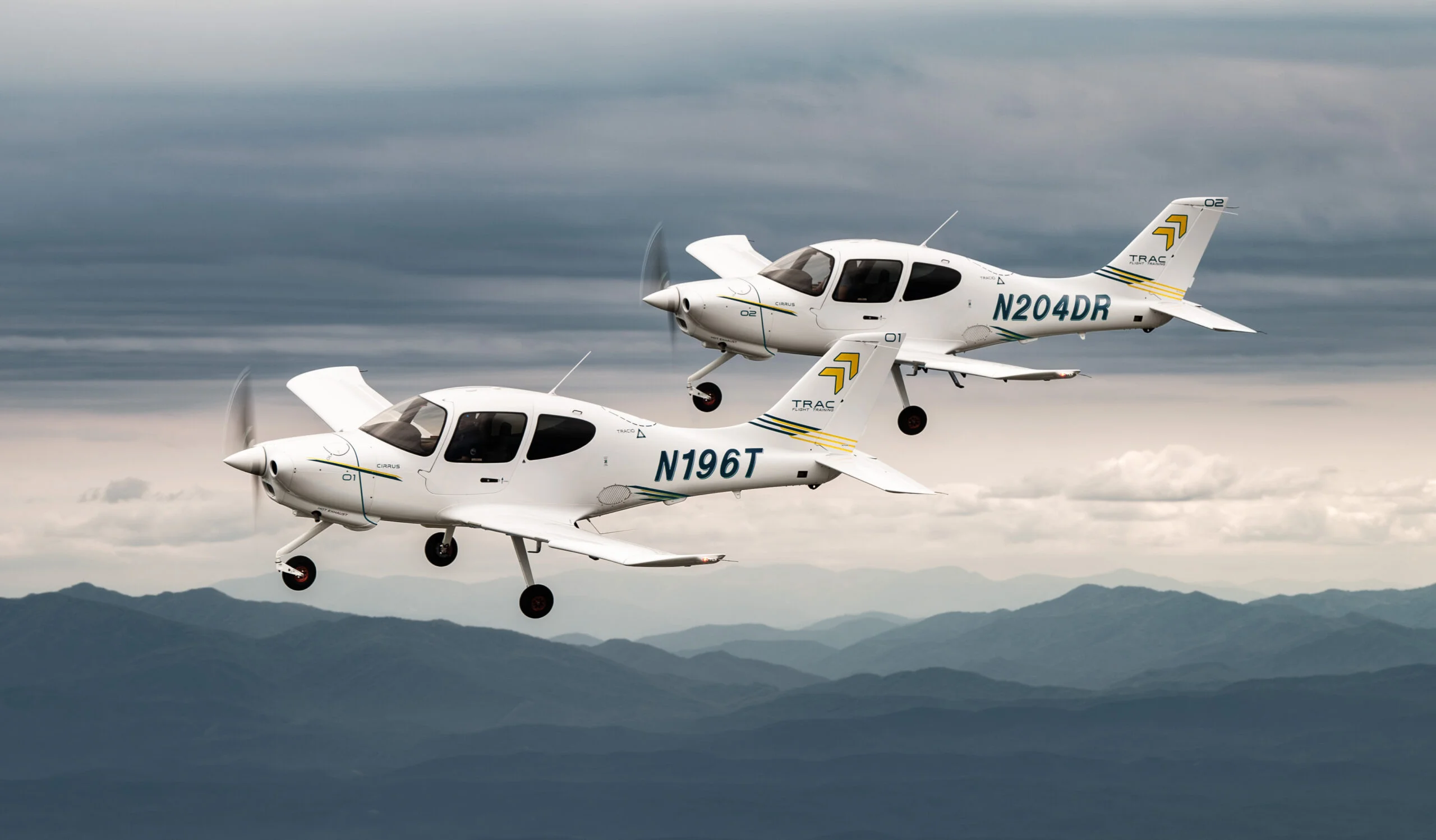
Cirrus Aircraft introduced the TRAC10 on July 6, 2026 — a clean-sheet, purpose-built training aircraft designed specifically for professional, collegiate, and career-oriented flight schools. The three-seat trainer is powered by a 160-horsepower turbocharged Rotax 916 iSc FADEC engine, features a Garmin flight deck and the Cirrus Airframe Parachute System (CAPS), burns as little as 5.9 gallons per hour at 65 percent cruise power, and starts at $499,900. Cirrus has already secured orders for more than 100 TRAC10 aircraft from 13 flight schools worldwide. U.S. deliveries begin in 2027, followed by international deliveries in 2028. The aircraft will be manufactured at Cirrus’s Duluth, Minnesota headquarters.
For an industry projecting demand for more than 130,000 new pilots in North America over the next decade, the TRAC10 is one of the most significant new-trainer launches in years. Here’s what makes it different and what it means for flight schools evaluating fleet renewal.
What the TRAC10 Actually Is
The TRAC10 is a clean-sheet design — not a training variant of an existing Cirrus SR-series aircraft. That distinction matters. Cirrus already produces training variants of its five-seat SR-series (TRAC20, TRAC22, TRAC22T) that flight schools have used for years. The TRAC10 is the first aircraft the company has designed from the ground up specifically for pilot training missions.
The core specifications:
- Engine: Turbocharged Rotax 916 iSc FADEC (Full Authority Digital Engine Control), 160 horsepower
- Fuel burn: As low as 5.9 gallons per hour at 65 percent power in cruise
- Fuel flexibility: 100LL avgas, unleaded 91/94, and select mogas blends
- Seats: Three — two front seats plus an elevated rear observer seat with configurable display
- Avionics: Garmin flight deck with Electronic Stability & Protection (ESP), Blue Level Button (LVL), and automatic database updates
- Safety systems: Cirrus Airframe Parachute System (CAPS), airline-style stick shakers, cuffed-wing design for spin resistance
- Fleet management: Cirrus IQ for wireless data transmission, third-party flight debrief integration, and fleet management dashboards
- Base price: $499,900
- Manufacturing: Duluth, Minnesota
- U.S. deliveries: Begin 2027
- International deliveries: Begin 2028
Photos released by Cirrus on launch day show an aircraft with registration N204DR — which FAA records list as an “SR10” model produced in 2025, suggesting the TRAC10 evolved from an earlier internal designation.
Why “Purpose-Built” Matters for Flight Schools
Cirrus CEO Zean Nielsen framed the TRAC10’s positioning directly. “Drawing on more than thirty years of designing, building, and supporting aircraft worldwide, the TRAC10 is our most deliberate answer yet to what professional flight schools need to succeed,” Nielsen said. “Our focus on safety, efficiency, connectivity, and reliability serves every stakeholder in the professional pilot training equation.”
Pat Waddick, Cirrus’s President of Innovation & Operations, was more specific about the design philosophy: “The TRAC10 is a complete reimagining of the modern training aircraft. Our team challenged decades-old norms and designed in industry-leading safety, durability, ergonomics, and operational efficiency.”
For flight schools, the “purpose-built” argument matters because most training aircraft on the market today weren’t designed for training. The Cessna 172 was designed in 1955 as a general-purpose personal aircraft. The Piper Cherokee family dates to 1960. Even more recent trainers like the Diamond DA20 and Tecnam P2010 are essentially adapted general aviation aircraft with training packages.
The TRAC10 flips that model. Every design choice — the three-seat layout for observational training, the elevated observer seat, the adjustable rudder pedals and seats for varying student heights, the FADEC engine that eliminates mixture and prop management complexity, the automatic database updates that eliminate monthly manual work — was made specifically to serve the flight training mission.
The Rotax 916 iSc Engine Decision
The most consequential design decision on the TRAC10 is the Rotax 916 iSc engine. Traditional GA trainers use Lycoming or Continental piston engines running on 100LL leaded avgas. The Rotax 916 iSc is a different architecture:
Turbocharged four-cylinder design producing 160 horsepower at a more efficient specific fuel consumption than legacy air-cooled engines. Rotax engines are liquid-cooled, which improves cylinder head longevity and reduces heat-related maintenance.
FADEC (Full Authority Digital Engine Control) eliminates traditional pilot workload around mixture control, prop pitch, and manifold pressure management. Students learn to fly the airplane rather than manage engine parameters — reducing training complexity in the critical early hours.
Multi-fuel capability allows operation on 100LL avgas, unleaded 91/94 auto gas, and select mogas blends. This future-proofs the aircraft against the ongoing industry transition away from 100LL, which contains tetraethyl lead and is being phased out in favor of unleaded alternatives like G100UL.
Built-in redundancy in the electronic engine control provides multiple layers of protection against single-point failures — a critical consideration for aircraft that will accumulate thousands of hours annually in flight school service.
Efficiency advantage at 5.9 gallons per hour cruise burn is significantly better than comparable Lycoming O-320 or O-360 configurations. Over 500 flight hours per year, the fuel savings alone can total tens of thousands of dollars per aircraft.
For flight schools running fleets of 5 to 20 aircraft flying 800 to 1,200 hours annually per aircraft, these operational economics add up quickly.
Safety Systems Built for Student Pilots
The TRAC10 includes every major Cirrus safety innovation plus several designed specifically for the training environment:
Cirrus Airframe Parachute System (CAPS). The whole-airframe parachute system standard on every Cirrus aircraft since 1998. As of 2026, worldwide Cirrus fleet flight time exceeds 19 million hours, and 290 people have returned home safely as a result of CAPS deployment. CAPS won Cirrus the Robert J. Collier Trophy in 2017, aviation’s most prestigious annual honor.
Electronic Stability & Protection (ESP). A Garmin system that prevents the aircraft from exceeding ascent, descent, and bank limits. For student pilots still developing the muscle memory to recognize and correct unusual attitudes, ESP is a genuine safety net.
Blue Level Button (LVL). A single-button system that automatically returns the aircraft to straight-and-level flight. Designed for spatial disorientation recovery or workload overload situations.
Airline-style stick shakers. Vibration warnings on the control stick when the aircraft approaches stall — providing tactile warning that supplements the traditional stall horn. Airline pilots have used this technology for decades; the TRAC10 brings it to ab-initio training.
Cuffed-wing design. The wing leading edge is contoured to promote spin resistance and maintain aileron authority at low speeds. This directly addresses one of the highest-risk categories in student pilot training — inadvertent stalls during traffic pattern operations.
Together, these systems represent the most comprehensive integrated safety package ever offered in a purpose-built trainer.
Cirrus IQ: The Fleet Management Backbone
Cirrus IQ is arguably as important to flight schools as the airframe itself. The system wirelessly transmits aircraft data — engine parameters, fuel and oil levels, coolant temperatures, maintenance interval tracking — to a fleet management dashboard accessible by school operations staff.
The practical benefits for a flight school:
- Real-time fleet visibility. Chief pilots and dispatch can see aircraft status without physically inspecting each airframe
- Predictive maintenance. Trending data catches problems before they become deferrals or unscheduled maintenance events
- Integration with third-party debrief tools. Instructors and students can review flight data through platforms like CloudAhoy, ForeFlight, or Garmin Pilot
- Automatic database updates. No more monthly SD card swaps to update navigation databases — the aircraft handles it wirelessly
For flight schools operating 10 to 20 aircraft, Cirrus IQ replaces the manual coordination effort of multiple maintenance managers, dispatch staff, and IT teams. It’s a competitive advantage that goes beyond airframe capabilities.
The 100-Order Signal
Cirrus disclosed at launch that it has already secured orders for more than 100 TRAC10 aircraft from 13 professional flight schools worldwide. That’s a substantial vote of confidence from launch customers who committed to the platform before deliveries began.
The 100-order backlog matters because:
Flight schools rarely take risks on new aircraft. The economics of buying, financing, insuring, and integrating a new type into a fleet are significant. Schools that committed to the TRAC10 pre-launch did so after Cirrus consultations, prototype demonstrations, and internal ROI analysis. Their willingness to commit reflects confidence in Cirrus’s ability to deliver.
13 schools across geographies means diverse validation. Both U.S. and international customers signed on, suggesting the design meets flight training needs across regulatory and operating environments.
Production ramp-up should be smoother. With 100 orders in the book, Cirrus can plan production, supplier commitments, and staffing with confidence. This reduces the risk of the delivery delays that have plagued other new-aircraft programs.
Cirrus has not disclosed the identities of the 13 launch customers, but they likely include a mix of major U.S. flight training organizations (potentially including ATP Flight School, CAE, and university programs like UND Aerospace and Embry-Riddle), plus international operators in Europe, the Middle East, and Asia.
Where the TRAC10 Fits in the Cirrus Ecosystem
The TRAC10 is now one of five aircraft in the Cirrus training portfolio:
- TRAC10 (new, 2027 delivery) — clean-sheet three-seat trainer with Rotax 916 iSc
- TRAC20 — training variant of the SR20 with the Lycoming IO-390 engine
- TRAC22 — training variant of the SR22 with the Continental IO-550-N engine
- TRAC22T — turbocharged training variant of the SR22T
- Vision Jet training aircraft — used for jet type ratings
For flight schools, the expanded portfolio means Cirrus can support students from ab-initio training through advanced ratings within a single manufacturer’s ecosystem — the way an integrated flight training organization actually operates.
Cirrus has confirmed it will continue producing the TRAC20, TRAC22, and TRAC22T variants; the TRAC10 is expanding the lineup, not replacing existing options.
The Talent Center Connection
The TRAC10 launch comes just 10 days after Cirrus opened its Cirrus Talent Center in Hermantown, Minnesota, on June 26, 2026 — a 22,000-square-foot workforce development facility designed for recruitment, training, and CAPS assembly. Cirrus is targeting more than 240 additional Duluth-based jobs in 2026-2027 and produced 800 aircraft over the past year.
The two announcements reinforce each other. Cirrus is simultaneously:
- Expanding its manufacturing workforce through the Talent Center to support production growth
- Expanding its product portfolio through the TRAC10 to serve a distinct market segment
- Investing in the entire flight training pipeline — from student pilots training in TRAC series aircraft to future Cirrus employees recruited through the Talent Center
Together, they signal that Cirrus is positioning itself as the central OEM for the coming decade’s pilot training expansion.
The Industry Context
The TRAC10 arrives at a specific moment in aviation’s workforce cycle:
- Boeing’s most recent forecast projects North America needs more than 130,000 new pilots over the next decade
- The FAA’s 2026 Air Traffic Controller Workforce Plan targets 2,200 new controller hires in 2026 alone
- The FAA’s $26 million Aviation Workforce Development Grants (May 2026) fund pilot and maintenance technician training pipelines
- Bladen Community College’s aviation programs — North Carolina’s first community college ATC program launching spring 2027 — represents one of many new pipeline entries
- EAA AirVenture 2026’s WomenVenture Design-Build-Test theme highlights how the industry is investing in workforce diversity across every discipline
For flight schools, meeting projected demand requires modern, efficient, safe fleet capacity. The TRAC10 is Cirrus’s answer to that market need — a purpose-built platform designed to reduce operating costs, improve safety outcomes, and scale training operations without adding proportional workforce or maintenance overhead.
The Bottom Line
The Cirrus TRAC10 is one of the most consequential new-trainer launches in a generation. It’s the first clean-sheet aircraft Cirrus has designed specifically for flight training. Its Rotax 916 iSc engine offers meaningful fuel efficiency and multi-fuel flexibility. Its CAPS, ESP, Blue Level Button, and stick shaker safety package sets a new standard for student pilot protection. Its Cirrus IQ fleet management system addresses the operational needs of professional flight schools rather than individual owner-operators.
At $499,900 with U.S. deliveries beginning in 2027, the TRAC10 is priced at a premium to legacy trainers — but the fuel efficiency, safety systems, and fleet management capabilities may deliver total-cost-of-ownership advantages that offset the higher acquisition cost over 10-year operating cycles.
With 100+ orders from 13 flight schools already secured, the market has voted with pre-launch commitments. For flight schools evaluating fleet renewal decisions in 2026 and beyond, the TRAC10 is now a serious option to consider alongside the Cessna Skyhawk, Piper Archer, Diamond DA20, and Tecnam P2010 — and Cirrus is betting that its purpose-built architecture will make it the preferred choice for the next generation of professional pilot training.
Frequently Asked Questions
What is the Cirrus TRAC10? The Cirrus TRAC10 is a clean-sheet, three-seat, purpose-built training aircraft introduced by Cirrus Aircraft on July 6, 2026, designed specifically for professional, collegiate, and career-oriented flight schools. It is powered by a 160-horsepower turbocharged Rotax 916 iSc FADEC engine, features a Garmin flight deck, includes the Cirrus Airframe Parachute System (CAPS), and starts at $499,900. Cirrus has secured over 100 orders from 13 flight schools worldwide.
When will the Cirrus TRAC10 be delivered? U.S. deliveries of the TRAC10 begin in 2027, with international deliveries following in 2028. The aircraft will be manufactured at Cirrus’s headquarters at Duluth International Airport in Duluth, Minnesota. Cirrus has not published specific delivery quantities per year, but the 100+ order backlog will be filled across the initial delivery period.
How much does the Cirrus TRAC10 cost? The Cirrus TRAC10 base price is $499,900 (approximately $500,000). This positions it at a premium to legacy trainers like the Cessna Skyhawk and Piper Archer but at a lower price point than higher-end options like the TRAC20 or TRAC22. Total-cost-of-ownership advantages from fuel efficiency and integrated safety systems may offset the higher acquisition cost over the aircraft’s operating life.
What engine does the Cirrus TRAC10 use? The TRAC10 is powered by a 160-horsepower turbocharged Rotax 916 iSc FADEC engine. The engine burns as little as 5.9 gallons per hour at 65 percent cruise power and can operate on multiple fuels including 100LL avgas, unleaded 91/94 auto gas, and select mogas blends. The FADEC (Full Authority Digital Engine Control) system automates mixture and power management, reducing pilot workload for student pilots.
How does the TRAC10 differ from other Cirrus TRAC aircraft? The TRAC10 is Cirrus’s first clean-sheet, purpose-built training aircraft. Existing TRAC aircraft (TRAC20, TRAC22, TRAC22T) are training variants of the five-seat SR-series personal aircraft. The TRAC10 is a smaller three-seat design specifically engineered for the flight training mission, with a Rotax engine (instead of the Lycoming/Continental engines in the TRAC20/22 series) and features like the elevated rear observer seat and Cirrus IQ fleet management integration.
Sources:
- Cirrus Aircraft — Cirrus Introduces the TRAC10: A Purpose-Built Aircraft Engineered to Transform Professional Flight Training (July 6, 2026)
- FlightGlobal — Cirrus Developing Clean-Sheet ‘TRAC10’ Trainer (July 6, 2026)
- AeroTime — Cirrus Launches TRAC10, a New Light Aircraft for the Flight Training Market (July 6, 2026)
- Business Wire (via Las Vegas Sun) — Cirrus Introduces the TRAC10 (July 6, 2026)
- AFM — Cirrus Introduces TRAC10 Flight Training Aircraft With 100+ Orders from FTOs (July 8, 2026)