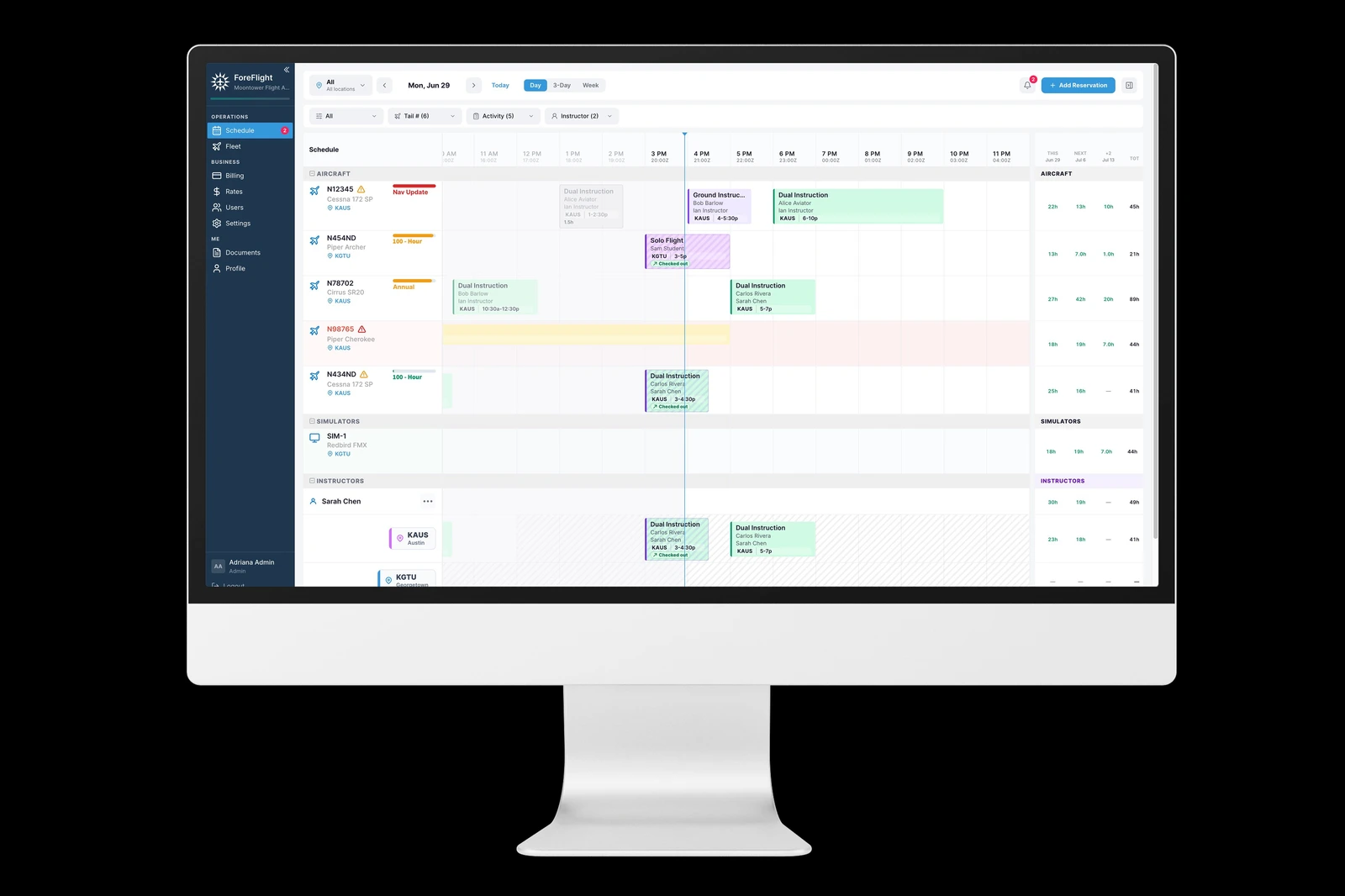
Jeppesen ForeFlight unveiled its aviation-centric AI strategy on July 1, 2026, introducing an agentic AI engine called Jeppesen ForeFlight Airflow and rolling out several new features that put artificial intelligence directly into the hands of general aviation pilots. Announced from Austin, Texas, the release includes three headline new capabilities: Clear Notams for AI-summarized NOTAM briefings, a ChatGPT-based AI Connector that lets pilots query their ForeFlight data through OpenAI’s ChatGPT via a Model Context Protocol (MCP) server, and Scheduler — a flight school scheduling platform integrated with ForeFlight Mobile. Additional AI expansion to Google Gemini and Anthropic Claude is planned, giving pilots the ability to choose their preferred AI provider.
For an industry where 75 percent of the world’s pilots rely on Jeppesen ForeFlight tools, this launch represents one of the more consequential AI deployments in general aviation to date. Here’s what’s actually in the release and what it means for pilots.
What Jeppesen ForeFlight Airflow Is
Jeppesen ForeFlight Airflow is the foundational agentic AI engine underpinning the company’s broader AI strategy across every aviation segment — general aviation, commercial, business, and military.
The company describes Airflow as combining three elements:
- Commercially available data — the standard datasets ForeFlight already uses (weather, NOTAMs, charts, airport data, airspace boundaries)
- Segregated proprietary customer data — each operator’s specific fleet, crew, and flight information kept separate and secure
- Extensive domain knowledge — safety, certification expertise, and contextual reasoning across every aviation market
The engine is built on an open architecture designed to be model-agnostic, meaning customers can integrate their own AI agents, use third-party AI solutions, or deploy Jeppesen ForeFlight’s native agents. The first product built on Airflow is the ForeFlight AI Connector, currently in preview for General Aviation users.
Brad Surak, CEO of Jeppesen ForeFlight, framed the differentiation directly in the announcement.
“General AI is confident, but often wrong. In our industry, these mistakes cascade into costly, dangerous, or catastrophic outcomes,” Surak said. “Artificial intelligence is not enough for this industry, we need aviation intelligence: the assurance that the right data, right context, and right reasoning are applied every time, and always cross-checked and filtered through industry safety and governance protocols.”
Surak also emphasized how ForeFlight has positioned itself for the transition. “We have helped the industry evolve from paper to digital to mobile, and we are bringing to market a highly differentiated AI offering in Jeppesen ForeFlight Airflow that customers can deploy on their own terms and timelines, at significantly lower IT costs than previous industry transitions.”
The Five AI Principles Jeppesen ForeFlight Says Matter
The company defined five specific principles that differentiate its aviation AI from general-purpose AI:
1. Reasons in context. Trusted workflows that grasp how the aviation industry actually operates — not just what tended to happen last time.
2. Reasons from certified inputs. Every output carries the regulatory authority and certified accuracy of Jeppesen ForeFlight’s longstanding aviation data.
3. Carries a visible why-trail. Every recommendation reveals the underlying causal logic, from specific inputs and operational constraints through evaluated alternatives and associated uncertainty. This auditable decision trace creates a continuous improvement cycle.
4. Operates inside the customer’s Safety Management System (SMS). Built on the safety framework aviation already runs on via ForeFlight’s patent-pending Aviation Intelligence SMS (AI-SMS).
5. Human-centered judgments. AI handles the volume; customers select how much automation they need, with humans remaining in control of decision-making wherever necessary.
Together, these principles represent Jeppesen ForeFlight’s positioning against the risk that general-purpose AI (like ChatGPT alone) will hallucinate or make dangerous errors in the aviation context.
Feature 1: Clear Notams
Clear Notams is the AI-powered NOTAM summarization feature that pilots have been asking for since the modern NOTAM system was introduced. NOTAMs — Notices to Air Missions — are the FAA’s mechanism for alerting pilots to information critical to a flight, but they’ve long been criticized for their dense, all-caps, jargon-heavy format that makes actual comprehension difficult.
The problem is well-documented. FAA analysis and multiple safety studies have found that pilots often fail to identify or properly interpret critical NOTAMs because of the sheer volume and format complexity. In 2023, the FAA’s NOTAM system experienced a nationwide outage that ground-stopped U.S. commercial aviation for hours, focusing renewed attention on both the technical infrastructure and the user experience of NOTAMs.
Clear Notams uses AI to summarize NOTAM briefings, extract the most safety-critical information, and present it in plain-language format. For pilots who currently spend 15-30 minutes decoding NOTAMs for a single cross-country flight, the time savings and improved comprehension could be substantial.
The feature builds on ForeFlight’s earlier Graphical NOTAMs in FliteDeck Pro (announced April 2026), which transformed dense NOTAM text into map-linked visual information for airline pilots. Clear Notams extends the AI-powered NOTAM improvement concept to the general aviation Mobile app.
Feature 2: ForeFlight AI Connector (ChatGPT Integration)
The AI Connector is the most technically novel feature in the July 1 release. It’s an MCP server — Model Context Protocol server — that connects ForeFlight Mobile to a pilot’s existing OpenAI ChatGPT environment.
For pilots unfamiliar with MCP: it’s an emerging protocol that lets AI applications like ChatGPT securely access external data sources and tools. In ForeFlight’s implementation, MCP means that a pilot can ask ChatGPT questions about their own ForeFlight data — logbook entries, flight plans, aircraft types flown, historical flight records — and get responses that integrate their personal aviation information with ChatGPT’s broader capabilities.
Example use cases include:
- Logbook analysis. “How many hours have I flown in the last 12 months, and what percentage was in the Cessna 172?”
- Flight plan queries. “What flight plans do I have saved for my trip to Colorado this month?”
- Refueling optimization. “Given my usual routes and typical fuel prices, what would be a good refueling strategy for the next quarter?”
- Cross-referencing. “Compare my recent instrument approaches at KSAF and KABQ.”
The company explicitly plans to expand the AI Connector to additional AI platforms. “The company intends to expand this feature to other popular AI applications such as Google’s Gemini and Anthropic’s Claude so users can use the experience layer of their choosing,” according to the announcement.
For pilots who already use ChatGPT, Claude, or Gemini in other parts of their life, this integration means they can bring their AI assistant into flight planning without adopting a new tool or workflow.
Feature 3: Scheduler for Flight Schools
Scheduler is a flight school scheduling platform integrated with ForeFlight Mobile. The specific mechanics haven’t been fully detailed in early press coverage, but the strategic intent is clear: give flight schools a scheduling system that natively connects to the same tool pilots and instructors already use for flight planning, navigation, and logbook management.
For flight schools, integrated scheduling addresses a longstanding pain point. Most flight schools currently juggle multiple systems — a scheduling tool (often Flight Schedule Pro, Aviation Scheduler, or in-house solutions), a separate flight planning tool (ForeFlight or Garmin Pilot), a separate logbook tool (Foreflight logbook, MyFlightbook, or paper), and various administrative tools. Consolidating scheduling into ForeFlight reduces the number of platforms flight schools and their students need to manage.
For students and instructors, the value proposition is convenience: reservations, flight planning, in-flight tools, and logbook entries all happening in a single app. For schools, the AI dimension likely extends to optimization — matching students, instructors, aircraft, and weather windows more efficiently than manual scheduling.
Why This Announcement Matters
Several factors combine to make this a significant industry moment:
Scale. Jeppesen ForeFlight tools are used by more than 75 percent of the world’s pilots. What ForeFlight does with AI shapes how the aviation industry engages with AI more broadly.
Post-Boeing strategic pivot. Jeppesen ForeFlight was spun off from Boeing in November 2025 to private equity firm Thoma Bravo. The AI strategy is the company’s most substantial post-spinoff strategic move and a key element of its independent growth thesis.
Model-agnostic architecture. By explicitly supporting OpenAI, Google, and Anthropic AI models, Jeppesen ForeFlight avoids locking pilots into a single AI provider. This matters because aviation professionals tend to be careful about tool dependencies, and giving them choice reduces adoption friction.
Safety-first AI framing. The five-principle differentiation, the AI-SMS framework, and the “visible why-trail” concept respond directly to the aviation industry’s core concern about AI: that black-box systems making safety-critical recommendations without transparency create liability and safety exposure.
Regulatory backdrop. The FAA has been building AI oversight capacity throughout 2025 and 2026, and Jeppesen ForeFlight’s positioning as an aviation-native AI provider is designed to fit within that regulatory framework rather than fight it.
The Post-Boeing Context
Understanding why this announcement lands so heavily requires understanding what happened to Jeppesen ForeFlight in late 2025 and early 2026.
Jeppesen — the aeronautical charting and data company founded in 1934 — was acquired by Boeing in 2000. ForeFlight — the general aviation mobile app maker — was acquired by Boeing in 2019. In November 2025, Boeing divested both to private equity firm Thoma Bravo, which combined them into a single company operating as Jeppesen ForeFlight.
The immediate post-spinoff period brought two controversial moves: layoffs of employees and price increases on ForeFlight subscriptions. Both actions drew criticism from the aviation community and industry press, with concerns that private equity ownership would prioritize short-term profits over product quality.
The AI strategy announcement on July 1, 2026 is Jeppesen ForeFlight’s answer to those concerns — a substantial investment in long-term product capability that repositions the company as an aviation technology leader rather than a financial-engineering target. Whether the strategy delivers on its promise will determine how the industry views both the company and private equity ownership of critical aviation infrastructure.
What Pilots Should Do Now
For pilots evaluating whether these new features are worth attention:
If you use ForeFlight Mobile: The Clear Notams feature is being rolled out to general aviation users and doesn’t require any new setup. Watch for its appearance in your app.
If you’re interested in the AI Connector: The feature is in preview for General Aviation users. Interested operators should contact their Jeppesen ForeFlight account executive or visit ai.jeppesenforeflight.com for early co-development access.
If you run or attend a flight school: The Scheduler feature is worth investigating for its potential to consolidate scheduling, flight planning, and student tracking into a single platform. Compare its capabilities against existing tools before committing.
If you already use ChatGPT, Claude, or Gemini: The MCP server architecture means you can start experimenting with AI-assisted aviation workflows using tools you already know. This is one of the lower-friction ways to introduce AI into your personal flight operations.
If you’re skeptical of AI in aviation: The five-principle framework and AI-SMS approach are worth reading in detail. Whether the reality matches the marketing will be revealed through actual use. In the meantime, the auditability commitments and “visible why-trail” concept represent meaningful transparency claims that industry observers can hold the company accountable to.
How This Fits the Broader Aviation AI Landscape
Jeppesen ForeFlight’s Airflow launch is one of several major AI initiatives across aviation in 2026:
- FAA rulemaking on AI oversight progressing through multiple parallel workstreams
- eVTOL Integration Pilot Program using AI for airspace integration testing
- Cirrus Aircraft Talent Center (June 2026) investing in workforce for AI-enabled aircraft development
- Boeing’s post-737 MAX safety modernization including AI-informed system safety assessments
- The FAA’s Part 25 Certification Modernization NPRM (June 2026) creating regulatory infrastructure for AI-enabled aircraft systems
The pattern is clear: 2026 is the year aviation moves from cautious AI experimentation to substantive AI deployment across pilot tools, aircraft systems, air traffic management, and regulatory oversight. Jeppesen ForeFlight’s announcement is one of the most consumer-facing pieces of that shift.
The Bottom Line
Jeppesen ForeFlight’s July 1, 2026 announcement — introducing the Airflow AI engine and rolling out Clear Notams, the ChatGPT-based AI Connector, and the Scheduler flight school platform — represents one of the more consequential AI product launches in general aviation to date. For pilots, the immediate impact depends on which of the three new features fits your operation. For the industry, the significance is broader: this is the moment aviation’s largest tools provider commits to AI as a strategic priority, with a clearly articulated safety-first framework and a model-agnostic architecture that supports OpenAI, Google Gemini, and Anthropic Claude.
For an industry that has spent years worrying about the risks of introducing AI into aviation, Jeppesen ForeFlight’s approach — combining domain expertise, safety governance, and user choice — offers a template for what responsible AI deployment could look like. Whether the execution matches the framing will determine whether this becomes a defining moment in aviation’s AI transition or a cautionary tale.
Either way, the tools 75 percent of pilots use every day are about to change substantially.
Frequently Asked Questions
What are Jeppesen ForeFlight’s new AI features? On July 1, 2026, Jeppesen ForeFlight announced its aviation-centric AI engine, Airflow, along with three new features: Clear Notams (AI-summarized NOTAM briefings), the ForeFlight AI Connector (an MCP server connecting ForeFlight to OpenAI ChatGPT with planned expansion to Google Gemini and Anthropic Claude), and Scheduler (an integrated flight school scheduling platform).
What is the ForeFlight AI Connector? The ForeFlight AI Connector is a Model Context Protocol (MCP) server that connects ForeFlight Mobile to a pilot’s existing OpenAI ChatGPT environment. It lets pilots query their personal ForeFlight data — logbook entries, flight plans, aircraft types flown, and refueling options — through ChatGPT. The feature is currently in preview for General Aviation users, with planned expansion to Google Gemini and Anthropic Claude.
What is Clear Notams? Clear Notams is a new Jeppesen ForeFlight feature that uses AI to summarize NOTAM briefings in plain-language format, extracting the most safety-critical information from the dense, jargon-heavy default NOTAM presentation. The feature is being rolled out to ForeFlight Mobile users as part of the July 2026 AI release.
What is Jeppesen ForeFlight Airflow? Jeppesen ForeFlight Airflow is the company’s agentic AI engine, launched July 1, 2026. It combines commercially available data, segregated proprietary customer data, and aviation domain knowledge to provide safety-focused AI reasoning across every aviation segment. Airflow is built on an open, model-agnostic architecture, and the company is releasing General Aviation features first with Commercial, Business, and Military applications planned for later in 2026 and beyond.
Will Jeppesen ForeFlight support Anthropic Claude and Google Gemini? Yes. The initial ForeFlight AI Connector integrates with OpenAI ChatGPT, but Jeppesen ForeFlight has publicly committed to expanding the feature to other popular AI applications, specifically naming Google’s Gemini and Anthropic’s Claude. The stated goal is to let users choose the AI provider they prefer.
Sources:
- GlobeNewswire — Jeppesen ForeFlight Unveils Agentic AI Strategy and Engine for the Aviation Industry (July 1, 2026)
- The Air Current — Untangled from Boeing, Jeppesen ForeFlight Bets Big on AI
- NBAA — Jeppesen ForeFlight VP: Flight Data Plus AI Will Strengthen Aviation Safety (March 2026)
- Aviation International News — Jeppesen ForeFlight Releases Graphical Notams in FliteDeck Pro (April 2026)
- Jeppesen ForeFlight — Official Site