
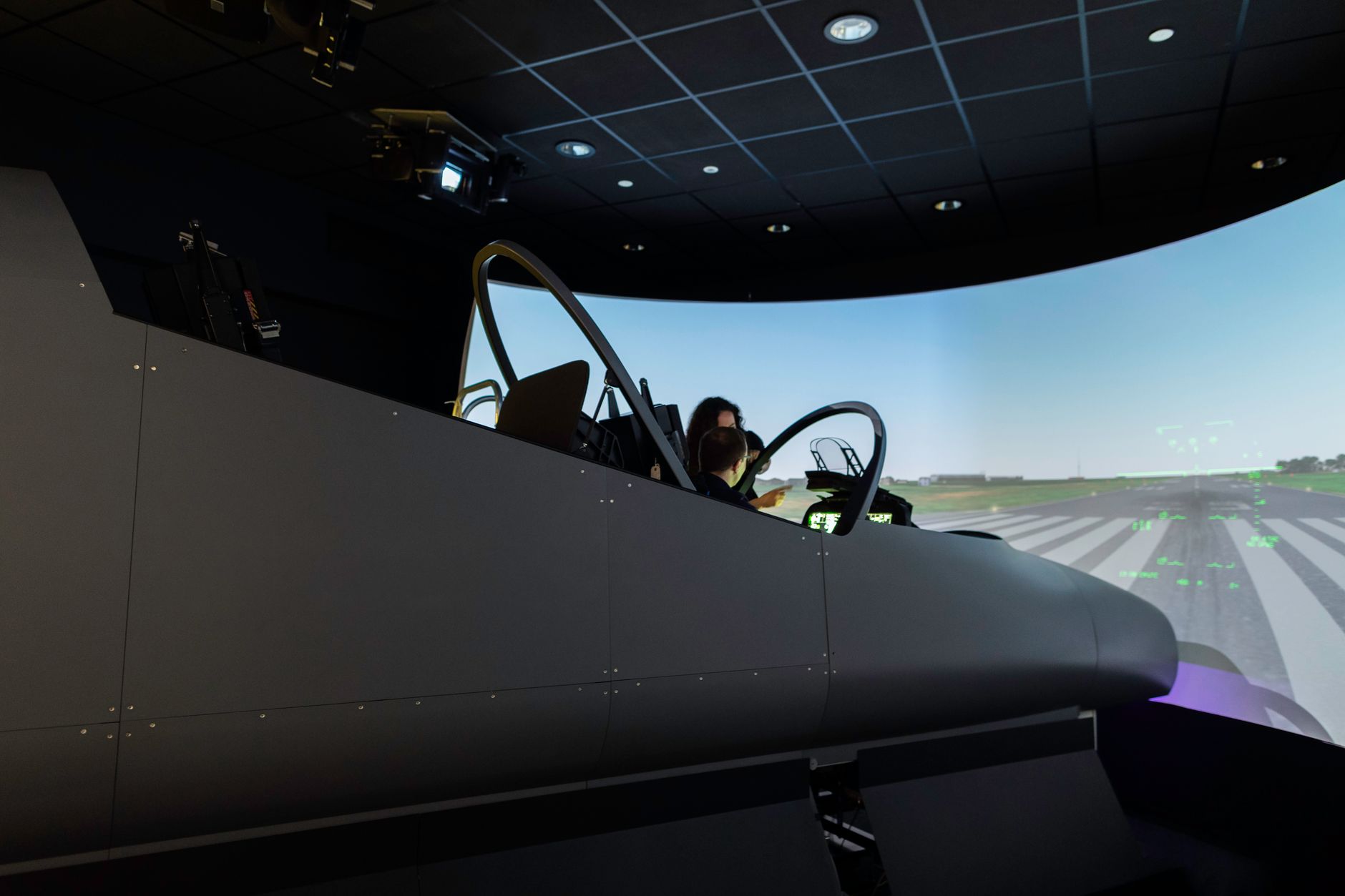
A recurring debate in general aviation circles asks the wrong question. The framing usually goes: now that home simulators have become so capable, can sport- or private-pilot-level flight time combined with thousands of hours in Microsoft Flight Simulator or X-Plane really replace what a formal training program offers? It’s a tempting question to argue about on pilot forums, but professional aviation answered it years ago and moved on. Every airline pilot, every Part 135 charter captain, every corporate jet pilot recurrently trains in a simulator — and those operations have the safety records to show for it.
The real question for general aviation is different and much more practical. Why do we still treat simulator training as optional or supplemental for early-stage students and private pilots, when the part of aviation with the best safety record has built its training culture around exactly that kind of training? The argument worth having isn’t “sim versus real airplane.” It’s about closing the gap between how professionally trained pilots learn to fly safely and how the rest of general aviation does.
The case rests on two distinct, well-documented capabilities of modern simulators: they are excellent at teaching the routine — instrument scan, automation, procedures — and they are the only practical place to rehearse the crises that no instructor would ever introduce in a real aircraft. The first capability gets discussed often. The second is exactly where GA has the biggest room to grow, and the accident record shows why.
What Modern Simulators Genuinely Teach
A great deal of aviation knowledge and skill can be developed effectively in a simulated environment. Navigation concepts, instrument interpretation, route planning, procedural operations, and the handling of routine abnormal situations can all be practiced repeatedly without weather, fuel, or wear-and-tear constraints.
The FAA itself has formally recognized how far these devices have come. In its 2016 rulemaking expanding training-device credit, the agency noted that modern Aviation Training Devices can simulate variable winds, ceilings, and visibility, along with icing, turbulence, and hundreds of distinct equipment-failure scenarios — capabilities that simply did not exist in earlier-generation devices. The 2008 advisory circular AC 61-136 created the two categories most general aviation pilots use today: the Basic Aviation Training Device and the Advanced Aviation Training Device.
Working pilots and CFIs routinely acknowledge that students with long-term simulator exposure often advance faster through formal training than peers without that background. During that same FAA rulemaking, AOPA argued that simulator training makes instrument instruction safer and more effective, and Redbird Flight Simulations made the point that the device is the place to learn, ask questions, and make mistakes, while the aircraft is where the student demonstrates what they’ve already internalized. The transfer of instrument scan, autopilot and automation management, and GPS-navigator and glass-cockpit programming from ground devices to real aircraft is well-documented in aviation education research.
This is the part of simulator value general aviation already understands reasonably well, even if the community doesn’t fully act on it. Students with prior sim exposure progress faster. CFIs who pair a sim with the airplane get better results. The data is unambiguous. But this is also the easier half of the problem. Success — flying in normal weather, with functioning equipment, following standard procedures — is the most accessible part of aviation. Real aircraft and simulators both offer plenty of opportunity to practice it.
What is genuinely difficult, and what determines whether a pilot is truly prepared, are the situations that almost never happen but cause catastrophic consequences when they do. That is the half of simulator value general aviation has been slowest to embrace — and it is exactly the half airline and corporate aviation has organized its training culture around.
The Devices, From BATD to Full Flight Simulator
Not all “simulators” are the same in the FAA’s eyes, and the differences matter for what a pilot can actually log and learn. Approved devices fall into a rough ladder of fidelity:
- BATD (Basic Aviation Training Device): An entry-level approved device with a generic cockpit and basic instruments, well suited to foundational procedural work and early instrument practice. Under current guidance it can be credited for a limited amount of instrument time toward the instrument rating and a small amount toward the private pilot certificate. BATDs are common in homes and smaller flight schools, with examples from manufacturers like Redbird Flight Simulations, RealSimGear, and Gleim.
- AATD (Advanced Aviation Training Device): A higher-fidelity device that must represent a specific aircraft model, with a full instrument panel, navigation systems, and — importantly for this discussion — the ability to simulate every emergency procedure that carries a checklist in the aircraft’s flight manual. AATDs allow broader training credit, including more instrument time and credit toward commercial and ATP requirements under Part 141. Redbird’s full-motion FMX is a familiar AATD, and newer entrants such as True Course Simulations are bringing VR and mixed-reality cockpits into this space (configurations vary, so the device’s FAA Letter of Authorization defines exactly what can be logged).
- FTD (Flight Training Device): A full-size replica of a specific aircraft’s instruments, equipment, panels, and controls in an open or enclosed flight deck, graded by level. FTDs are a fixture of collegiate and professional programs — many university flight schools run Frasca or Redbird FTDs alongside their AATDs.
- FFS (Full Flight Simulator): The highest-fidelity tier, with full six-axis motion and the visual and systems realism required for airline-style type-rating and recurrent training. FFS devices, built by manufacturers such as CAE and operated at centers like FlightSafety International and SimCom, sit at the top of the ladder and are where complex-aircraft and turbine pilots do much of their crisis work.
Both ATD categories require an FAA Letter of Authorization, valid for five years, that spells out exactly how each device may be used. One practical caveat: time logged in a BATD or AATD applies only to the specific credits listed in that letter and does not count toward total flight time, whereas higher-tier FTD and FFS time used under Part 142, 121, or 135 programs is treated differently. The fidelity ladder matters, but as the rest of this article argues, the scenarios a school chooses to run on a device often matter more than the tier of the device itself.
The Part You Can’t Practice in the Air
The accident record is remarkably consistent about where general aviation pilots get hurt. According to the AOPA Air Safety Institute’s most recent Richard G. McSpadden Report (formerly the Nall Report), roughly 70 percent of non-commercial fixed-wing accidents are pilot-related, and loss of control in flight remains the single leading causal factor. The institute’s safety analysts have noted that this pattern holds year after year, with weather-related accidents remaining the most lethal category.
This is not a story of a dangerous industry getting worse. In the most recent year with complete data, general aviation accidents declined to about 1,097, of which 186 were fatal — a fatal accident rate of roughly 0.65 per 100,000 flight hours. The FAA’s 2025 General Aviation Safety Fact Sheet reports that 2024 produced the lowest GA fatal accident rate since the agency began tracking it in 2009. The long-term trend is genuinely encouraging, and training is a meaningful part of why.
But the accidents that still happen cluster around a familiar set of crisis scenarios — and almost none of them can be safely rehearsed in a real airplane:
- Engine failures during takeoff, initial climb, and other critical phases
- In-flight fires and electrical system anomalies
- Partial power loss and induction or carburetor icing
- Vacuum or electrical failures that remove attitude instruments in cloud
- Severe icing encounters beyond the aircraft’s capability
- Microbursts and wind shear on approach
- Stall and spin sequences during low-altitude maneuvering
- Inadvertent flight into instrument conditions for VFR-only pilots
That last category is worth dwelling on, because it is the clearest illustration of why crisis rehearsal matters. VFR into IMC is among the most lethal events in all of general aviation. The AOPA Air Safety Institute reports a fatality rate of about 86 percent for these accidents in non-commercial fixed-wing aircraft — and, sobering for anyone who assumes a rating is a shield, roughly one-third of them involve instrument-rated pilots. A frequently cited study found that non-instrument-rated pilots who blunder into cloud lose control of the aircraft in about 178 seconds. Other research has estimated that flying in instrument conditions makes a fatal outcome roughly 14 times more likely than the same flight in visual conditions.
No instructor can deliberately induce a vacuum failure in actual cloud. No flight school can introduce realistic wind shear on a training sortie. No examiner is going to fail an engine just after rotation over a populated area. The cost of practicing crisis in a real aircraft is the very crisis you are trying to learn to prevent. This is exactly where simulators stop being a convenience and become irreplaceable — and it is exactly the kind of training airline and corporate programs require recurrently while general aviation often leaves it to chance.
Why It Isn’t Just About Knowing the Procedure
If crisis response were only a matter of memorizing checklists, the case for repetitive simulator practice would be weaker. The research says it is not.
The FAA’s own Industry Training Standards (FITS) program was built on this realization. When investigators reviewed accidents in technically advanced aircraft, they traced the leading causes not to a lack of stick-and-rudder ability but to gaps in situational awareness, decision-making, and risk management. One body of FITS research estimated that more than half of fatal accidents can be attributed to poor decision-making rather than mechanical failure or raw handling error. The conclusion reshaped GA training philosophy: teach pilots to manage real-world scenarios, not just to pass a maneuvers-based practical test.
A landmark line of simulator research goes a step further and explains why a calm, rehearsed pilot outperforms a startled one. In a frequently cited motion-simulator study published in 2017, researchers sprang an unexpected aerodynamic stall on a group of airline pilots. About 78 percent of them made errors executing a recovery procedure they had practiced many times — purely because the event was a surprise rather than something they were braced for. A companion 2018 study in the journal Human Factors found that pilots trained on standardized, predictable scenarios developed skills that were comparatively “brittle”: they performed well on predictable tests but transferred poorly to genuinely novel emergencies.
The cognitive model behind this work, developed by Landman and colleagues, describes pilots as operating from mental “frames” — knowledge structures built from prior experience. A surprise event that doesn’t fit any existing frame momentarily disrupts performance, sometimes badly. The practical implication is direct: a pilot who has already seen a given crisis unfold many times in a simulator has a frame ready. A pilot seeing it for the first time at altitude does not.
A follow-up 2024 study, indexed in the National Library of Medicine, examined how trainees respond to unexpected events of varying urgency and reached a similar conclusion — that no amount of standardized training can fully cover the dynamic situations pilots face in real operations. The takeaway for simulator use is significant: a device that only recreates predictable scenarios, even with perfect cockpit fidelity, does not fully prepare a pilot. A device that introduces unexpected, unpredictable, and variable scenarios builds the adaptive judgment that real emergencies demand.
What the FAA, EASA, and NTSB Recommend
Regulators on both sides of the Atlantic have converged on the same conclusion: scenario-based simulator training focused on emergencies and abnormal situations is one of the most effective tools available to reduce accident rates.
In the United States, the FAA’s FITS framework, FAASTeam education materials, and the broader move toward proficiency-based currency under 14 CFR 61.56 all favor scenario-based instruction over rote procedural drills. The Pilot’s Handbook of Aeronautical Knowledge and the agency’s training-device credit rules increasingly treat the simulator as the proving ground for decision-making, not just hour-building.
EASA has invested heavily in the specific problem of startle and surprise. Its multi-year Startle Effect Management research project ran experiments in Boeing 737 and 747 simulators to develop and validate techniques pilots can use to recover composure mid-crisis — and European regulations now formally require surprise and startle elements to be built into upset prevention and recovery training. The agency’s guidance treats simulators as the appropriate venue for “managing startle and surprise in the cockpit,” explicitly recognizing this as a cognitive skill rather than a procedural one.
The NTSB’s Safety Alert SA-031, published in 2014 and revised in 2015, makes the case bluntly for an adjacent community: the board has investigated numerous accidents in which simulator training could have given pilots the knowledge and skills to handle in-flight emergencies and avoid maneuvering errors. The alert is helicopter-focused, but the airplane parallels are direct. For general aviation, the highest-value simulator scenarios mirror the NTSB’s own list of fatal-accident contributors:
- Post-takeoff engine failures and the impossible-turn decision
- Single-engine emergencies in light twins
- Stabilized-approach failures and runway excursions
- Recovery from unusual attitudes and unintended spins
- Degraded visual conditions and inadvertent IMC encounters
- Scenario-based training tailored to the pilot’s actual mission, terrain, and home airport
Every one of these can be recreated in a simulator at virtually zero risk. And every one of them is exactly the kind of training airline and corporate recurrent programs make routine.
Why Many Pilots Stay Calm in a Crisis
Pilots who handle emergencies well often share a characteristic that has little to do with bravery and everything to do with preparation. They have failed many times in simulators. They have watched how a crisis begins, how it escalates, and which decisions make it worse. When a real anomaly occurs, they may not have seen that exact case before, but they have enough reference experience — enough ready “frames,” in the language of the research — to make good judgment calls under stress.
This is the mechanism that simulator-based crisis training builds, and it is the mechanism that no real-aircraft training can replicate. A pilot can make wrong decisions in a simulator, watch the situation gradually spiral out of control, then reset and try a different approach. The pilot can experience the visual, auditory, and physiological cues of a crisis without bearing the actual consequences of that crisis.
Frasca Flight Simulation, one of the major training-device manufacturers, made the point well in a 2023 industry analysis: in a real aircraft, pilots tend to “rehearse” emergencies by talking through the steps and touching switches rather than actually working the problem, and they don’t experience the real cues of an unfolding emergency — so when a genuine one arrives, the knowledge doesn’t fully transfer. In a simulator, by contrast, the consequences of every decision play out completely. Instructors can freeze the scenario mid-action to debrief, then resume. Pilots can repeat the same maneuver several times in rapid succession without repositioning an aircraft. The result is deeper learning of decision-making, not just procedural compliance.
What This Means for Pilots, Schools, and Owners
Closing the gap between how general aviation and professional aviation use simulators starts with broadening the conversation. The dominant GA discussion focuses on fidelity — how realistic the cockpit feels, how complete the instruments are, how finely detailed the avionics are. Those things matter. But they are not the only question, and arguably not the most consequential one.
The more important question is: what crises can this simulator put a pilot through, and how often?
For student pilots, this means choosing training programs that integrate simulator work from day one rather than treating it as a supplement to “real” flying. That is how every airline pilot learns to fly, and it is how more GA students should be learning, too. Recurrent offerings like the Cirrus Annual Flight Review Course — which for 2026 explicitly focuses on stabilized approaches and go-arounds — reflect this shift toward decision-driven training, but the same logic applies just as strongly to a PPL student on their tenth lesson as to a turbine pilot on their tenth recurrent.
For flight schools, it means investing in the scenarios that run on the device, not just the hardware on the floor. A BATD, AATD, or FTD is only as valuable as the library of emergencies, system failures, weather encounters, and decision points it’s used to deliver. A glass-cockpit AATD that never simulates a vacuum failure or an inadvertent IMC encounter is leaving its most important capability unused — and notably, an AATD is required to be able to reproduce every emergency procedure in the aircraft’s flight manual, so that capability is already built in.
For aircraft owners and owner-pilots, it means choosing recurrent training that emphasizes crisis response over comfort flying — and the economics increasingly reward it. Insurers have watched claims fall as recurrent training rises, and many now offer premium discounts, commonly in the neighborhood of 10 percent, for pilots who complete annual simulator-based or recurrent training. Avemco’s Safety Rewards Program, for instance, provides premium credits for pilots who train beyond the FAA’s minimum flight-review requirement. Type-specific recurrent programs at full-flight-simulator providers like SimCom and FlightSafety International have long led on emergency-focused training, and Redbird- and True Course-equipped flight schools now bring scenario-rich practice within reach of the everyday GA pilot — including the one who simply books a simulator hour before a long cross-country into unfamiliar terrain.
For solo practitioners using home simulators, it means deliberately introducing failures and surprises into practice sessions rather than flying the same comfortable routes. Microsoft Flight Simulator, X-Plane, and similar platforms let users inject engine failures, weather changes, and system anomalies at random — turning a familiar flight into a meaningful crisis-practice session. The research on surprise suggests that this unpredictability is precisely what builds resilient skill.
The Bottom Line
The “can simulators replace real flight training” debate is a distraction. Professional aviation answered it long ago: simulators don’t replace real flying, but they sit alongside it as the place where pilots become genuinely safe rather than just legally certified. That model produces the airline and corporate safety records the rest of the industry envies. The reason general aviation lags is not that the technology isn’t ready, the research isn’t clear, or the regulators haven’t blessed it — it’s that GA culture still treats simulators as optional. Hobbyist gear. Something a student “uses” if the school happens to have one.
The reframing this article argues for is simple. Modern simulators do two distinct things. They build routine skills — instrument scan, navigation, automation management, standard procedures — that transfer well to real aircraft. And they rehearse the crises a pilot cannot practice in flight: the engine failure on takeoff, the vacuum loss in cloud, the wind shear on short final, the icing encounter that exceeds the airplane’s capability, the inadvertent slide from visual conditions into instrument ones that kills so many capable pilots within minutes. Both jobs matter. The second one is the one general aviation needs to take more seriously, earlier in the training arc, and more often after the checkride.
The essence of flight is not only the pursuit of success — it is also the avoidance of failure. Simulators serve both. They let a pilot get good at flying, and they let that pilot see what a crisis looks like before it actually arrives. When the real one comes, that pilot will not be meeting the situation for the first time. They will feel a flicker of familiarity: “This — I think I’ve been through something like this before.”
That is what simulators give. The question for general aviation isn’t whether they can replace flight time — it’s whether the community will start using them the way professional aviation always has.
Frequently Asked Questions
What is the value of flight simulator training? Simulators do two valuable things. They efficiently build routine skills — instrument scan, navigation, automation management, and standard procedures — and they let pilots safely rehearse emergencies that cannot be practiced in a real aircraft, such as engine failures, system malfunctions, severe weather, and inadvertent IMC encounters. NTSB and EASA guidance both emphasize this crisis-rehearsal function as one of the most safety-critical roles of flight simulation.
What’s the difference between a BATD, AATD, FTD, and FFS? They form a ladder of fidelity and training credit. A BATD (Basic Aviation Training Device) is an entry-level approved device with a generic cockpit, good for foundational and early instrument work. An AATD (Advanced Aviation Training Device) represents a specific aircraft, carries broader credit, and must be able to simulate every emergency in the aircraft’s flight manual. An FTD (Flight Training Device) is a full-size, levelled replica of a specific aircraft’s flight deck. An FFS (Full Flight Simulator) is the top tier, with full motion and the realism used for airline-style type ratings. Manufacturers span the range — Redbird Flight Simulations and True Course Simulations in the ATD space, Frasca for FTDs, and CAE-built full flight simulators at centers like FlightSafety and SimCom.
Can simulator training replace real flight training? This is the wrong question, and professional aviation has already moved past it. Airline, corporate, and Part 135 pilots all recurrently train in simulators — not because simulators replace flying, but because they sit alongside it and do something a real aircraft cannot: they let pilots safely rehearse engine failures, system malfunctions, severe weather, and inadvertent IMC encounters. The more useful question for general aviation is why we still treat simulator training as optional for early-stage students and private pilots, when the part of aviation with the best safety record has built its training culture around exactly that kind of training. The FAA recognizes training-device time toward certain requirements under 14 CFR Part 61 and Part 142.
What types of emergencies are best practiced in a simulator? For general aviation, the highest-value categories include engine failures during takeoff and climb, partial power loss, vacuum or electrical failures in instrument conditions, severe icing, wind shear, inadvertent IMC encounters for VFR pilots, and recovery from unusual attitudes and unintended spins. The AOPA Air Safety Institute reports that VFR into IMC alone is fatal in roughly 86 percent of cases — and none of these scenarios can be safely practiced in a real aircraft.
Why are unexpected events so hard to train for? Research on startle and surprise shows that a known procedure can fall apart when the triggering event is unexpected. In one motion-simulator study, about 78 percent of pilots made errors recovering from a stall they had practiced many times, simply because it was sprung on them. Studies in Human Factors (2018) and the National Library of Medicine (2024) found that standardized, predictable training produces “brittle” skills, while unpredictable and variable scenarios build the adaptive judgment real emergencies require.
How can general aviation pilots benefit from simulator crisis training? GA pilots can use home simulators (Microsoft Flight Simulator, X-Plane), BATD/AATD devices at flight schools, and type-specific recurrent programs to practice emergency scenarios well beyond what the FAA flight review requires. There’s a financial incentive, too: many aviation insurers offer premium discounts — often around 10 percent — for pilots who complete annual recurrent or simulator-based training, and programs such as Avemco’s Safety Rewards Program reward training beyond the minimum.
Sources:
- AOPA Air Safety Institute — The Richard G. McSpadden Report (formerly the Nall Report)
- AOPA — McSpadden Report Figure View (accident counts and rates)
- FAA — 2025 General Aviation Safety Fact Sheet
- AOPA Air Safety Institute — VFR into IMC: Avoidance and Escape
- AOPA — VFR into IMC / NTSB data analysis
- General Aviation News — VFR into IMC deadly for GA pilots in under three minutes (178-second finding)
- NTSB — Safety Alert SA-031: Safety Through Helicopter Simulators
- EASA — Startle Effect Management, Final Research Report (EASA_REP_RESEA_2015_3)
- The Influence of Surprise on Upset Recovery Performance in Airline Pilots (Landman et al., 2017)
- Human Factors (2018) — Training Pilots for Unexpected Events: The Advantage of Unpredictable and Variable Scenarios
- PMC — Dealing With Unexpected Events on the Flight Deck: A Conceptual Model of Startle and Surprise
- NCBI / Frontiers (2024) — Effects of Unexpected Event Urgency and Flight Scenario Familiarity on Pilot Trainees
- FAA — FITS Research and Studies (scenario-based training effectiveness)
- Federal Register — Aviation Training Device Credit for Pilot Certification (ATD capabilities, AC 61-136)
- FAA — Approved Aviation Training Devices (ATD) list
- NJ Aero Club — The Different Kinds of Simulators Explained: BATD, AATD, FFS, FTD
- Redbird Flight Simulations — AATD product line
- Frasca Flight Simulation — Scenario-Based Training: Leveraging Simulators to Maximize Safety
- Avemco — Recurrent Training and Insurance (Safety Rewards Program)



One thought on “Why General Aviation Undervalues Simulator Training — and What Professional Pilots Already Know”