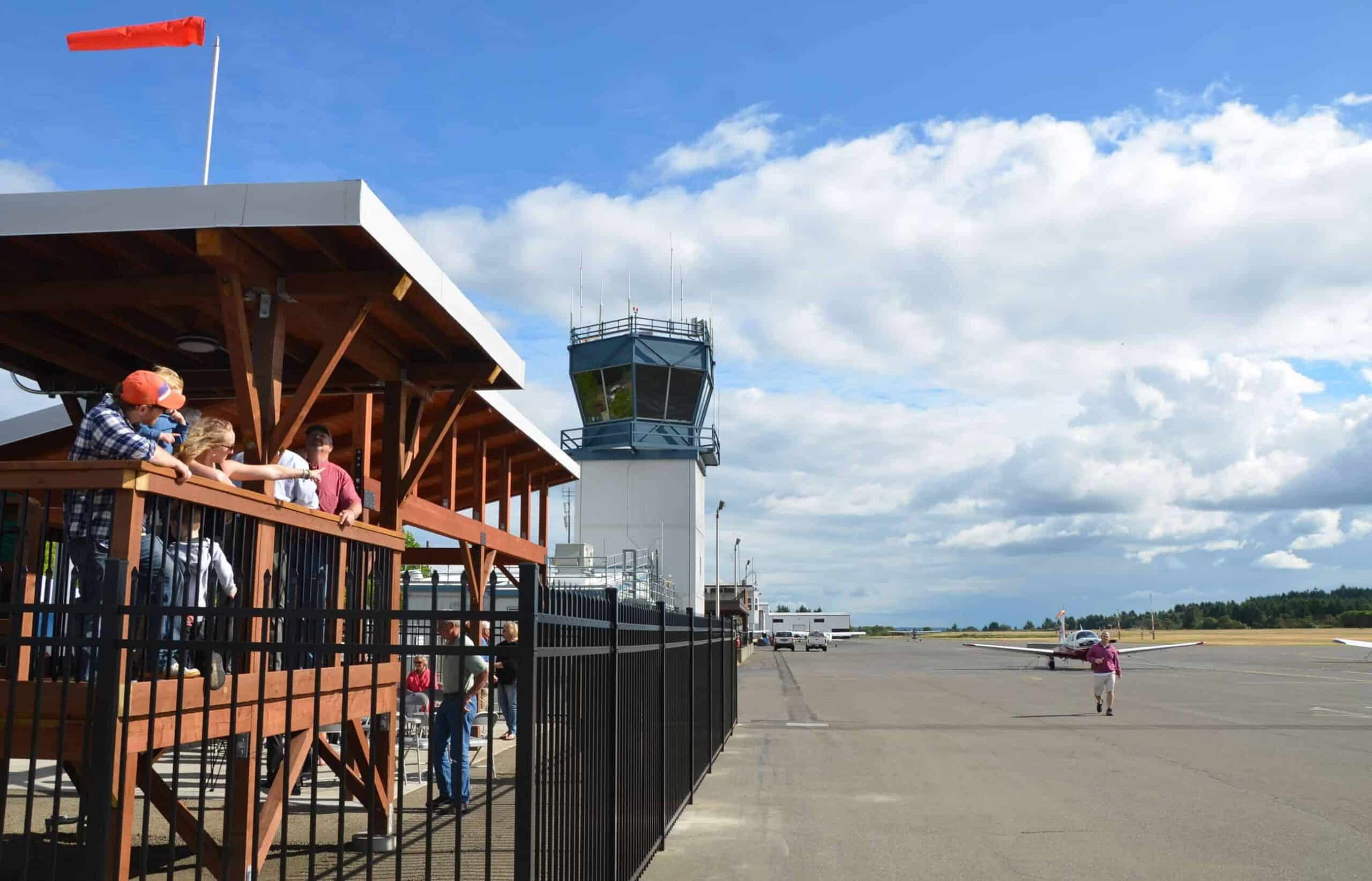

A full-service fixed base operator and flight school at Tacoma Narrows Airport (KTIW) in Gig Harbor, Washington, has been listed for sale at an all-inclusive price of $5.5 million. What makes the listing notable isn’t the price — it’s the stack of certificates. According to the listing, the operation holds Part 61 and Part 141 flight training certificates, a Part 145 repair station and maintenance school, and a Part 135 on-demand charter certificate, alongside a 15-aircraft fleet, on-site jet fuel and avgas, and hangars. The school is described as VA-qualified for veterans’ education benefits and college-approved for partnerships with local institutions. Inquiries go to Christine Winkelseth at 253-888-0451.
For anyone tracking the flight training business — or considering buying into it — a vertically integrated operation of this kind reaching the open market is worth a closer look. Here’s what’s on offer and what a buyer would be evaluating.
What the Listing Includes
Per the listing materials, the business combines several revenue lines that usually exist as separate companies:
Part 61 flight training. Flexible, individually paced instruction — the model most GA flight schools operate under.
Part 141 flight training. FAA-approved structured curriculum, which permits reduced hour requirements for certain certificates and is a prerequisite for many collegiate partnerships and VA benefit eligibility.
Part 145 repair station and maintenance school. An FAA-certificated repair station, plus a maintenance training component — meaning the operation can both maintain its own fleet and train technicians.
Part 135 charter certificate. On-demand charter authority, adding a revenue stream that doesn’t depend on student volume.
15 aircraft. A fleet supporting training and rental across experience levels.
Fuel and hangars. On-site jet fuel and avgas, plus hangar storage — the recurring, less cyclical revenue that FBOs depend on.
VA-qualified and college-approved. Veterans’ education benefits and institutional partnerships both broaden the student pipeline beyond self-funded individuals.
The listing describes the school as having decades of operating history at the field.
Why Four Certificates Is the Real Story
Most flight schools hold one or two certificates. Holding all four — 61, 141, 145, and 135 — is genuinely uncommon, and it changes the economics of the business.
Each certificate took time and money to obtain. A Part 141 approval requires FAA-accepted curriculum, facilities, and personnel. A Part 145 repair station certificate involves its own approval process, quality systems, and inspections. A Part 135 certificate is among the more demanding certifications in general aviation, routinely taking a year or more and substantial cost to obtain. A buyer is acquiring those approvals rather than building them, which is a meaningful part of what $5.5 million buys.
The revenue lines hedge each other. Flight training demand is cyclical and sensitive to financing and airline hiring. Charter, maintenance, fuel, and hangar rental respond to different pressures. An operation that can shift emphasis between them is more resilient than a pure training school.
In-house maintenance is a structural advantage. Aircraft maintenance was ranked the third-biggest challenge facing flight training organizations in Redbird’s State of Flight Training 2026 report, and downtime waiting on a shop is one of the most common causes of schedule disruption at flight schools. A school with its own Part 145 station controls that variable.
The maintenance school addresses a documented shortage. Boeing projects North America will need 123,000 new aviation maintenance technicians through 2044, and roughly one-third of A&P school seats nationally sit unfilled — largely a matter of awareness rather than capacity. A training operation already positioned in that market has a tailwind.
The Market Context
The listing arrives during a period of significant consolidation in flight training.
Redbird’s 2026 industry report found that 18% of small flight training organizations are not profitable, and that profit margins scale clearly with size — roughly 12% for small operations, 15% for medium, and 18% for large. The same report documented large FTOs moving aggressively to multiple locations: the share operating from a single location fell from 84% in 2020 to 33% in 2025.
That environment cuts both ways for a listing like this one. Larger operators are actively acquiring, which broadens the buyer pool. But it also means an independent buyer would be entering a market where scale increasingly determines margin — and where the operational advantages here (in-house maintenance, diversified revenue, existing certificates) are exactly what a single-location school typically lacks.
Local factors matter too. Washington’s HB 2711, signed in March 2026, raises the state aviation fuel tax from 18 to 25 cents per gallon effective November 1, 2026, doubles annual aircraft registration fees, and increases aircraft excise taxes beginning January 1, 2027, with automatic 2% annual escalation from 2028. For an operation selling fuel and running a 15-aircraft fleet, those are real line items to model.
On the demand side, Tacoma Narrows sits within reach of the Seattle–Tacoma metropolitan area — a large population base with strong aerospace employment and airline presence, and the kind of catchment that supports both training volume and charter demand.
What a Buyer Would Want to Verify
The listing is seller marketing, and any serious buyer would move quickly past it to diligence. The questions that would matter most:
Financials. Revenue and margin by line — training, charter, maintenance, fuel, hangars. Which segments actually carry the business, and which are marginal.
Fleet condition. Ages, total times, engine and prop times remaining, avionics currency, and near-term overhaul or upgrade liabilities across 15 aircraft. A fleet approaching several overhauls simultaneously is a very different asset than one recently refreshed.
Certificate standing. Current status and history of the 141, 145, and 135 certificates, including any FAA findings, and — critically — how each transfers or requires re-approval on a change of ownership. Part 135 certificates in particular do not simply convey with a sale.
Airport lease terms. Ground lease length, remaining term, rent escalation, renewal rights, and any sponsor obligations with the airport authority. For an FBO, the lease is frequently the single most consequential document.
Instructor and mechanic staffing. Retention through a transition is a live risk, particularly for CFIs who may be building hours toward airline jobs and for A&Ps in a tight labor market.
Fuel infrastructure. Tank age, condition, environmental compliance and any remediation history — a routine but occasionally expensive surprise in FBO transactions.
Student pipeline. Active enrollment, VA-funded student counts, and the terms and durability of the college partnerships.
The Bottom Line
A flight school and FBO at Tacoma Narrows Airport in Gig Harbor is on the market at $5.5 million, offering an unusually integrated package: Part 61, 141, 145, and 135 certificates, 15 aircraft, jet fuel and avgas, hangars, VA qualification, and college partnerships.
Whether it represents good value depends entirely on financials, fleet condition, lease terms, and certificate transferability — none of which a listing can answer. But in a market where 18% of small flight schools aren’t profitable and scale increasingly determines margin, an operation with diversified revenue and in-house maintenance is a more defensible asset than a training-only school of comparable size.
For a qualified buyer looking to enter the sector, or an existing operator seeking a Pacific Northwest location, it’s a listing worth diligence. Inquiries go to Christine Winkelseth at 253-888-0451.
Details in this article come from the seller’s listing materials and have not been independently verified. Prospective buyers should conduct their own due diligence.
Frequently Asked Questions
What flight school and FBO is for sale in Gig Harbor, Washington? A full-service fixed base operator and flight school at Tacoma Narrows Airport (KTIW) in Gig Harbor, Washington, is listed for sale at an all-inclusive price of $5.5 million. According to the listing, it holds Part 61, Part 141, Part 145, and Part 135 certificates, operates 15 aircraft, and includes on-site jet fuel, avgas, and hangars. Inquiries go to Christine Winkelseth at 253-888-0451.
What do the Part 61, 141, 145, and 135 certificates mean? Part 61 covers flexible, individually paced flight training. Part 141 is FAA-approved structured curriculum training, which permits reduced hour requirements for certain certificates and supports VA benefit eligibility and collegiate partnerships. Part 145 designates an FAA-certificated repair station for aircraft maintenance. Part 135 authorizes on-demand charter operations. Holding all four is uncommon for a single general aviation operation.
Why does holding multiple certificates matter in a flight school sale? Each certificate represents significant time, cost, and FAA approval effort that a buyer acquires rather than builds — a Part 135 certificate alone routinely takes a year or more to obtain. Multiple certificates also diversify revenue across training, charter, maintenance, and fuel, which respond to different market pressures, and in-house maintenance reduces the aircraft downtime that Redbird’s 2026 industry report identified as a leading challenge for flight training organizations.
How does the flight training market look for buyers in 2026? Redbird’s State of Flight Training 2026 report found that 18% of small flight training organizations are not profitable, with profit margins scaling by size — roughly 12% for small, 15% for medium, and 18% for large operations. Consolidation is accelerating: the share of large FTOs operating from a single location fell from 84% in 2020 to 33% in 2025. That means both an active buyer pool and a market where scale increasingly determines margin.
What should a buyer verify before purchasing a flight school and FBO? Key diligence items include revenue and margin by business line, fleet condition and upcoming overhaul liabilities across all aircraft, current standing of each FAA certificate and how it transfers on change of ownership, airport ground lease terms and remaining duration, instructor and mechanic retention risk, fuel tank condition and environmental compliance, and the durability of student pipeline sources including VA-funded enrollment and college partnerships.
Sources: