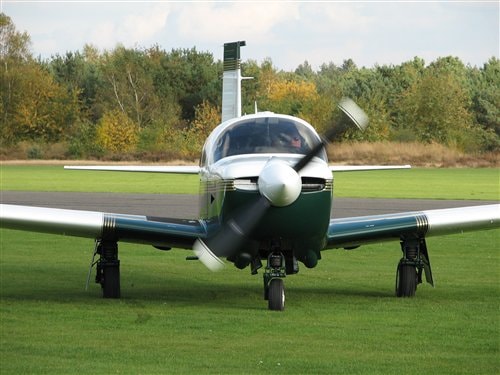
The Mooney M20J, commonly marketed as the “201,” has earned a near-legend status in general aviation because it does something that still feels a little unfair: it delivers serious cross-country speed and efficiency on a 200-hp piston engine—without needing turbocharging or exotic systems.
Mooney leaned into that reputation by branding the airplane around a headline number: 201 mph (hence “201”). AOPA notes that the airplane got the label because of its “supposed maximum cruising speed of 201 miles per hour,” even though real-world cruise numbers depend heavily on altitude, power setting, and how the airplane is equipped and flown.
If you’re looking for a “personal traveling airplane” that feels like a sports car—slippery, efficient, and built to go places—the M20J is one of the most compelling options in the certified fleet.
At a glance: what the M20J is (and what it isn’t)
What it is:
A four-seat, low-wing, retractable-gear traveling airplane optimized for speed and efficiency. AOPA’s aircraft fact sheet describes the M20J as a 4-place, all-metal, low-wing, high-performance single-engine airplane with retractable gear.
What it isn’t:
It’s not a “load hauler” in the way some fixed-gear four-seaters can be, and it’s not a trainer-like airplane that happily sheds speed with minimal planning. Mooneys are famous for being slippery—which is a compliment in cruise and a requirement for good energy management on descent and landing.
The origin story: why the “201” happened
Introduced in 1977 and marketed around speed
A widely cited overview notes the M20J was produced from 1977 to 1998 and marketed as the “201” to highlight the claimed top speed of 201 mph.
The LoPresti cleanup: making an already-clean airplane even cleaner
The M20J’s “step change” in performance is closely associated with aerodynamic cleanup work. Aviation Consumer notes that the 201 is “very much the work” of LeRoy LoPresti, known for extracting performance through drag reduction and refinement.
What changed versus earlier Mooneys
In simple terms, the 201 focused on drag reduction and detail refinement—things that add up:
- improved engine cooling and airflow management
- a more streamlined windshield/cowl area
- improved landing gear door treatment
- other incremental “cleanups” that help cruise speed and efficiency
(Exact configurations vary by year and sub-variant, but the design intent is consistent: cruise speed through cleanliness.)
Airframe and construction: why Mooneys feel “different”
Steel-tube cabin cage + semi-monocoque tailcone
Plane & Pilot describes the Mooney fuselage as incorporating a welded steel-tube cage around the cabin, with a conventional semi-monocoque tailcone attached.
This contributes to the Mooney “feel”: solid, compact, and a little more “purpose-built” than some of the roomier, boxier alternatives.
Pushrod controls and trim behavior
AOPA notes that Mooney pitch trim involves moving more than just a small trim tab (a broader tail/empennage trim arrangement), which is one reason trim can feel “stiff,” and why configuration changes (like flap deployment) may demand active trim management.
Powerplant: the proven IO-360 recipe
A major part of the M20J’s appeal is the engine choice: a 200-hp Lycoming IO-360 variant (model varies by year/config). The New Zealand type acceptance report (based on FAA Type Certificate 2A3) lists the M20J engine as Lycoming IO-360-A1B6D or IO-360-A3B6/D.
Aviation Consumer emphasizes how well-regarded this engine is in service, noting it’s among the most proven/reliable in the industry when flown regularly.
Fuel system: 64 gallons usable (and why wet wings matter)
One of the most “Mooney” ownership topics is the integral (wet-wing) fuel tank system.
A POH/AFM document for the M20J describes fuel being carried in two integral sealed sections in the forward inboard wings, with total usable fuel capacity of 64 gallons.
Why it matters:
Wet wings are light and efficient, but the sealant is a wear item over decades.
- Aviation Consumer’s M20J review notes that tanks “generally need to be resealed every 20 years.”
- A dedicated Aviation Consumer maintenance article goes deeper: wet wings often begin with staining/odors and can progress, and it cites typical full reseal cost ranges (commonly quoted in the mid-$6k to ~$8k range depending on condition and shop).
Ownership takeaway: If you’re buying an M20J, treat “tank history” as a major value driver, not a footnote.
Weights: 2740 lb vs 2900 lb gross (and why some M20Js are more “useful”)
This is one of the biggest “know before you buy” items.
The NZ type acceptance report (again, anchored to FAA Type Certificate 2A3) lists the M20J with:
- 2740 lb max takeoff weight for many serials, and
- 2900 lb for later serials and certain earlier aircraft when compliant with specific documentation/supplements.
Mooney also issued a Special Letter (April 1992) explaining that 1991-and-later M20J aircraft increased gross weight from 2740 to 2900 lb, and that the increase is retrofit-capable for some earlier serial numbers (with required kit items such as an airspeed indicator and AFM supplement plus inspections).
Practical impact: That 160 lb can be the difference between:
- “full fuel + two adults + bags” and
- “full fuel + two adults + bags + a little breathing room”
…or simply better takeoff/climb margins on warm days.
Performance: what pilots actually love about the M20J
Cruise speed and fuel burn (typical)
AOPA’s M20J budget-buy profile gives a solid real-world framing:
- cruises about 160 knots on around 11.5 gph
- at 55% power, can burn just under 8 gph
- with 64 gallons, about 700 miles range carrying around 800 lb useful load (typical)
The “201 mph” label vs reality
Aviation Consumer is blunt (in a helpful way): it jokes that the 201 should “really be more like a Mooney 184,” noting these airplanes don’t honestly cruise at 175 knots in typical conditions.
Both things can be true:
- The marketing speed is optimistic, and
- The airplane is still exceptionally efficient for the speed it delivers.
Range and efficiency are the superpower
If you fly 300–700 nm trips often, the M20J hits a sweet spot:
- fast enough to make trips feel “short,”
- efficient enough to not feel punished at the pump,
- and mature enough as a design that shops and parts ecosystems are well-established.
Handling: “stable in IMC,” but you must manage energy
Plane & Pilot’s summary captures the Mooney experience well:
- stable and predictable in IMC
- responsive to inputs
- but requires study and practice to use well as a complex/high-performance airplane
The big Mooney lesson: it doesn’t like to slow down
Plane & Pilot also notes:
- Mooneys “don’t like to slow down,”
- airspeed control is essential, and
- the M20J guidance for approach speeds (e.g., 65–71 knots depending on technique/config) matters because extra speed increases landing distance quickly.
“Slippery to land” + gear “donuts” = be smooth
AOPA’s budget-buy piece calls out two key realities:
- Mooneys can be slippery if you don’t control speed, and
- the rubber “doughnuts” (shock discs) mean landings should be smooth to avoid oscillations that can escalate into expensive outcomes.
Gear and landing gear maintenance: the Mooney “donuts” are real (and important)
Mooney landing gear uses rubber shock discs (often called “donuts” or “pucks”) for shock absorption rather than oleo struts.
- AOPA’s “Early Mooneys” article describes rubber “biscuits/doughnuts” as the shock-absorbing medium and notes occasional replacement and lubrication.
- Aviation Consumer’s M20J review notes that “donuts” need replacement occasionally and highlights window sealing to prevent corrosion of the steel cabin structure—important for aircraft stored outside.
- Mooney’s own Service Bulletin M20-344A describes rubber discs used for shock absorption in the welded steel tube gear structure and emphasizes maintenance/inspection practices.
Buyer note: Gear condition is not just “maintenance.” It’s safety and operating confidence.
Cabin comfort: sports car vibes, not SUV vibes
The M20J cabin works well for many missions, but it’s not universally roomy.
AOPA notes Mooneys can feel cramped, especially in the back seat.
Plane & Pilot also describes the cabin structure and access characteristics (including baggage access and the “step onto the wing-walk” boarding reality).
Reality check: The M20J shines as a two-adult traveling machine (plus bags). It can do four seats, but comfort and payload will vary with occupant size, fuel load, and the individual aircraft’s empty weight.
Variants you’ll see in listings (and what to ask)
People say “M20J” and mean several flavors. Common names you’ll run into include:
- 201 (baseline marketing name)
- 201SE / 201LM special equipment packages
- 205 (late-1980s refinements)
- MSE (early-1990s and later “more features / higher gross weight era” in many aircraft)
The type acceptance report explicitly references 201/205/MSE designations around the M20J family and notes the 2740 vs 2900 lb weight split by serial/AFM supplement.
What to ask sellers (practical):
- What’s the current max gross weight on the W&B and AFM supplements—2740 or 2900?
- When were the tanks last resealed, and by whom?
- Are speed brakes installed? (Many Mooney pilots like them because of the airplane’s energy retention.)
- What prop is installed (2-blade vs 3-blade), and is it dynamically balanced?
The ownership “gotchas” (and how to be smart about them)
1) Wet wing reseal
This is the big one:
- Expect that tanks may need reseal on a multi-decade airframe.
2) Donuts/gear condition and maintenance discipline
Rubber discs wear with time and use; staying ahead of it matters.
3) Window sealing and steel-tube corrosion risk (especially outdoor storage)
Aviation Consumer specifically warns that for Mooneys parked outside, side windows should be sealed properly to help prevent corrosion of the steel cabin structure.
4) “Mooney-specific” maintenance knowledge
AOPA’s Mooney fact sheet recommends finding a reputable Mooney shop and highlights the value of the Mooney Aircraft Pilots Association for ownership guidance.
Buying guide: prebuy checklist that actually protects you
If you’re shopping for an M20J, here’s a practical checklist that lines up with the airplane’s real-world ownership profile.
Logs and history
- Complete airframe/engine/prop logs
- Consistent annuals and recurring squawks resolved
- Documentation for gross weight configuration and any supplements (especially if 2900 lb)
Fuel tanks
- Evidence of reseal (invoice + shop name + year)
- If no reseal history: budget for it and inspect carefully for staining/odor/weeping
Landing gear
- Condition of shock discs (“donuts”)
- Rigging/inspection history
- Any gear-related SB compliance (ask the inspecting mechanic what’s relevant for that serial)
Engine/prop
- IO-360 health indicators: compressions, oil analysis trends if available, utilization consistency
- Prop type and vibration history (some owners report tradeoffs with certain 3-blade setups)
Avionics and mission fit
- IFR capability is more about the panel than the model name
- Ask whether the airplane is routinely flown IFR and maintained to that standard
Training/transition plan
- Mooneys reward proficiency. Plane & Pilot emphasizes study and practice to learn best operation, and that airspeed control is essential.
“Should I get an M20J?” Mission fit
Great fit if you want:
- 300–700 nm travel efficiency
- strong cruise speed without turbo complexity
- a “pilot’s airplane” that rewards precision
- a proven engine platform (IO-360) and a mature fleet ecosystem
Not the best fit if you want:
- maximum cabin comfort for four adults
- super easy speed management (you’ll need to plan descents and approaches)
- “set it and forget it” ownership without occasional big-ticket items like tanks
FAQ: Mooney M20J (201)
Is the “201 mph” speed real?
It’s a marketing label tied to a claimed top speed; real-world cruise depends on configuration, altitude, power, and technique. Both AOPA and Aviation Consumer acknowledge the “201” branding while also highlighting typical cruise numbers in the 160-knot neighborhood for many aircraft/settings.
How much fuel does an M20J hold?
A common reference is 64 gallons usable, carried in two integral (wet-wing) sections.
What’s the gross weight—2740 or 2900?
Both exist depending on serial and documentation/supplements. Mooney’s Special Letter explains the 1991-and-later increase to 2900 lb and retrofit eligibility for some earlier serials; the type-acceptance summary lays out the split.
Do Mooney tanks really need resealing?
Often, yes—on older airframes. Aviation Consumer notes the tanks “generally need to be resealed every 20 years,” and their maintenance coverage explains why wet wing sealant fails over time and what reseal work typically looks like.
*This article provides general information only. Always operate using the specific aircraft’s FAA-approved AFM/POH, supplements, and limitations, and seek transition training appropriate to complex/high-performance aircraft.