The Cessna 172 Skyhawk is the most-produced aircraft in history, with more than 44,000 built since 1956 — more than any airliner, any fighter, and any other general aviation airplane ever made. It’s the airplane more pilots have soloed than any other, the backbone of flight training in more than 150 countries, and one of the few aircraft designs still rolling off a production line nearly seven decades after its first flight. But behind that familiar high-wing silhouette is a history most pilots have never heard: a 64-day nonstop flight that still stands as a record, a decade-long production shutdown, a stint in U.S. military service, thousands of airframes built in France, and a Cold War incident that embarrassed a superpower.
Here are ten things you probably didn’t know about the world’s most successful airplane.
1. It Started Life as a Cessna 170 With a Nose Wheel
The 172 wasn’t designed from a blank sheet. It was derived from the Cessna 170, a tailwheel airplane Cessna had been building since the late 1940s. The essential change was replacing the conventional (tailwheel) landing gear with tricycle gear — a nose wheel instead of a tailwheel.
That single change transformed the airplane’s accessibility. Tricycle gear made ground handling dramatically easier, reduced the risk of ground loops, and improved forward visibility while taxiing. For student pilots, it removed one of the steepest parts of the learning curve.
The 172 first flew on June 12, 1955, and entered production for the 1956 model year. Cessna continued building the tailwheel 170 alongside it for a short time — but the market had spoken. The 170 ended production in 1956, and the 172 went on to outsell every airplane ever built.
2. It’s the Most-Produced Aircraft in History — and It Isn’t Close
More than 44,000 Cessna 172s have been built. No other aircraft type in history — civil or military — comes close to that figure in the general aviation category, and the 172 tops virtually every “most-produced aircraft” list compiled.
For perspective on the scale: the 172 has been produced across seven decades, operates in more than 150 countries, and is still being manufactured today. A pilot who trained in a 172 in 1960 and a student who solos one this year are flying recognizably the same airplane, separated by 65 years.
Many of its contemporaries didn’t survive. The Beechcraft Musketeer is long out of production. The Piper Cherokee line has been consolidated and reduced. The Skyhawk kept going.
3. A Cessna 172 Once Stayed Airborne for Nearly 65 Days
This is the fact that stops people in their tracks. In late 1958, two pilots took off in a Cessna 172 and did not land for 64 days, 22 hours, 19 minutes, and 5 seconds.
Robert “Bob” Timm and John Cook departed McCarran Field in Las Vegas (now Harry Reid International Airport) on December 4, 1958, and touched down again on February 7, 1959. Their airplane, registration N9172B, covered an estimated 150,000 miles during the flight — roughly six times the distance around the Earth at the equator.
The record for refueled flight endurance has never been broken.
Making it work required serious engineering. The airplane carried a 95-gallon belly fuel tank with an electric transfer pump to refill the wing tanks in flight. The crew rigged a system that allowed oil to be added and changed without shutting down the engine. And to refuel, they descended to about 20 feet above a straight stretch of desert highway, matching speed with a truck below while fuel was hoisted up to the airplane — once a day, for more than two months.
The two pilots flew in shifts, ate, slept, and lived in a four-seat airplane for nine weeks. By the end, the engine was so worn that the airplane could barely maintain altitude.
4. That Record Flight Was a Casino Publicity Stunt
The most remarkable endurance flight in light aviation history wasn’t a research program or a military test. It was marketing for a Las Vegas hotel.
Bob Timm was a former World War II bomber pilot working as a slot machine mechanic at the Hacienda Hotel. He pitched the idea of a record-setting endurance flight to the hotel’s owner as a publicity vehicle, and walked away with a reported $100,000 budget. The airplane flew with the Hacienda name painted prominently on its side, and the effort also raised money for cancer research.
It worked. The flight drew national attention, landed in the Guinness Book of World Records, and made an ordinary production Cessna 172 into a piece of aviation history.
The airplane itself survived. After passing through private ownership — including years on a farm in Saskatchewan, Canada — N9172B was located by Timm’s son and returned to Las Vegas in 1988. It has since been preserved and displayed at the airport it departed from, where travelers walk past it without realizing what they’re looking at.
5. The Silhouette You Picture Wasn’t There at the Start
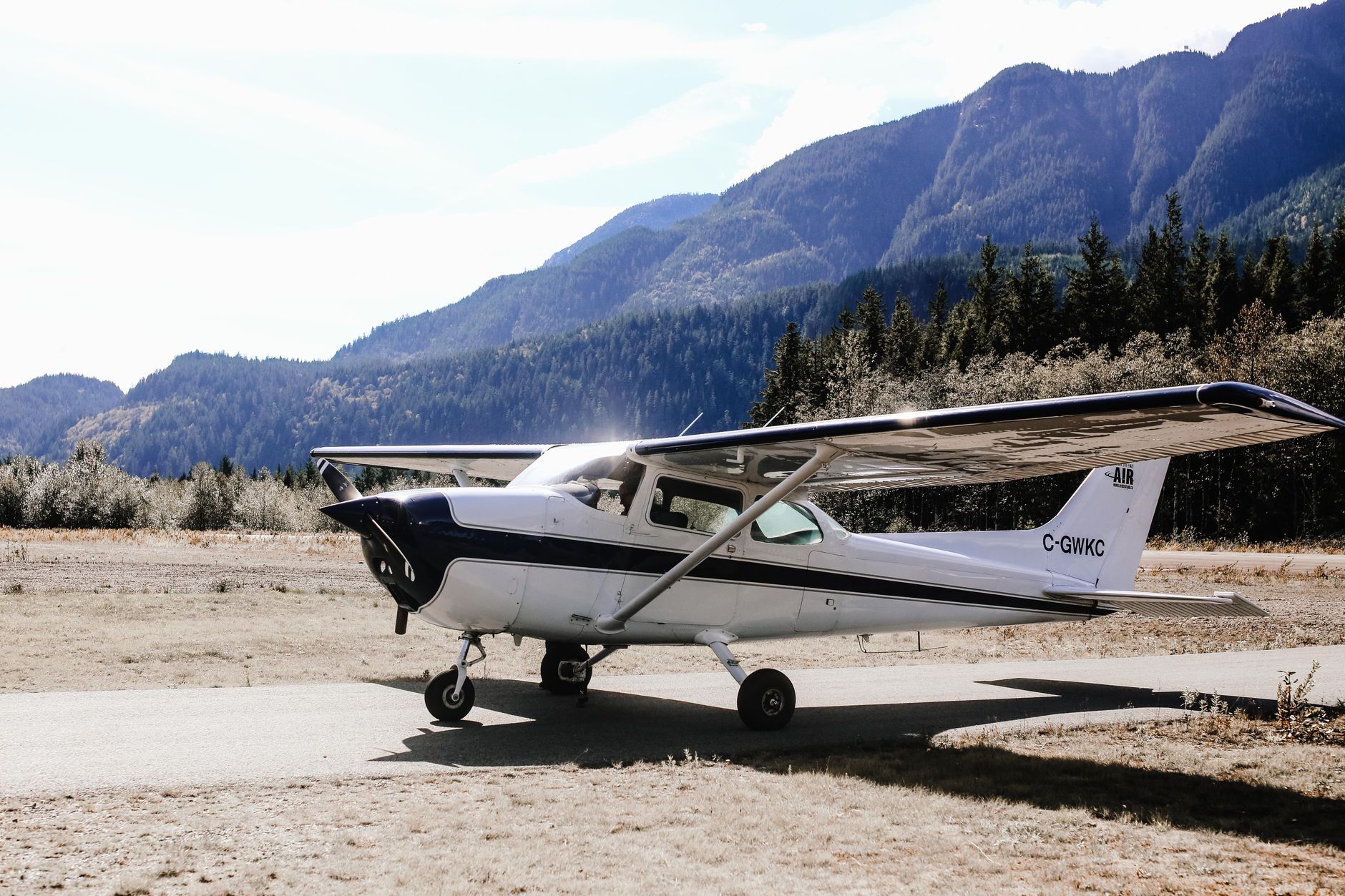
Ask a pilot to sketch a Cessna 172 and they’ll draw a swept vertical tail and a wraparound rear window. Neither feature existed on the original.
The 1956 through 1959 model years had a straight, squared-off vertical tail — visually much closer to the Cessna 170 it came from. The swept tail that defines the modern Skyhawk profile arrived with the 1960 model year (172A).
The rear window — Cessna marketed it as “Omni-Vision” — came even later, arriving with the 1963 model year (172D). It improved rearward visibility at the cost of a small amount of structural weight and some rear-seat headroom.
So the airplane most people picture as “a Cessna 172” is really the post-1963 version. The earliest Skyhawks look noticeably different — and to some eyes, more like the taildragger they descended from.
6. Production Stopped Completely for a Decade
The Skyhawk’s continuous run has a ten-year hole in it. Cessna halted production of the 172 — and its entire single-engine piston line — in 1986.
The cause wasn’t lack of demand. It was product liability. By the mid-1980s, litigation costs against U.S. general aviation manufacturers had risen to the point that building small airplanes became economically untenable. Manufacturers faced open-ended liability for aircraft they had built decades earlier, and the cost of that exposure was being priced into every new airframe.
Relief came with the General Aviation Revitalization Act of 1994 (GARA), which established an 18-year statute of repose limiting manufacturer liability for older aircraft. With that protection in place, Cessna restarted single-engine production — and the Skyhawk returned in 1996, built at a new facility in Independence, Kansas, where it is still produced today.
The airplane that resumed production was the 172R, later joined by the 172S, which remains the current model.
7. It Served in the U.S. Military as the T-41 Mescalero
The Skyhawk wore a military uniform. Beginning in 1964, the U.S. Air Force purchased essentially off-the-shelf Cessna 172s and designated them the T-41 Mescalero.
The Air Force eventually ordered roughly 855 aircraft across several versions. Early models were close to the civilian airplane; later variants were progressively more capable, with the T-41D featuring a 210-horsepower engine and a constant-speed propeller.
The T-41 was used for initial flight screening — putting officer candidates in an airplane early to determine aptitude before committing to expensive advanced training. Both the Air Force Academy and the Naval Academy used the type for cadet flight training, and T-41s were also supplied to allied nations through military assistance programs.
For an airplane best known as a civilian trainer, filtering the pilot pipeline for the U.S. military is a notable second career.
8. Thousands of Skyhawks Were Built in France
Not every Cessna 172 came from Kansas. Cessna acquired an interest in Reims Aviation in France in 1960, and Reims built Skyhawks under license for the European market for decades.
French-built aircraft carried a distinct designation — the F172 (the “F” for Reims/France) — and Reims also produced the FR172 Reims Rocket, a higher-powered variant with a fuel-injected Continental engine that offered notably better climb performance than the standard airplane.
For European pilots, the Reims-built Skyhawk was the Skyhawk. Many are still flying today, and the F-prefix registration is a small piece of trivia that catches out pilots who assume every 172 rolled out of Wichita or Independence.
9. It Has Flown Behind Many Different Engines
Pilots often speak of “the 172 engine” as if there were one. There have been many.
The earliest Skyhawks used the Continental O-300, a six-cylinder engine producing 145 horsepower — a distinctly different sound and configuration from what most modern 172 pilots know.
Cessna later moved to Lycoming, and the airplane has since flown behind a range of powerplants including the Lycoming O-320 (in multiple variants), the O-360, and the fuel-injected IO-360 used in the current 172S, which produces 180 horsepower.
Beyond the factory options, the Skyhawk has one of the richest supplemental type certificate (STC) ecosystems in aviation. Owners have installed 180-horsepower conversions, constant-speed propellers, three-blade props, tailwheel conversions for backcountry work, and — in a handful of experimental cases — even turbine power. Few airframes have been modified in as many ways.
10. A Teenager Once Flew One Into Red Square
On May 28, 1987, a 19-year-old West German named Mathias Rust flew a Reims-built Cessna F172P from Helsinki, Finland, penetrated Soviet airspace, and landed near Red Square in the heart of Moscow.
The flight covered roughly 500 miles through some of the most heavily defended airspace on Earth. Soviet air defense tracked the aircraft at various points but never engaged it — a failure that produced enormous political fallout. The Soviet defense minister and the head of the air defense forces were removed from their posts in the aftermath, and the episode is widely cited by historians as a moment that helped Mikhail Gorbachev restructure the Soviet military leadership.
Rust was convicted and served time in a Soviet prison before being released in 1988.
It remains one of the strangest chapters in Cold War history — and the airplane at the center of it was an ordinary four-seat trainer that thousands of student pilots fly every day.
Why the Skyhawk Endures
None of the 172’s individual qualities are extraordinary. It isn’t fast. It isn’t especially roomy. It doesn’t carry a remarkable load. Compared to modern composite designs, its performance numbers are unremarkable.
What it is, is forgiving, predictable, simple, and repairable — and available essentially everywhere. Its handling gives students clear feedback without punishing mistakes harshly. Its systems are straightforward enough to teach. Parts and mechanics familiar with the type exist at nearly every airport in the country. And after nearly 70 years, the accumulated knowledge base around the airplane is unmatched.
That combination is why the Skyhawk has outlasted most of its competitors and why, in an era of glass cockpits and composite airframes, flight schools still buy new ones. The 172 has trained more pilots than any airplane in history — and it isn’t finished yet.
Frequently Asked Questions
How many Cessna 172s have been built? More than 44,000 Cessna 172 Skyhawks have been built since production began for the 1956 model year, making it the most-produced aircraft in history. Production ran from 1956 to 1986, paused for a decade, and resumed in 1996 at Cessna’s facility in Independence, Kansas, where the aircraft is still manufactured today as the 172S.
What is the Cessna 172 flight endurance record? Pilots Robert Timm and John Cook kept a Cessna 172 (registration N9172B) airborne for 64 days, 22 hours, 19 minutes, and 5 seconds — departing McCarran Field in Las Vegas on December 4, 1958, and landing on February 7, 1959. The flight covered an estimated 150,000 miles. The aircraft was modified with a 95-gallon belly fuel tank and refueled once daily from a truck while flying about 20 feet above a desert highway. The refueled endurance record has never been broken.
Why did Cessna stop building the 172 in 1986? Cessna halted production of the 172 and its other single-engine piston aircraft in 1986 primarily because of product liability costs. By the mid-1980s, open-ended litigation exposure for aircraft built decades earlier had made manufacturing light aircraft economically unviable in the United States. The General Aviation Revitalization Act of 1994 established an 18-year statute of repose limiting that liability, which allowed Cessna to resume 172 production in 1996.
What was the Cessna T-41 Mescalero? The T-41 Mescalero was the U.S. military designation for the Cessna 172. Beginning in 1964, the Air Force purchased roughly 855 aircraft across several versions for initial flight screening and cadet training, used by both the Air Force Academy and the Naval Academy. Later variants were progressively more powerful, with the T-41D featuring a 210-horsepower engine and constant-speed propeller. T-41s were also supplied to allied nations through military assistance programs.
When did the Cessna 172 get its swept tail and rear window? Neither feature was on the original. The 1956–1959 Skyhawks had a straight, squared-off vertical tail. The swept tail arrived with the 1960 model year (172A). The wraparound rear window, which Cessna marketed as “Omni-Vision,” was introduced with the 1963 model year (172D). The familiar modern Skyhawk silhouette therefore dates from 1963 onward.
Sources: