If you’ve spent any time around homebuilt airplanes, you’ve probably heard the BD-4 described in the same breath as words like “fast,” “simple,” “boxy,” and “ahead of its time.” That’s not hype—Jim Bede introduced the BD-4 at EAA Rockford in 1968, aiming for a practical four-seat traveler that could be built by “regular people,” with fewer fabrication headaches than scratch-building.
More than 50 years later, the BD-4 remains a fascinating aircraft because it sits at a rare intersection:
- High-wing utility vibe, but cruise speeds that can embarrass plenty of certified four-seaters
- All-metal, but famously bonded (not traditionally riveted everywhere)
- A design that evolved through multiple wing and fuel-system iterations as builders and real-world operations surfaced what worked—and what needed improvement
This post is a deep, practical guide to the BD-4: where it came from, what it’s like as a traveling machine, what variants matter, and what to know if you’re buying, flying, or building one today.
What is the BD-4?
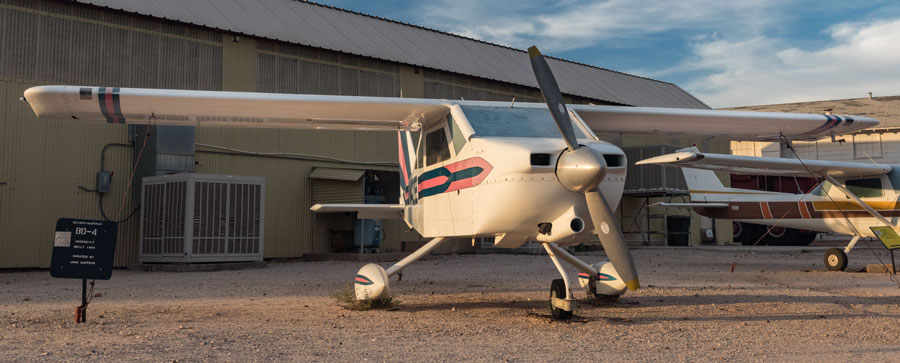
At its core, the Bede BD-4 is a high-wing, cantilever, all-metal amateur-built airplane that can be configured as two-seat or four-seat, and with tailwheel or tricycle gear—builder’s choice.
It was designed with a very “Bede” philosophy: make it efficient to build (straight lines, simple geometry, modular parts), while keeping the aircraft strong and performance-oriented. Kitplanes notes that Bede designed the BD-4 to exceed Part 23 structural standards for Normal/Utility, and even contemplated aerobatic loads at a lower gross weight (with aerobatics not recommended).
Quick specs snapshot (BD-4B as a reference point)
Because BD-4s vary a lot by engine, build quality, and modifications, the cleanest “baseline” is often the BD-4B specs sheet:
| Spec | BD-4B (typical reference) |
|---|---|
| Wingspan | 25.58 ft |
| Folded wingspan (with folding option) | 7 ft |
| Length | 21.38 ft |
| Cabin width | 42 in |
| Fuel capacity | 51–80 gal |
| Gear | Fixed trike or tailwheel |
| Cruise speed (75% power) | ~172 mph (150 hp) / 192 mph (180 hp) / 198 mph (200 hp) |
| Stall speed (flaps down) | ~52–55 mph |
| Rate of climb (max) | ~1250–1700 fpm |
| Range (max) | ~900 miles |
| Vne (listed) | 234 mph |
All of the above figures come from the BD-4B spec/performance document.
(For a museum reference point, Pima Air & Space lists similar scale/mission numbers—4 seats, ~180 hp example, and ~900-mile range. )
Origin story: why the BD-4 mattered in 1968 (and still matters)
The “real kitplane” moment
Kitplanes describes the BD-4 as ahead of its time in 1968: an all-metal four-seater that was bonded, not riveted, introduced publicly at EAA Rockford.
That matters because early homebuilding often meant either:
- Plans-building with lots of fabrication, or
- Partial kits that still demanded deep shop skills
The BD-4 leaned into modularization and builder-friendly decisions. For example, Kitplanes describes a fuselage “safety cage” concept that bolts together—an “Erector Set” style frame.
Early kit economics (a fun reality check)
One of the most telling historical details: a BD-4 ad in 1969 listed multiple kit packages, and the complete kit (including electrical/instruments) was priced under $3,000—engine not included.
(That doesn’t translate cleanly to today’s dollars, but it shows the original intent: make ownership possible by making building possible.)
The BD-4 design philosophy in plain English
If you walk up to a BD-4, the first impression is usually: compact, slab-sided, functional. That’s not an accident.
Kitplanes calls out that the BD-4 (especially in later incarnations like the BD-4C) is “stodgy” and “boxy,” but engineered, efficient, and fast.
Key design choices that shaped the aircraft
1) A clean high wing (no struts)
The wings are cantilevered—no draggy struts—supporting the BD-4’s reputation as a true cross-country machine.
2) Bonded metal construction
The BD-4 story is inseparable from its bonding approach. Both Kitplanes and the BD-4C “website information” document emphasize bonded skins and a rivet-minimized wing skin approach (especially in the newer wing).
3) Builder-friendly structure
The BD-4C document describes a gusseted and bolted aluminum frame (“erector set” safety cage), no welding, and no complicated jigs—clearly oriented to home shops.
Wings and fuel: the BD-4’s most important evolution
If you want to understand why some pilots love the BD-4 and why some builders are cautious, start here.
The original idea: “wet wing” simplicity
A major BD-4 hallmark is using the wing as a fuel tank (“wet wing”), which can save weight and complexity and increase capacity.
The reality: leaks and fuel pickup edge cases
Kitplanes explains that earlier wing sections used as fuel tanks sometimes leaked. It also notes operational quirks: with a flat wing and low fuel at higher angles of attack, fuel pickups could be unported—prompting later design improvements.
The “new wing” direction: honeycomb ribs + tubular spar
The BD-4C materials describe a redesigned wing using aluminum honeycomb ribs and a tubular spar, with a bonded skin that’s rivet-free except at the trailing edge spar, plus flap system details.
And Kitplanes adds the practical punchline: owners of BD-4s in the FAA registry have looked at replacing older wing styles with newer metal wing options, and the “folding wing option” exists even if it’s not commonly purchased today.
Bottom line: When evaluating a BD-4 (especially buying one), wing/fuel-system configuration is not trivia—it’s central.
Cabin and ergonomics: “small airplane, surprisingly roomy”
The BD-4 is often described as compact outside, roomy inside. That effect comes from flat-sided geometry and efficient packaging.
Cabin width: 42 inches (and the modern BD-4C stretch)
- BD-4B references list 42-inch cabin width.
- Kitplanes reports the BD-4C was widened by 4 inches (to 46 inches) and lengthened by 14 inches to fit modern occupants and increase useful cabin space.
Doors and access
Kitplanes specifically notes doors on both sides on the BD-4C for easier access to a roomy cabin.
Panel space and IFR ambition
The BD-4C document explicitly describes a spacious instrument panel that can accommodate IFR components.
(As always with Experimentals: capability depends on the specific aircraft’s build and equipment, not the airframe concept alone.)
Gear configuration and the folding wing story
One of the BD-4’s underrated selling points is how configurable it is:
- Tailwheel or tricycle gear (fixed)
- Optional folding wings (and when equipped, a very compact folded footprint)
The BD-4B spec document lists a folded wingspan of 7 feet—which is wildly practical for certain hangar/towing/storage setups (assuming the specific aircraft is built with that feature and maintained appropriately).
Engines and performance: why BD-4 owners talk about “speed per dollar”
The BD-4 is commonly flown with Lycoming-class engines, but the core performance story is simple:
It’s a relatively clean airframe that rewards horsepower.
The BD-4B spec sheet provides a rare apples-to-apples set of performance estimates across 150/180/200 hp:
- Cruise (75% power): ~172 / 192 / 198 mph (150 / 180 / 200 hp)
- Stall (flaps down): ~52–55 mph
- Climb (max): ~1250–1700 fpm
- Range (max): ~900 miles
Kitplanes adds a real-world narrative point: a BD-4C builder kept coming back to the platform because it “cruises at 191 mph on 200 hp,” with the factory expecting further incremental performance improvements.
Handling notes: not a 172, and that’s the point
Kitplanes’ flight impressions emphasize:
- It’s clean and stable as a traveling machine
- It tends to require good coordination and slightly higher speeds than pilots used to Cessnas/Pipers might expect
That’s not a criticism; it’s mission alignment. The BD-4 shines when flown like what it is: a fast, efficient personal transport.
Variants you’ll actually see (and what changes)
The BD-4 family has multiple labels floating around in the community. Two practical anchors:
BD-4B
Often treated as the “mainstream” reference spec set, with published performance tables, and commonly discussed in builder circles. The BD-4B spec sheet is one of the best single documents for baseline numbers.
BD-4C (the modern “current model” line)
The BD-4C is repeatedly described as the “current model being sold” in certain eras, with:
- Updated sizing (wider/longer cabin)
- Newer wing/fuel solutions emphasized in BD-4C materials
Wikipedia also summarizes BD-4B vs BD-4C positioning (with build-time estimates and a claimed completion count), but note that builder-population figures can be hard to verify precisely across decades of amateur-built records.
Ownership realities: every BD-4 is “a custom airplane”
This is true of all Experimentals, but it’s especially true for legacy kitplanes that lived through decades of modifications.
What varies aircraft-to-aircraft
- Wing generation (and fuel tank / pickup details)
- Engine/prop combination
- Empty weight (sometimes dramatically)
- Avionics and electrical design quality
- Landing gear configuration and build quality
- Cooling, baffling, and cowling execution
So: if you’re buying one, evaluate it like two purchases at once:
- the design, and
- the execution.
Community and support: where BD-4 owners actually go for help
One reason the BD-4 persists is that it developed an ecosystem of newsletters, parts sources, and builder communities.
The EAA’s BD-4 resource page includes:
- Kit/plans contact info
- Parts availability leads
- Newsletter references
- A long index of BD-4 articles across EAA publications (spanning decades)
That EAA index is gold if you’re doing deeper research—especially on specific issues like fuel limitations, gear topics, and historical service bulletins that may have emerged over time.
What’s happening now: SureWings, “revivals,” and modern kit positioning
The BD-4 story isn’t just history—there’s been meaningful movement recently.
2024: Legacy BD-4C design sold to SureWings (Kitplanes)
Kitplanes reported that the Bede Aircraft company (run by Jim Bede’s son) maintained a presence selling BD-4 kits (designated BD-4C), and that the BD-4C design was sold, with SureWings outlining major enhancement plans and a high-price “complete kit” concept.
2026: “BD-4C-S SureWings Edition” messaging (Aero-News Network)
Aero-News Network described a modernized “SureWings Edition” approach intended to simplify the traditional customization-heavy kit experience, while noting that Bede Aviation continued to offer more traditional partial/complete kits.
Takeaway: If you’re researching BD-4s today, you’ll see both:
- Legacy-built BD-4s (the bulk of flying aircraft), and
- Newer “program” concepts attempting to modernize the builder experience and standardize the result.
Who the BD-4 is perfect for (and who it isn’t)
The BD-4 is a great fit if you want:
- A fast cross-country Experimental with real fuel capacity potential
- A high-wing cabin that’s easy to access (especially in BD-4C sizing)
- Builder-friendly structure concepts (especially if supported by a strong documentation trail)
- A community with deep archives and long-running knowledge bases
It’s not the best fit if you want:
- “Certified-airplane simplicity” in maintenance/ownership (this is Experimental, with all that implies)
- The slow-speed manners of a trainer like a 172 (the BD-4 tends to like higher speeds and good coordination)
- A purchase where two BD-4s are truly comparable without deep inspection (they aren’t)
Safety & training note
The BD-4 is an amateur-built experimental aircraft; build quality, modifications, and maintenance vary widely. Performance and handling can differ significantly between individual aircraft. Seek transition training with a qualified instructor familiar with similar performance profiles, and follow all applicable FAA guidance and limitations for the specific aircraft.