The FAA unveiled Mobile Clearance at EAA AirVenture Oshkosh 2026 — a digital system that lets general aviation and business aviation pilots request IFR departure clearances through approved flight applications instead of over the radio. FAA Deputy Administrator Chris Rocheleau announced the system during a presentation at the show on Thursday, July 23, 2026. Beginning in August, Mobile Clearance will also allow pilots to cancel IFR through their flight apps, freeing controllers to focus on aircraft separation. Operational evaluations began in Houston in May 2026 and expanded this summer to Appleton International Airport (KATW) in Wisconsin and New Century AirCenter (KIXD) in Kansas, with Kansas City, Nashville, and Austin planned for this fall ahead of nationwide deployment beginning in 2027.
For instrument pilots who have spent years copying clearances over a crackling radio — or calling clearance delivery on a cell phone from the runup area at a non-towered field — this is one of the most practical modernization steps to reach the GA cockpit in years. Here’s how it works and when you’ll get it.
One Important Clarification: It’s Not an FAA App
A common misconception worth clearing up immediately: Mobile Clearance is not a standalone FAA app you download.
It’s an FAA system that delivers clearances through approved third-party flight applications — the apps pilots already use, including ForeFlight and Garmin Pilot. The FAA built the back-end infrastructure and approval framework; the app developers build the pilot-facing interface.
That design decision matters. Rather than asking pilots to adopt yet another app and switch between tools during preflight, Mobile Clearance appears inside the flight-planning app where the pilot already filed the flight plan. It’s an integration, not an addition.
How Mobile Clearance Works
The system builds on the FAA’s System Wide Information Management (SWIM) Flight Data Publication Service — the data backbone that already feeds flight plan information to connected applications.
The general workflow, as implemented by app partners:
- File your IFR flight plan as normal through your flight app.
- Departing from a Mobile Clearance airport, the option appears in the app within a set window before your proposed departure time (Garmin Pilot uses 30 minutes).
- Start a session to request your clearance.
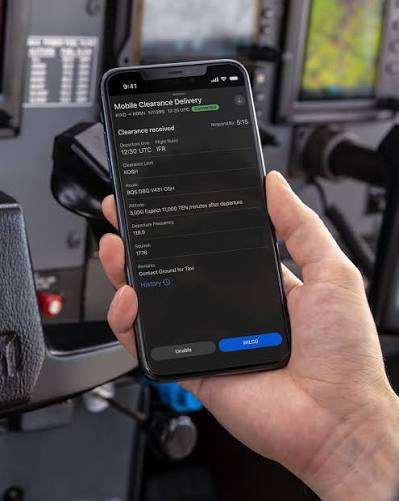
- Receive the clearance from ATC as text in the app.
- Review it on screen — no copying, no “say again.”
- Accept it with a WILCO response.
Beginning in August 2026, the system also supports canceling IFR through the app, helping pilots transition to VFR without tying up a controller on the radio.
The obvious advantage over voice: a text clearance can be read at your own pace, re-read as many times as needed, and — critically — is not subject to the misheard fixes, garbled frequencies, and readback errors that make clearance copying one of the more error-prone routine tasks in instrument flying.
Why This Matters: The Problem It Solves
The FAA has framed Mobile Clearance around three benefits: modernizing pilot-controller communications, improving safety, and enhancing efficiency.
The underlying problem is well documented. Where data communications services aren’t available, IFR clearances must be issued verbally. At non-towered airports, clearance delivery, negotiating IFR release, and canceling IFR all have to be done by voice. That creates several recurring friction points:
Read-back errors. Voice clearances are subject to mishearing and misinterpretation — a wrong altitude, a misheard fix, a transposed frequency. Text eliminates the transcription step entirely.
Controller workload. Every voice clearance occupies a controller who could otherwise be focused on separating aircraft. MITRE has estimated that more than 15,000 clearances are read daily at towered and non-towered airports.
Delays at non-towered fields. Pilots holding short waiting for a clearance while ATC handles higher-priority traffic is a familiar experience — burning fuel, watching a weather window close, and sometimes being told to “stand by” repeatedly.
Equipment gaps. Airlines and large aircraft have long had Controller-Pilot Data Link Communications (CPDLC) — the ability to receive and load a clearance digitally. That equipment is expensive and heavy, putting it out of reach for most light GA aircraft. Mobile Clearance delivers a similar capability using the phone or tablet already in the cockpit.
As AOPA argued when advocating for the technology, if a clearance can be delivered to an app connected to the aircraft’s navigator, a pilot could load it with a button press — taking the human transcription step, and the errors that come with it, out of the loop.
The Rollout Timeline
Mobile Clearance is being deployed in phases:
- May 2026: Operational evaluations begin in Houston
- Summer 2026: Testing expands to Appleton International Airport (KATW), Wisconsin, and New Century AirCenter (KIXD), Kansas
- August 2026: IFR cancellation capability goes live
- Fall 2026: Additional locations planned, including Kansas City, Missouri; Nashville, Tennessee; and Austin, Texas
- 2027: Nationwide deployment begins
- Through 2028: Phased expansion continues as app partners extend coverage
The Appleton inclusion is a notable detail for AirVenture attendees — KATW is one of the primary alternates and overflow fields for Oshkosh traffic, roughly 20 miles northeast of Wittman Regional Airport.
Garmin Pilot Launches Mobile Clearance Delivery
Garmin announced its implementation the same day. Mobile Clearance Delivery is now available in Garmin Pilot for Premium subscribers on iOS devices, developed in collaboration with the FAA and MITRE.
The feature lives on the new Flights page in Garmin Pilot. After filing an IFR flight plan, pilots departing from a Mobile Clearance Delivery airport see the option appear within 30 minutes of their proposed departure time. From there, the pilot starts a session, receives the clearance from ATC, reviews it in the app, and accepts it with a WILCO response.
Garmin has said the capability will expand to additional airports in phases through 2028, tracking the FAA’s national rollout.
ForeFlight is also among the approved applications supporting the system.
A Decade in the Making
Mobile Clearance didn’t appear overnight. The concept traces back to 2014, when the MITRE Corporation — the not-for-profit that conducts federally funded research for the FAA — began exploring mobile IFR clearance delivery.
MITRE’s Mobile Departure Expected Clearance research produced a working prototype that used SWIM flight data to deliver text-based expected clearances to a pilot’s mobile device. Early testing at Manassas Regional Airport in Virginia demonstrated the technology worked, with participating pilots receiving anticipated clearances electronically and reporting any discrepancies against what ATC actually issued.
AOPA publicly supported the prototype as early as 2017, urging the FAA to field test it promptly and noting that roughly 75 percent of pilots were already using portable or mobile devices for aviation purposes. Industry consensus reports on performance-based navigation and the future of flight service had both called for improvements to how IFR clearances reach GA aircraft.
Nine years after MITRE began the work and after sustained advocacy from the GA community, the FAA is fielding it.
Where Mobile Clearance Fits in the Modernization Push
The announcement came during the same AirVenture week in which FAA and union leadership made a broader case for air traffic control modernization. FAA Air Traffic Organization COO Frank McIntosh joined ALPA and NATCA at the show to update the community on the ATC overhaul — electronic flight strips replacing paper, new radars replacing 1970s equipment, surface safety tools, and fiber replacing copper — and to call for an additional $20 billion to complete the effort.
Mobile Clearance fits that same theme from the GA side. Where the airline system is getting electronic flight strips and CPDLC, general aviation is getting a phone-based equivalent that requires no new avionics, no installation cost, and no aircraft downtime.
It also joins a striking cluster of GA technology announcements from AirVenture 2026 and the weeks around it:
- Garmin AXIS integrated flight displays, combining PFD, MFD, IFR GPS, NAV/COMM, and audio panel in a single unit
- Jeppesen ForeFlight’s ClearNOTAMs, using AI to decode dense NOTAMs into plain English
- The Blackstar Eclipse simulator, bringing military-grade mixed-reality visuals to GA training
- MOSAIC Phase 2, effective July 24, 2026, opening the light-sport category to new aircraft types
Taken together, 2026 is shaping up as one of the most consequential years for general aviation cockpit technology in decades.
What Pilots Should Do Now
Check whether your departure airport is participating. Coverage is currently limited to the evaluation airports, with expansion through fall 2026 and nationwide rollout starting in 2027. Your app will show the option when it’s available at your departure field.
Confirm your app and subscription tier. Garmin’s implementation requires a Garmin Pilot Premium subscription on iOS. Check with ForeFlight and other providers regarding their specific requirements and availability.
Keep your radio skills sharp. Mobile Clearance supplements voice communication — it doesn’t replace it. You’ll still be copying clearances by voice at the vast majority of airports for the foreseeable future, and you’ll always need the capability when the app, the network, or the airport doesn’t support it.
Watch for the August IFR cancellation feature. For pilots who routinely cancel IFR in the air or on the ground at non-towered fields, this may end up being the most-used part of the system.
Verify everything. As with any digital tool, the clearance you accept is the clearance you’re expected to fly. Read it carefully before sending WILCO, and don’t hesitate to query ATC by voice if something looks wrong.
The Bottom Line
The FAA’s Mobile Clearance system brings a capability airlines have had for years — digital, text-based departure clearances — to general aviation without requiring a dollar of new avionics. Request your IFR clearance in ForeFlight or Garmin Pilot, read it on screen, accept with WILCO, and go. Starting in August, cancel IFR the same way.
The rollout is deliberate: Houston, Appleton, and New Century now; Kansas City, Nashville, and Austin this fall; nationwide beginning in 2027 and phasing through 2028. For a technology MITRE first prototyped in 2014 and AOPA has championed since 2017, the arrival is overdue and welcome.
For instrument pilots, the practical impact is straightforward — fewer read-back errors, less time holding short, less frequency congestion, and one less thing to fumble during a busy preflight. That’s a meaningful safety and efficiency gain from a tool that already lives in your flight bag.
Frequently Asked Questions
What is FAA Mobile Clearance? Mobile Clearance is an FAA system, unveiled at EAA AirVenture Oshkosh on July 23, 2026, that allows general aviation and business aviation pilots to request IFR departure clearances digitally through approved flight applications instead of by radio. Beginning in August 2026, it will also allow pilots to cancel IFR through their apps. The system uses the FAA’s System Wide Information Management (SWIM) Flight Data Publication Service and is designed to reduce radio workload, minimize read-back errors, and let controllers focus on aircraft separation.
Is Mobile Clearance a separate FAA app I need to download? No. Mobile Clearance is not a standalone FAA app. It is an FAA system delivered through approved third-party flight applications that pilots already use, including ForeFlight and Garmin Pilot. The FAA provides the back-end infrastructure and approval framework, while app developers build the pilot-facing interface within their existing apps.
Which airports support Mobile Clearance? Operational evaluations began in Houston in May 2026 and expanded over the summer to Appleton International Airport (KATW) in Wisconsin and New Century AirCenter (KIXD) in Kansas. Additional locations planned for fall 2026 include Kansas City, Missouri; Nashville, Tennessee; and Austin, Texas. Nationwide deployment is scheduled to begin in 2027, with phased expansion continuing through 2028.
How do I use Mobile Clearance in Garmin Pilot? Garmin’s Mobile Clearance Delivery is available to Garmin Pilot Premium subscribers on iOS devices and lives on the app’s new Flights page. After filing an IFR flight plan, pilots departing from a participating airport will see the option appear within 30 minutes of their proposed departure time. The pilot starts a session, receives the clearance from ATC, reviews it in the app, and accepts it with a WILCO response.
Does Mobile Clearance replace radio communication with ATC? No. Mobile Clearance supplements voice communication rather than replacing it. Pilots will still copy clearances by radio at the majority of airports for the foreseeable future and must retain that capability for any situation where the system, network, or airport does not support digital delivery. Pilots should carefully review any clearance received in the app before accepting it and query ATC by voice if anything appears incorrect.
Sources:
- AVweb — FAA Debuts New Tool for Digital Departure Clearances (July 23, 2026)
- FLYING Magazine — FAA Debuts New Tool for Digital Departure Clearances (July 23, 2026)
- Garmin — Garmin Pilot Adds Mobile Clearance Delivery for Streamlined IFR Clearances (July 23, 2026)
- AvBrief — Garmin Adds Mobile Clearance Delivery to Garmin Pilot (July 23, 2026)
- MITRE — Mobile Departure Expected Clearance
- FAA — Information Exchange Through Mobile Applications (Fact Sheet)
- AOPA — App Could Deliver IFR Clearances to Mobile Devices