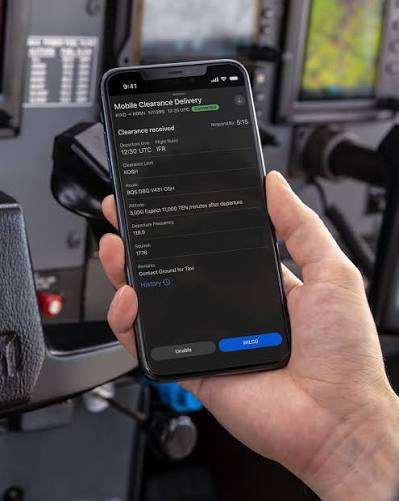
Adventure Pilot is preparing to release iFly EFB 14.1, an update to its electronic flight bag app built around a single idea: bring the right information to the pilot at the right moment, so less time is spent hunting through screens and more time is spent flying. The headline feature is Dynamic Checklists — context-aware checklists that surface relevant frequencies, runway details, altitude references, and ATC cues as the flight situation changes, with the ability to jump directly from a checklist row to the related part of the app. The release also adds VFR Visual Approaches, Turn-Aware Flight Plans, new vertical and horizontal navigation instruments, MOS weather data, and a printable NavLog. For iFly’s loyal following of budget-conscious general aviation pilots, 14.1 is a meaningful step forward in cockpit usability.
Here’s a full breakdown of what’s new, and where iFly EFB fits in the increasingly crowded electronic flight bag market.
Dynamic Checklists: The Standout Feature
Traditional electronic checklists are essentially digitized paper — a static list of items you tick off in sequence. iFly EFB 14.1’s Dynamic Checklists turn that static list into a context-aware cockpit tool.
The difference is that checklist items adapt to the current flight situation. Rather than just reading “set departure frequency,” a Dynamic Checklist can surface the actual relevant frequency for your airport. It can present runway details, altitude references, ATC cues, and other timely information right at the moment the checklist item calls for it — so you’re not tapping away to another screen to find what you need.
The second half of the feature is navigation. Pilots can jump directly from checklist rows to related areas of the app, keeping planning, navigation, and cockpit tasks connected. If a checklist item references a frequency, a nav aid, or an approach, the pilot can move straight to that information rather than backing out of the checklist and hunting for it.
The practical payoff is reduced “screen-hunting” — the head-down, menu-diving behavior that pulls a pilot’s attention away from flying the aircraft. For single-pilot IFR especially, anything that shortens the path between “I need this information” and “I have this information” is a genuine workload and safety benefit.
VFR Visual Approaches and Turn-Aware Flight Plans
Two more features in 14.1 focus on how a route actually unfolds in flight.
VFR Visual Approaches give pilots a clearer way to prepare for and fly runway-specific arrivals. Rather than a generic approach to the airport, the feature helps pilots set up for the specific runway they’ll use — useful for briefing the arrival and flying a more stabilized, predictable pattern entry.
Turn-Aware Flight Plans address a subtle but real limitation of most moving-map flight plans: they show routes as straight lines connecting waypoints with sharp corners, which isn’t how an aircraft actually flies. iFly’s turn-aware paths present smoother, speed-aware turns that reflect how the route will genuinely unfold at your aircraft’s speed — making transitions easier to anticipate. For pilots trying to stay ahead of the airplane, a route that looks like the airplane will actually fly it is more useful than one drawn with impossible right angles.
Paired together, the two features give pilots a more natural, realistic view of both the en route and arrival phases.
The Rest of the 14.1 Update
Beyond the headline features, iFly EFB 14.1 adds several enhancements:
Vertical Nav and Horizontal Nav instruments. New instruments providing additional precision when tracking routes, descents, and approach-style guidance — useful for flying more stabilized descents and profiles.
MOS weather data. Model Output Statistics weather adds another source for evaluating conditions before and during flight, complementing existing weather products.
Printable NavLog. Pilots can generate a printable NavLog from their flight plan, making it easier to review, brief, and carry key route information in a familiar paper format — a nod to pilots who still like a physical backup.
Improved Night Mode. Updated color palettes for maps, forms, and menus for better readability in low-light cockpit conditions.
Custom waypoint management. Additional export/import options for managing custom waypoints.
Expanded flight plan tools. Improvements to planning, review, and cockpit usability.
Map and navigation refinements. New refinements designed to make route information easier to interpret at a glance.
Adventure Pilot also flagged improved traffic awareness in the surrounding release cycle — clearer traffic labels, relative-altitude quick info, and safeguards so dangerous traffic always alerts both visually and audibly, along with faster, more reliable alerts and audio callouts.
What Adventure Pilot Said
Juanita Boyd, Vice President of Adventure Pilot, framed the release around the company’s core design philosophy: “iFly EFB 14.1 is about bringing the right information closer to the pilot. From smarter checklists to better visual guidance, this release helps pilots spend less time hunting through screens and more time focused on the flight.”
That framing — information at the right time, less screen-hunting, more flying — is consistent with how Adventure Pilot has positioned iFly for years: an EFB built by pilots, optimized for real-world cockpit use, and tested in actual flying conditions rather than just in a lab.
Where iFly EFB Fits in the Market
For pilots less familiar with iFly, some context helps. The iFly EFB (formerly marketed as iFly GPS) is made by Adventure Pilot, a Texas-based company that has been building portable aviation navigation tools since before the iPad existed. Over the years it has developed a loyal following as the affordable, capable alternative to the market-leading ForeFlight and Garmin Pilot.
Several characteristics define iFly’s position:
Price. iFly is consistently one of the most affordably priced full-featured EFBs on the market. Its VFR subscription runs roughly $75–$95 per year depending on the plan, well below ForeFlight’s and Garmin Pilot’s entry-level pricing — with IFR charts available as an add-on. For budget-conscious pilots and students, that gap matters.
Multi-platform support. Unlike ForeFlight, which runs only on iOS, iFly EFB runs on iOS, Android, and Windows. For the large population of pilots who don’t use Apple devices, iFly is one of the few full-featured EFBs available on their hardware.
Features included at the base level. iFly bundles capabilities into its base subscription that competitors often reserve for higher tiers or paid add-ons — including terrain alerts, synthetic vision, and vertical planning. Its patented RealPlan automated VFR flight planning has no direct equivalent in entry-level subscriptions elsewhere, and it offers custom instrument layouts and data blocks for a level of configurability that stands out.
Pilot-focused support. Adventure Pilot staffs its Texas office with pilots who answer support calls directly — a differentiator the company emphasizes.
Used in training. iFly is used as a teaching tool at flight training programs, including at Ohio State University, reflecting its suitability for student pilots learning EFB skills.
The honest trade-offs: ForeFlight retains an edge in interface polish and ecosystem integration, and Garmin Pilot’s tight integration with Garmin panel avionics remains a strong differentiator for IFR pilots flying connected cockpits. But for pilots who want a deep feature set at a competitive price — or who fly with Android or Windows devices — iFly holds its own.
Why This Matters for Pilots
The broader significance of the 14.1 release is what it says about EFB competition in 2026. The electronic flight bag market has matured to the point where even the more affordable options are shipping genuinely innovative features rather than just matching the leaders.
Dynamic Checklists are a good example. Context-aware checklists that surface relevant information and link to related app functions represent real product thinking about how pilots actually work in the cockpit — not just a spec-sheet feature. For a mid-priced EFB to introduce that kind of capability is a signal of healthy competition that ultimately benefits every pilot, regardless of which app they fly.
For student pilots and budget-conscious owners in particular, the message is encouraging: you don’t have to buy the most expensive EFB to get thoughtful, workload-reducing features. As of 2026, the affordable tier of the EFB market is genuinely capable.
What Pilots Should Do
If you already fly iFly EFB: Watch for the 14.1 update and explore Dynamic Checklists in particular. Building a context-aware checklist for your aircraft and typical operations is the kind of setup that pays off on every flight.
If you’re shopping for an EFB: iFly is worth a look, especially if price is a factor or you fly with an Android or Windows device. Adventure Pilot offers a 30-day free trial, so you can test the interface and features before committing.
If you’re a student pilot: EFB proficiency is a modern pilot skill worth developing early. Whichever app you choose, learning to use checklists, flight planning, and in-flight tools efficiently — without excessive screen-hunting — is part of good cockpit resource management.
As always: An EFB is a tool, not a crutch. Download offline charts before every flight, carry a backup (a second device or paper), and remember that the FAA approves EFBs as paper chart replacements under AC 91-78 — but the responsibility for having current, accessible information remains with the pilot.
The Bottom Line
iFly EFB 14.1 brings genuinely useful cockpit enhancements — led by Dynamic Checklists that adapt to the flight situation and connect directly to related app functions — to one of the most affordable full-featured electronic flight bags on the market. Paired with VFR Visual Approaches, Turn-Aware Flight Plans, new nav instruments, MOS weather, and a printable NavLog, the update reinforces Adventure Pilot’s long-standing pitch: deep capability at a competitive price, on the platform of your choice.
For the general aviation community, iFly’s continued innovation is a healthy sign that the EFB market remains competitive well beyond the two market leaders. Whether you fly iFly, ForeFlight, Garmin Pilot, or another app, that competition means better tools in every cockpit.
More information is available at iFlyEFB.com.
Frequently Asked Questions
What is new in iFly EFB 14.1? iFly EFB 14.1, from Adventure Pilot, introduces Dynamic Checklists (context-aware checklists that surface relevant frequencies, runway details, altitude references, and ATC cues, with direct links to related app areas), VFR Visual Approaches, and Turn-Aware Flight Plans. It also adds new Vertical Nav and Horizontal Nav instruments, MOS weather data, a printable NavLog, improved Night Mode, expanded custom waypoint management, and various flight plan and map refinements.
What are Dynamic Checklists in iFly EFB? Dynamic Checklists are context-aware checklists that adapt to the current flight situation rather than displaying a static list of items. They can surface relevant information — frequencies, runway details, altitude references, and ATC cues — at the appropriate moment, and let pilots jump directly from a checklist row to the related area of the app. The goal is to reduce “screen-hunting” so pilots spend less time navigating menus and more time flying.
How much does iFly EFB cost? iFly EFB is one of the more affordable full-featured electronic flight bags, with VFR subscription pricing generally in the $75–$95 per year range depending on the plan, and IFR charts available as an add-on. This positions it below the entry-level pricing of ForeFlight (around $120/year) and Garmin Pilot. Adventure Pilot offers a 30-day free trial. Pricing is subject to change, so check iFlyEFB.com for current rates.
What devices does iFly EFB run on? iFly EFB runs on iOS, Android, and Windows devices — making it one of the few full-featured electronic flight bags available to pilots who don’t use Apple hardware. This multi-platform support is a key differentiator from ForeFlight, which is iOS-only.
How does iFly EFB compare to ForeFlight and Garmin Pilot? iFly EFB is positioned as the affordable, capable alternative to ForeFlight and Garmin Pilot. It undercuts both on price and includes features at its base level — such as terrain alerts, synthetic vision, and vertical planning — that competitors often reserve for higher tiers. It also supports Android and Windows, and offers patented RealPlan automated VFR flight planning. The trade-offs: ForeFlight leads in interface polish and ecosystem integration, and Garmin Pilot offers tighter integration with Garmin panel avionics, both of which appeal to IFR pilots flying connected cockpits.
Sources: