In short: Rod Machado teaches a bracketing technique that keeps the course deviation indicator centered without ever looking at the heading indicator. Once you are on or near course, you roll into and immediately out of small, measured banks on the attitude indicator to first stop the needle, then center it, then fine-tune the wind correction.
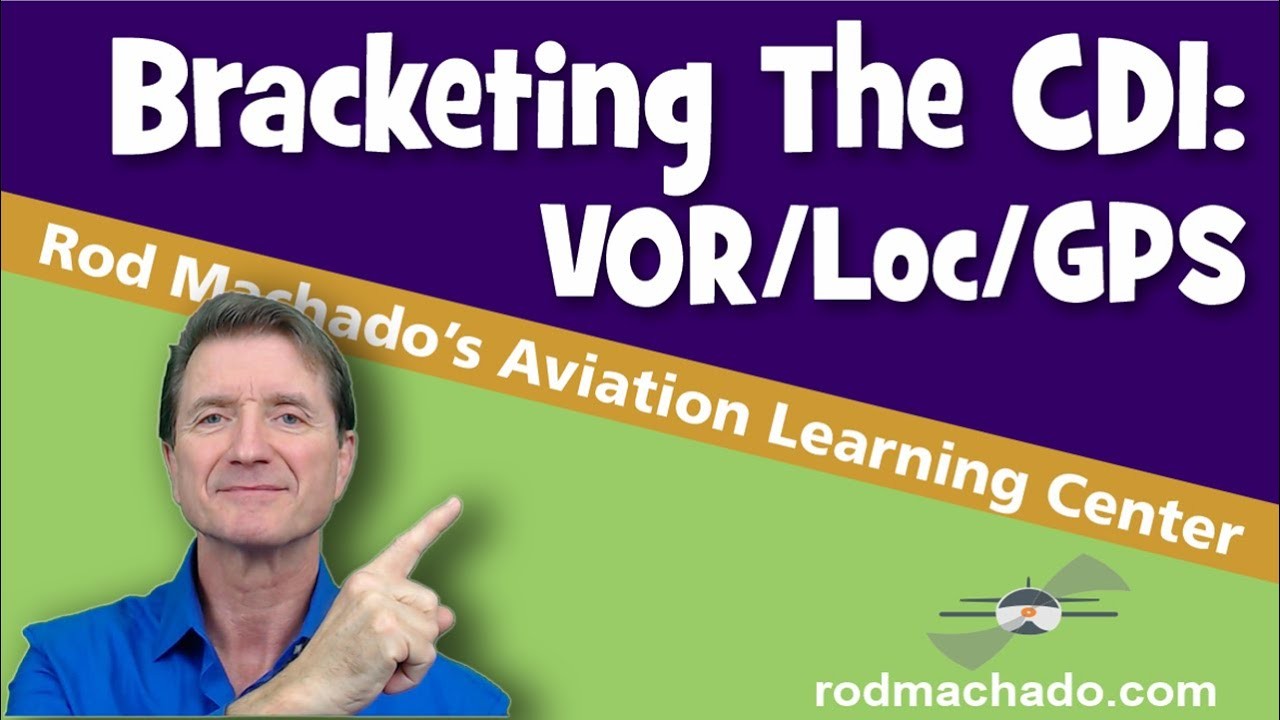
Video: “Bracketing the VOR LOC GPS CDI” by Rod Machado, from his YouTube channel.
What you’ll learn
- Why finding a tracking heading gets harder as you near the station or missed approach point
- How to start: fly the published course and wait patiently for the needle to move
- Rod’s four-step process using 10-degree, then 5- or 2.5-degree, roll increments
- Why you take out the correction once the needle centers
- How flying without the heading indicator frees attention for the attitude indicator on an ILS or LPV
The problem: a snaking ground track
Rod explains that bracketing is a strategy for keeping the needle centered while tracking a course or bearing to or from a navigation source. A common struggle for newer instrument pilots is finding a heading that holds the needle steady, and it matters more as the course sensitivity increases close to the station or the GPS missed approach point. The track you don’t want, Rod jokes, is a serpentine one.
To prove the method works in less-than-ideal conditions, he demonstrates it in a simulator on a 290-degree localizer course with strong, gusty crosswinds and rough turbulence dialed in.
Roll in, roll out, watch the needle
After turning to the inbound course, Rod waits for the needle to move. When it drifts right, he rolls into a 10-degree bank on the attitude indicator and immediately rolls back out. From that point on, he isn’t concerned with heading at all. He watches the needle and repeats 10-degree roll inputs until it stops moving, then until it starts back toward center. When it centers, he removes the extra roll he used to bring it back. After that, smaller 5- or 2.5-degree roll inputs stop or correct any slight drift as the wind changes.
Summarized, Rod’s steps are: roll in 10-degree intervals to stop the needle; roll in 10-degree intervals to center it; once centered, remove the roll applied in the second step; then use 2.5- or 5-degree rolls to stop or center a straying needle.
He then repeats the exercise on a traditional six-pack panel with the heading indicator covered, showing that the technique doesn’t depend on knowing your heading.
One less instrument to scan
Rod likes this approach because it removes the heading indicator from the tracking task, leaving more attention for the attitude indicator and everything else going on during an ILS or LPV approach. He says he uses it with all his students, and that any student can learn to keep the needle centered this way.
Go deeper with Rod Machado
Rod’s instrument ground school builds the navigation and approach knowledge that makes techniques like this one click in the airplane. Learn more in Rod Machado’s Instrument Pilot eGround School.
Looking for a flight instructor or flight school near you? Browse instructors and training programs on Skyfarer.
Affiliate disclosure: Skyfarer may earn a commission from qualifying purchases via our links. This funds our content for pilots.