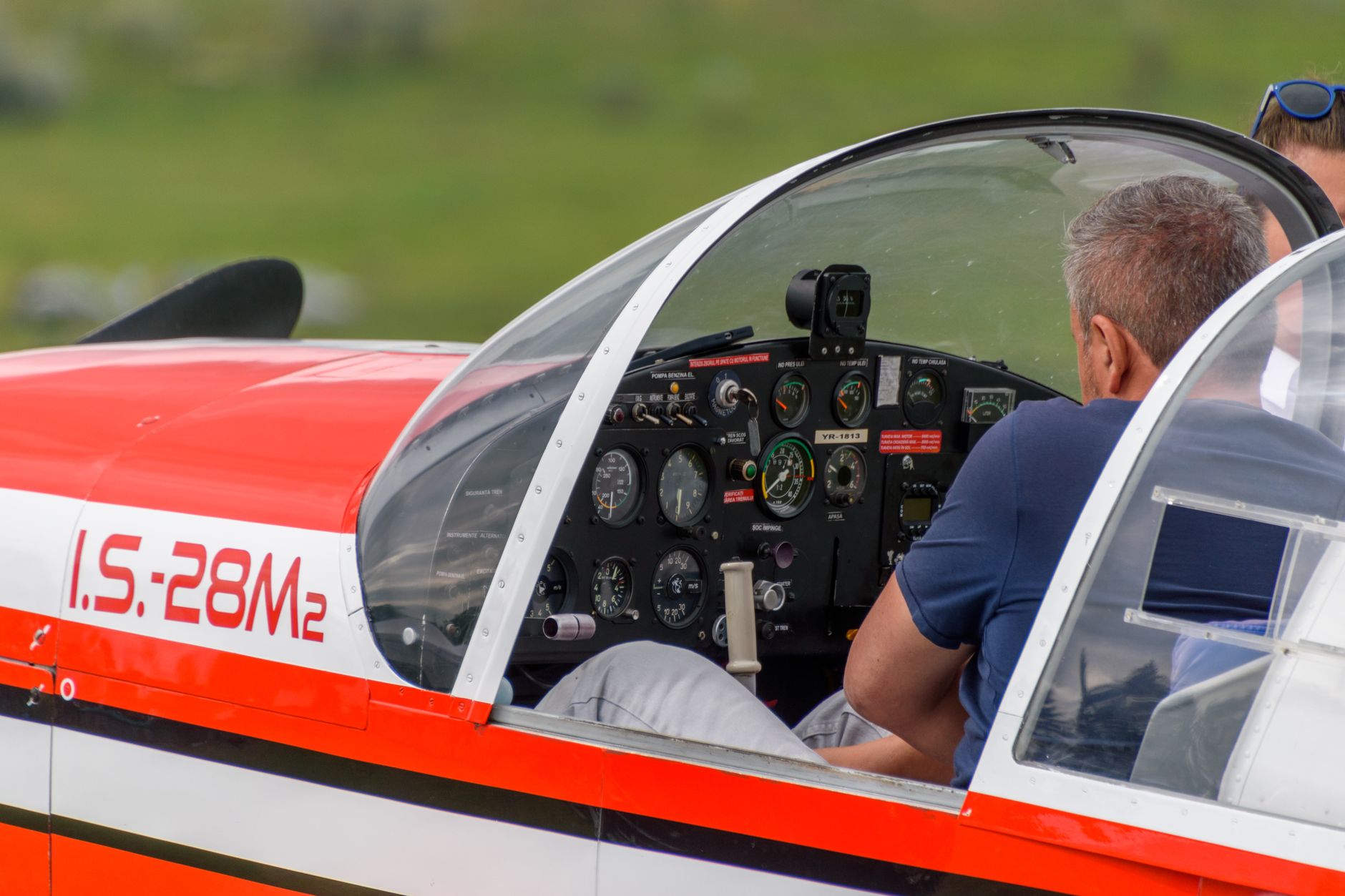
In short: Telling a student to look over the nose during the flare often fails, because the nose blocks the runway and students have not yet learned to use peripheral cues the way instructors do. Rod Machado teaches looking through the small triangular view to the left of the cowling at a stationary spot on the runway, turning your head enough that your dominant eye can see it.
Video: “Know Where to Look During the Flare” by Rod Machado, from his YouTube channel.
What you’ll learn
- Why looking over the nose makes the runway disappear for many students
- How instructors unknowingly rely on trained peripheral vision to land
- Rod’s find-the-planet strategy and where the stationary spot lies
- How to find your dominant eye with a simple finger-triangle test
- Why right-eye-dominant pilots need a real head turn to the left
- Why pilots over 50 may need to return to this technique as peripheral vision declines
The Problem With Looking Over the Nose
As you begin the roundout, the nose rises and blocks your forward view, so the runway effectively vanishes. Rod argues that instructors who teach looking over the nose are describing their own technique without realizing it depends on peripheral cues they have learned to read with experience. A new student simply does not have that skill yet.
His alternative is the find-the-planet strategy. At the start of the roundout, shift your focus to the triangular, pizza-slice view bounded by the left side of the windscreen, the horizon and the left side of the cowling. There you can see the left edge of the runway and a sliver of horizon. Look for the spot on the runway that stops looking blurry and appears stationary, which Rod places at roughly 80 to 100 feet ahead at typical approach speeds. That spot moves closer as you slow, helping you judge height and closure rate.
Your Dominant Eye Matters
Rod then shows how to find your dominant eye: make a triangle with your thumbs and index fingers, center a distant object in it with both eyes open, and slowly bring your hands toward your face. The triangle ends up over your dominant eye. Most right-handed people are right-eye dominant.
That matters because when you look left from the left seat, your right eye needs a good view of the runway too. So turn your head and shift your body enough, not just a token glance. Rod compares it to batters who turn their heads further to track the pitch with their dominant eye. He also notes that a right-handed, right-eye-dominant instructor has natural advantages looking to the right, which helps explain why their method does not always transfer to students.
A Fix for Experienced Pilots Too
Rod has flown with many pilots over 50 whose landings suddenly became inconsistent, and some considered quitting. Peripheral vision decreases with age, so they could no longer rely on cues they once used. Returning to the student technique of looking through the slice to the left of the cowling dramatically improved the landings of nearly all of them.
Go deeper with Rod Machado
Rod’s landing course goes much deeper into visual cues, roundout timing and flare technique for students and experienced pilots alike. Learn more in The Art of Takeoffs and Landings eCourse.
Looking for a flight instructor or flight school near you? Browse instructors and training programs on Skyfarer.
Affiliate disclosure: Skyfarer may earn a commission from qualifying purchases via our links. This funds our content for pilots.