
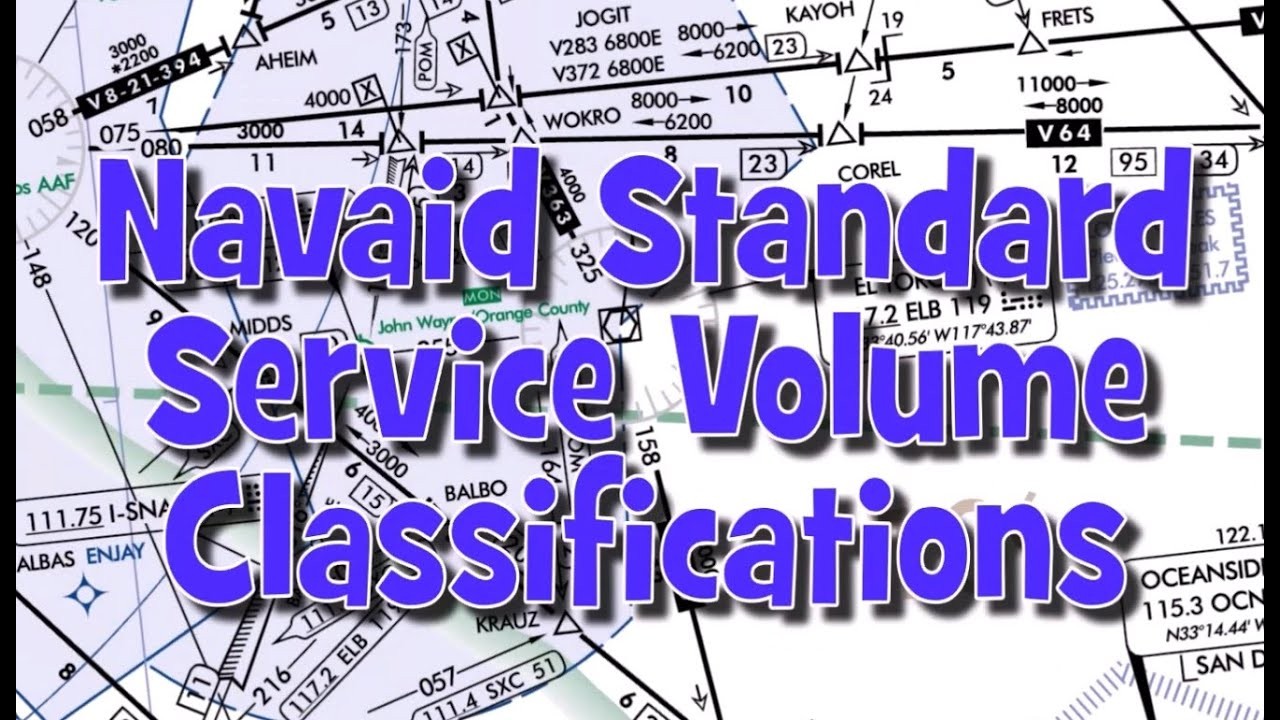
In short: As the VOR Minimum Operational Network removes some VORs, the standard service volumes of the remaining VORs and DMEs have been expanded so pilots can still navigate with them as a backup to GPS. Rod Machado shows how the SSV letters printed in enroute chart navaid boxes tell you the frequency-protected altitudes and distances for each component of a station.
Video: “Expanded VOR Service Volumes” by Rod Machado, from his YouTube channel.
What you’ll learn
- Why the MON program and performance-based navigation led to expanded SSVs
- How expanded VOR coverage supports pilots without GPS or after a GPS outage
- Where to find SSV letters on low and high altitude enroute charts
- How to read single versus double SSV letters for VOR, DME and TACAN components
- Why receiving a signal beyond its SSV does not mean it is reliable
Why service volumes grew
Rod explains that the MON, or VOR Minimum Operational Network, program is eliminating some VORs and their associated airways. To mitigate that loss, the standard service volumes of the remaining VORs and DMEs were increased. The goal, as Rod describes it, is that a pilot at 5,000 feet or more above a VOR can navigate direct to a VOR from any point in the National Airspace System.
That capability keeps the VOR network useful as a backup for airplanes without GPS, for an aircraft that suffers a GPS failure, or during a widespread GPS outage.
Decoding the navaid box
Low and high altitude enroute charts now show SSV letters inside navaid frequency boxes. These identify the frequency-protected altitudes and distances for every component of the station. A letter in parentheses is the SSV for the navaid, and double letters appear when a station has multiple components, such as a VOR with a DME or TACAN, each with its own service volume. The VOR’s SSV is always listed first.
Rod walks through several Southern California examples. Riverside shows a single VOR component with a VL service volume. Paradise shows two H’s, one for the VOR and one for the DME. El Toro shows two T’s, which Rod says provide frequency protection out to 25 nautical miles at altitudes between 1,000 and 12,000 feet above the transmitter height for both components. Oceanside shows a VH for the VOR and an H for the DME, meaning the two components have different protected volumes.
Protected does not mean exclusive
Rod closes with an important caution. SSVs exist to prevent frequency overlap between navaids. You may well receive a VOR or DME signal beyond its protected range, but there is no guarantee that signal is not coming from another facility on the same frequency located beyond the original station’s limits.
Go deeper with Rod Machado
Rod covers VOR navigation, enroute charts and IFR navaid limitations in detail in his instrument ground school. Learn more in Rod Machado’s Instrument Pilot eGround School.
Looking for a flight instructor or flight school near you? Browse instructors and training programs on Skyfarer.
Affiliate disclosure: Skyfarer may earn a commission from qualifying purchases via our links. This funds our content for pilots.



