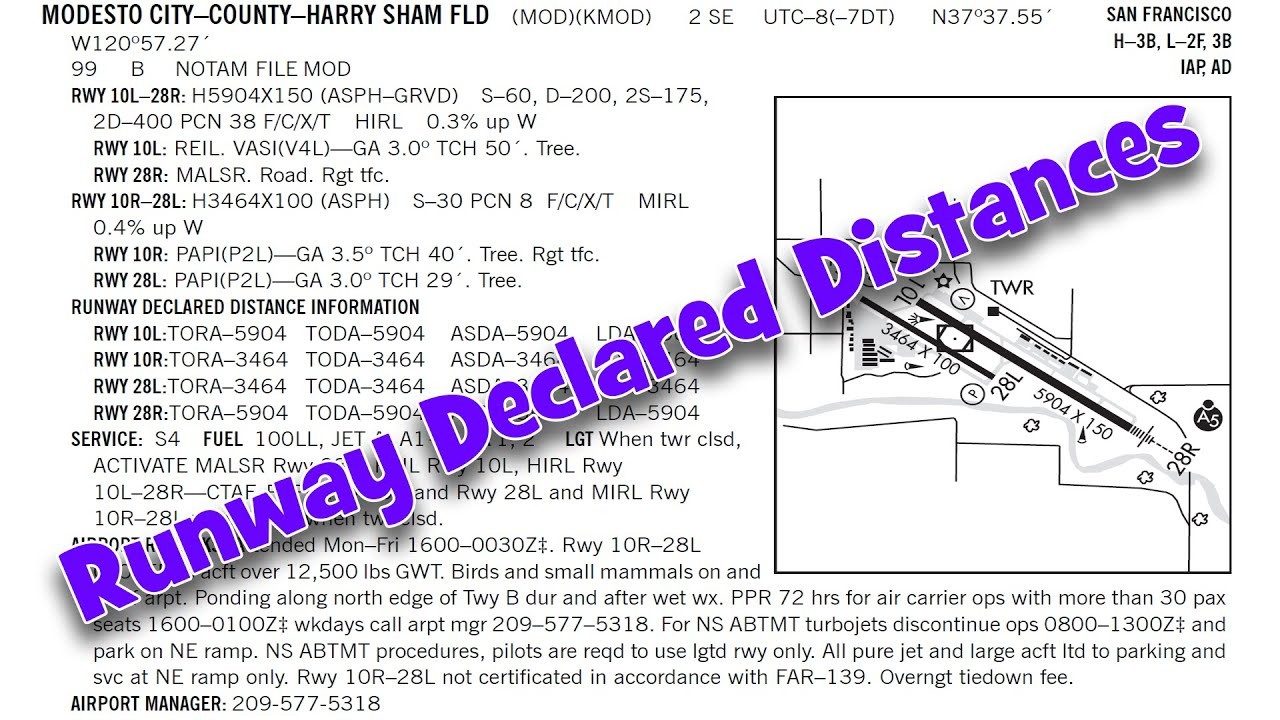
In short: Declared distances tell you how much of a runway is actually available and suitable for takeoff or landing. Rod Machado explains the four types, TORA, TODA, ASDA and LDA, and says the two that matter most to private pilots are the takeoff run available and the landing distance available.
Video: “Runway Declared Distances” by Rod Machado, from his YouTube channel.
What you’ll learn
- Why the paved length of a runway isn’t always the length you can use
- How displaced thresholds affect takeoff and landing distances
- What TORA, TODA, ASDA and LDA each mean
- How stopways and clearways factor into the numbers for turbine aircraft
- Which declared distances private pilots should use in their own calculations
- What to do when the Chart Supplement lists no declared distances
When runway length isn’t simply runway length
In this excerpt from his 40-hour private pilot ground school, Rod starts with a familiar idea: not every foot of pavement can be used for every purpose. Displaced thresholds, stopways, clearways and safety areas can all limit what’s available. You can use a displaced threshold area for takeoff, but you can’t land before the displaced threshold. Rod uses Chart Supplement examples to show how the same runway can offer different distances for takeoff and landing depending on direction.
The FAA is adding declared distance information to the Chart Supplement for airports with commercial operations. Rod emphasizes the key word, suitable: the distances reflect what’s available and suitable, even if you never learn what obstacle or environmental issue drove the restriction.
The four declared distances
TORA, the takeoff run available, is the length available for your ground run. TODA, the takeoff distance available, can be longer when a clearway lies beyond the runway; it’s meant mainly for turbine airplanes that must reach a minimum height over the end of the runway or clearway. ASDA, the accelerate-stop distance available, is the length a jet needs to accelerate and then stop after an aborted takeoff, and it can include a stopway. LDA, the landing distance available, is the runway usable for landing beyond any displaced threshold.
Rod notes that stopways, marked with yellow chevrons, aren’t for normal taxi, takeoff or landing. The exception is a large turbine airplane that needs it during an aborted takeoff.
What private pilots should focus on
For most general aviation flying, Rod says the two numbers to care about are TORA and LDA. Those are the values you’ll use to decide whether you can take off or land. If the Chart Supplement doesn’t list declared distances, which is common at smaller airports, make your own assessment from the runway length information it does provide.
Go deeper with Rod Machado
Rod’s Private/Commercial Pilot Handbook explains airport data, the Chart Supplement and takeoff and landing performance in the same clear, practical style. Learn more in Rod Machado’s Private/Commercial Pilot Handbook.
Looking for a flight instructor or flight school near you? Browse instructors and training programs on Skyfarer.
Affiliate disclosure: Skyfarer may earn a commission from qualifying purchases via our links. This funds our content for pilots.