Think about your last preflight. You sumped the fuel, checked the oil, moved the control surfaces, and looked over the prop. Then you climbed in, clicked the lap belt, pulled the shoulder harness across, and started the checklist. Most of us never really look at the restraints. They’re just there.
On October 28, 2026, the NTSB issued a safety alert asking pilots, owners, and mechanics to change that. One of the accidents behind it happened in April 2023, when a Cessna 172N crashed near Madison County Airport in London, Ohio, killing a flight instructor and a student pilot. Investigators found that the stitching that held the upper torso restraint to the airframe had separated. Both front seats had three-point restraints rated at 1,500 pounds.
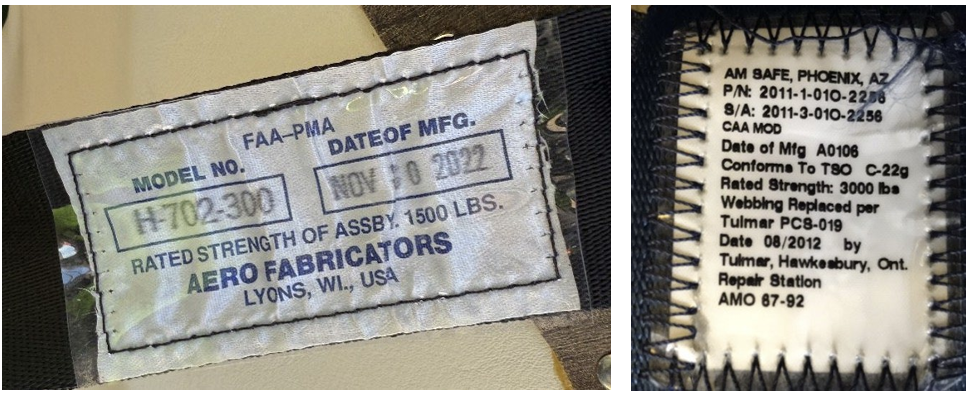
That 1,500-pound figure is the heart of the alert. Today’s benchmark is 3,000 pounds for a lap belt and 2,500 pounds for a shoulder harness, yet plenty of airplanes on the ramp still fly with restraints built to the older, weaker standard. Those restraints can be completely legal. They just offer less protection when it matters most.
Quick answer: NTSB Safety Alert SA-108, Seat Restraints: Small Component, Critical Protection, warns that aging, damaged, or lower-rated seat belts and shoulder harnesses can fail in a general aviation accident. The NTSB recommends inspecting restraints at every preflight and annual, replacing any lap belt rated below 3,000 lb or shoulder harness rated below 2,500 lb (or any restraint whose label you can’t read), upgrading to restraints that meet TSO-C22g, and adding shoulder harnesses through an FAA-approved method if your airplane doesn’t have them. You can read the full alert on the NTSB website.

The three accidents behind the alert
- Cessna 172N, London, Ohio (April 18, 2023). The flight instructor and student pilot were killed. The stitching at the upper torso restraint’s airframe attachment had separated. The airplane’s three-point restraints were rated at 1,500 lb and had been repaired in January 2022.
- Aeronca 7CCM, near Duluth, Minnesota (June 21, 2023). The pilot and passenger were killed. The upper torso restraint’s stitching separated at the airframe, and both shoulder webbings separated at the Y junction. The restraints were manufactured in 2009 and rated at 1,500 lb.
- Taylorcraft F-19 (April 30, 2005). The airplane struck terrain after takeoff. The pilot was killed when his shoulder harness failed. The passenger’s restraint held, and she was seriously injured. Investigators found signs that the pilot’s harness had been overloaded at some earlier point, which reduced its strength.

Why a legal restraint can still be a weak one
Aircraft restraints are built to an FAA Technical Standard Order. The older standard, TSO-C22f, dates to May 1972. In 1993 the FAA issued TSO-C22g, which raised the performance requirements for the dynamic loads an occupant puts on a restraint in a crash.
The catch: the FAA allowed restraint systems approved before TSO-C22g to stay in production for aircraft weighing 12,500 lb or less. That means a restraint can be brand new and still be built to the 1972 standard. The Aeronca restraints in the Duluth accident are a good example. They were made in 2009, 16 years after TSO-C22g, and were still rated at only 1,500 lb. In a separate investigation of an Aeronca 7AC, the NTSB also tested three new TSO-C22f restraints and found that all three failed below their 1,500-lb rating.
The numbers to look for
| Restraint | NTSB recommendation |
|---|---|
| Lap belt | Replace if rated below 3,000 lb |
| Shoulder harness | Replace if rated below 2,500 lb |
| Label missing or unreadable | Replace, because the rating can’t be verified |
| Not sure of the rating | Ask a mechanic or the restraint manufacturer |
| Replacement standard | Restraints that meet TSO-C22g |
How to inspect your restraints
The NTSB asks for a visual check of lap belts and shoulder harnesses on every preflight and at every annual. Restraints break down from sunlight, age, and repeated use, so look for:
- The label. Find the strength rating. If it’s below the numbers above, or you can’t read it, plan a replacement.
- The webbing. Cut or worn edges, fraying, deformation, and discoloration, which can signal UV damage.
- The stitching. Broken threads or damaged stitching, especially where the restraint attaches to the airframe. That’s exactly where the Ohio and Minnesota restraints separated.
- The Y junction. On harnesses where two shoulder straps join into one, check the junction and its stitching closely.

Pilot tip: If you find any tearing or fraying, don’t fly with it. Have a mechanic look at it first. And if you rent, add a quick look at the belts and harnesses to your walkaround, then squawk anything worn or unreadable so the next pilot doesn’t inherit it.
No shoulder harness? Add one
Many older airplanes left the factory with lap belts only. The NTSB recommends that owners of those airplanes install shoulder harnesses using an FAA-approved method, such as a supplemental type certificate (STC). The FAA has also published a policy statement on approving retrofit shoulder harness installations in small airplanes, which your mechanic can use as a starting point.
For mechanics
- Let owners know what restraint replacement options are available for their airplane.
- Know the signs of aging: cut or worn edges, damaged stitching, broken threads, UV damage, and excessive wear.
- Encourage owners of airplanes without shoulder harnesses to install them through an STC or another acceptable approval.
- Related guidance: FAA Advisory Circular 43.13-1B (chapter 9, section 9-46(b), on safety belt inspection) and FAA Special Airworthiness Information Bulletin (SAIB) 2026-10R1 on defective torso restraints and safety belts in GA aircraft.
Need a mechanic to check your restraints?
If you’re not sure what’s installed in your airplane or want help replacing it, you can find mechanics and other aviation service providers on Skyfarer.